

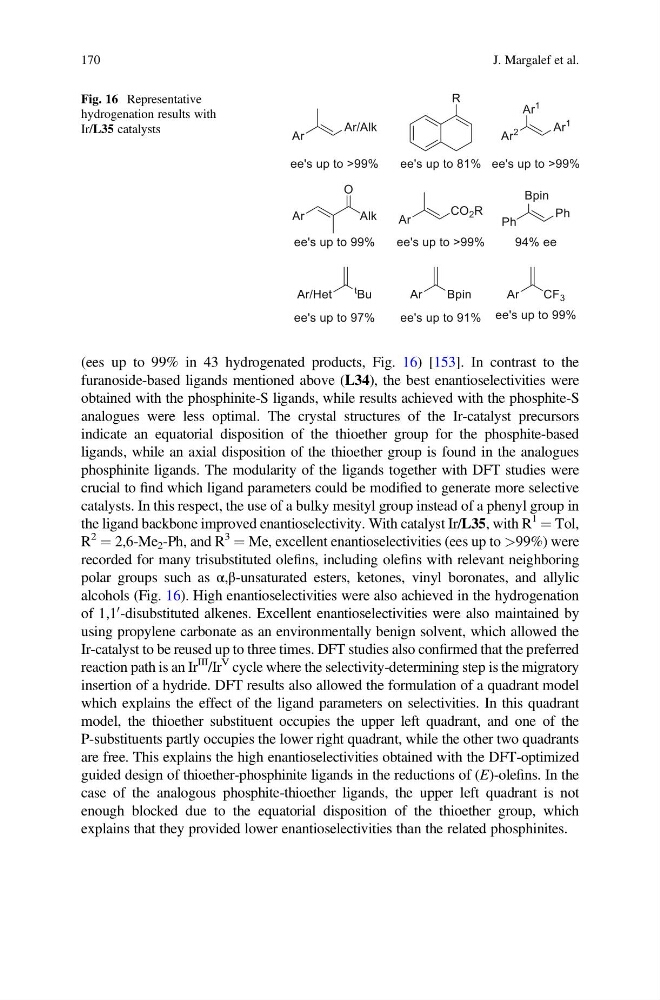
(ees up to 99% in 43 hydrogenated products, Fig. 16) [153]. In contrast to the
furanoside-based ligands mentioned above (L34), the best enantioselectivities were
obtained with the phosphinite-S ligands, while results achieved with the phosphite-S
analogues were less optimal. The crystal structures of the Ir-catalyst precursors
indicate an equatorial disposition of the thioether group for the phosphite-based
ligands, while an axial disposition of the thioether group is found in the analogues
phosphinite ligands. The modularity of the ligands together with DFT studies were
crucial to find which ligand parameters could be modified to generate more selective
catalysts. In this respect, the use of a bulky mesityl group instead of a phenyl group in
the ligand backbone improved enantioselectivity. With catalyst Ir/L35, with R
1
¼ Tol,
R
2
¼ 2,6-Me 2 -Ph, and R
3
¼ Me, excellent enantioselectivities (ees up to >99%) were
recorded for many trisubstituted olefins, including olefins with relevant neighboring
polar groups such as α,β-unsaturated esters, ketones, vinyl boronates, and allylic
alcohols (Fig. 16). High enantioselectivities were also achieved in the hydrogenation
of 1,1
0 -disubstituted alkenes. Excellent enantioselectivities were also maintained by
using propylene carbonate as an environmentally benign solvent, which allowed the
Ir-catalyst to be reused up to three times. DFT studies also confirmed that the preferred
reaction path is an Ir
III
/Ir
V cycle where the selectivity-determining step is the migratory
insertion of a hydride. DFT results also allowed the formulation of a quadrant model
which explains the effect of the ligand parameters on selectivities. In this quadrant
model, the thioether substituent occupies the upper left quadrant, and one of the
P-substituents partly occupies the lower right quadrant, while the other two quadrants
are free. This explains the high enantioselectivities obtained with the DFT-optimized
guided design of thioether-phosphinite ligands in the reductions of (E)-olefins. In the
case of the analogous phosphite-thioether ligands, the upper left quadrant is not
enough blocked due to the equatorial disposition of the thioether group, which
explains that they provided lower enantioselectivities than the related phosphinites.
Fig. 16 Representative
hydrogenation results with
Ir/L35 catalysts
170
J. Margalef et al.
furanoside-based ligands mentioned above (L34), the best enantioselectivities were
obtained with the phosphinite-S ligands, while results achieved with the phosphite-S
analogues were less optimal. The crystal structures of the Ir-catalyst precursors
indicate an equatorial disposition of the thioether group for the phosphite-based
ligands, while an axial disposition of the thioether group is found in the analogues
phosphinite ligands. The modularity of the ligands together with DFT studies were
crucial to find which ligand parameters could be modified to generate more selective
catalysts. In this respect, the use of a bulky mesityl group instead of a phenyl group in
the ligand backbone improved enantioselectivity. With catalyst Ir/L35, with R
1
¼ Tol,
R
2
¼ 2,6-Me 2 -Ph, and R
3
¼ Me, excellent enantioselectivities (ees up to >99%) were
recorded for many trisubstituted olefins, including olefins with relevant neighboring
polar groups such as α,β-unsaturated esters, ketones, vinyl boronates, and allylic
alcohols (Fig. 16). High enantioselectivities were also achieved in the hydrogenation
of 1,1
0 -disubstituted alkenes. Excellent enantioselectivities were also maintained by
using propylene carbonate as an environmentally benign solvent, which allowed the
Ir-catalyst to be reused up to three times. DFT studies also confirmed that the preferred
reaction path is an Ir
III
/Ir
V cycle where the selectivity-determining step is the migratory
insertion of a hydride. DFT results also allowed the formulation of a quadrant model
which explains the effect of the ligand parameters on selectivities. In this quadrant
model, the thioether substituent occupies the upper left quadrant, and one of the
P-substituents partly occupies the lower right quadrant, while the other two quadrants
are free. This explains the high enantioselectivities obtained with the DFT-optimized
guided design of thioether-phosphinite ligands in the reductions of (E)-olefins. In the
case of the analogous phosphite-thioether ligands, the upper left quadrant is not
enough blocked due to the equatorial disposition of the thioether group, which
explains that they provided lower enantioselectivities than the related phosphinites.
Fig. 16 Representative
hydrogenation results with
Ir/L35 catalysts
170
J. Margalef et al.