

2.2 Tetrasubstituted Unfunctionalized Olefins or with Poorly
Coordinative Groups
Despite the advances during the last 10 years in the asymmetric hydrogenation of
unfunctionalized olefins with the development of ligand libraries that allowed a
significant increase in the range of substrates that can been successfully hydrogenated, the reduction of tetrasubstituted olefins remains a challenge. The range of
such substrates that can be efficiently hydrogenated is still narrow [154].
In 1999, Buchwald’s group reported the first successful asymmetric hydrogenation of tetrasubstituted unfunctionalized olefins [155]. Although high
enantioselectivities were achieved for substituted indenes using the zirconocene
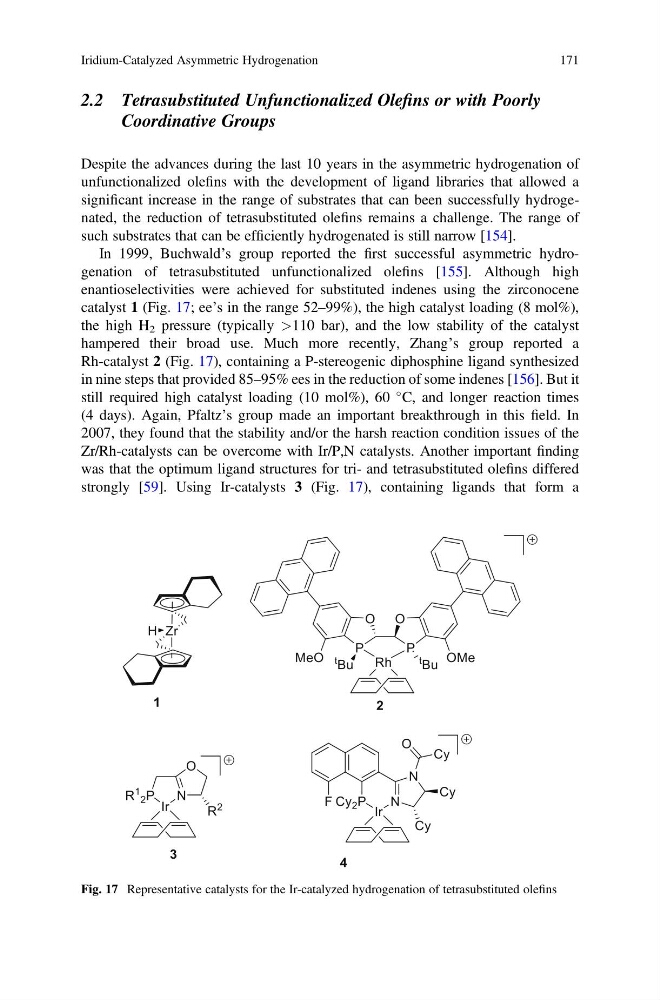
catalyst 1 (Fig. 17; ee’s in the range 52–99%), the high catalyst loading (8 mol%),
the high H 2 pressure (typically >110 bar), and the low stability of the catalyst
hampered their broad use. Much more recently, Zhang’s group reported a
Rh-catalyst 2 (Fig. 17), containing a P-stereogenic diphosphine ligand synthesized
in nine steps that provided 85–95% ees in the reduction of some indenes [156]. But it
still required high catalyst loading (10 mol%), 60
C, and longer reaction times
(4 days). Again, Pfaltz’s group made an important breakthrough in this field. In
2007, they found that the stability and/or the harsh reaction condition issues of the
Zr/Rh-catalysts can be overcome with Ir/P,N catalysts. Another important finding
was that the optimum ligand structures for tri- and tetrasubstituted olefins differed
strongly [59]. Using Ir-catalysts 3 (Fig. 17), containing ligands that form a
Fig. 17 Representative catalysts for the Ir-catalyzed hydrogenation of tetrasubstituted olefins
Iridium-Catalyzed Asymmetric Hydrogenation
171
Coordinative Groups
Despite the advances during the last 10 years in the asymmetric hydrogenation of
unfunctionalized olefins with the development of ligand libraries that allowed a
significant increase in the range of substrates that can been successfully hydrogenated, the reduction of tetrasubstituted olefins remains a challenge. The range of
such substrates that can be efficiently hydrogenated is still narrow [154].
In 1999, Buchwald’s group reported the first successful asymmetric hydrogenation of tetrasubstituted unfunctionalized olefins [155]. Although high
enantioselectivities were achieved for substituted indenes using the zirconocene
catalyst 1 (Fig. 17; ee’s in the range 52–99%), the high catalyst loading (8 mol%),
the high H 2 pressure (typically >110 bar), and the low stability of the catalyst
hampered their broad use. Much more recently, Zhang’s group reported a
Rh-catalyst 2 (Fig. 17), containing a P-stereogenic diphosphine ligand synthesized
in nine steps that provided 85–95% ees in the reduction of some indenes [156]. But it
still required high catalyst loading (10 mol%), 60
C, and longer reaction times
(4 days). Again, Pfaltz’s group made an important breakthrough in this field. In
2007, they found that the stability and/or the harsh reaction condition issues of the
Zr/Rh-catalysts can be overcome with Ir/P,N catalysts. Another important finding
was that the optimum ligand structures for tri- and tetrasubstituted olefins differed
strongly [59]. Using Ir-catalysts 3 (Fig. 17), containing ligands that form a
Fig. 17 Representative catalysts for the Ir-catalyzed hydrogenation of tetrasubstituted olefins
Iridium-Catalyzed Asymmetric Hydrogenation
171