

N-atom formed efficient Ir-catalysts for the asymmetric hydrogenation of several
minimally functionalized olefins (ees up to 99%).
At the same time, our group reported the application of a highly modular
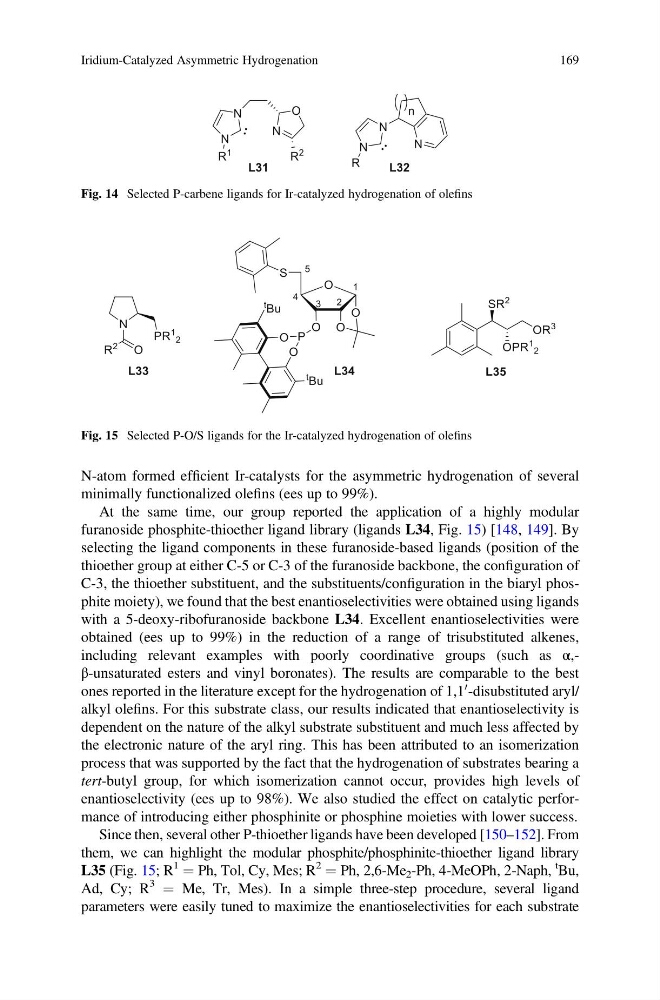
furanoside phosphite-thioether ligand library (ligands L34, Fig. 15) [148, 149]. By
selecting the ligand components in these furanoside-based ligands (position of the
thioether group at either C-5 or C-3 of the furanoside backbone, the configuration of
C-3, the thioether substituent, and the substituents/configuration in the biaryl phosphite moiety), we found that the best enantioselectivities were obtained using ligands
with a 5-deoxy-ribofuranoside backbone L34. Excellent enantioselectivities were
obtained (ees up to 99%) in the reduction of a range of trisubstituted alkenes,
including relevant examples with poorly coordinative groups (such as α,β-unsaturated esters and vinyl boronates). The results are comparable to the best
ones reported in the literature except for the hydrogenation of 1,1
0 -disubstituted aryl/
alkyl olefins. For this substrate class, our results indicated that enantioselectivity is
dependent on the nature of the alkyl substrate substituent and much less affected by
the electronic nature of the aryl ring. This has been attributed to an isomerization
process that was supported by the fact that the hydrogenation of substrates bearing a
tert-butyl group, for which isomerization cannot occur, provides high levels of
enantioselectivity (ees up to 98%). We also studied the effect on catalytic performance of introducing either phosphinite or phosphine moieties with lower success.
Since then, several other P-thioether ligands have been developed [150–152]. From
them, we can highlight the modular phosphite/phosphinite-thioether ligand library
L35 (Fig. 15; R
1
¼ Ph, Tol, Cy, Mes; R
2
¼ Ph, 2,6-Me 2 -Ph, 4-MeOPh, 2-Naph,
t
Bu,
Ad, Cy; R
3
¼ Me, Tr, Mes). In a simple three-step procedure, several ligand
parameters were easily tuned to maximize the enantioselectivities for each substrate
Fig. 14 Selected P-carbene ligands for Ir-catalyzed hydrogenation of olefins
Fig. 15 Selected P-O/S ligands for the Ir-catalyzed hydrogenation of olefins
Iridium-Catalyzed Asymmetric Hydrogenation
169
minimally functionalized olefins (ees up to 99%).
At the same time, our group reported the application of a highly modular
furanoside phosphite-thioether ligand library (ligands L34, Fig. 15) [148, 149]. By
selecting the ligand components in these furanoside-based ligands (position of the
thioether group at either C-5 or C-3 of the furanoside backbone, the configuration of
C-3, the thioether substituent, and the substituents/configuration in the biaryl phosphite moiety), we found that the best enantioselectivities were obtained using ligands
with a 5-deoxy-ribofuranoside backbone L34. Excellent enantioselectivities were
obtained (ees up to 99%) in the reduction of a range of trisubstituted alkenes,
including relevant examples with poorly coordinative groups (such as α,β-unsaturated esters and vinyl boronates). The results are comparable to the best
ones reported in the literature except for the hydrogenation of 1,1
0 -disubstituted aryl/
alkyl olefins. For this substrate class, our results indicated that enantioselectivity is
dependent on the nature of the alkyl substrate substituent and much less affected by
the electronic nature of the aryl ring. This has been attributed to an isomerization
process that was supported by the fact that the hydrogenation of substrates bearing a
tert-butyl group, for which isomerization cannot occur, provides high levels of
enantioselectivity (ees up to 98%). We also studied the effect on catalytic performance of introducing either phosphinite or phosphine moieties with lower success.
Since then, several other P-thioether ligands have been developed [150–152]. From
them, we can highlight the modular phosphite/phosphinite-thioether ligand library
L35 (Fig. 15; R
1
¼ Ph, Tol, Cy, Mes; R
2
¼ Ph, 2,6-Me 2 -Ph, 4-MeOPh, 2-Naph,
t
Bu,
Ad, Cy; R
3
¼ Me, Tr, Mes). In a simple three-step procedure, several ligand
parameters were easily tuned to maximize the enantioselectivities for each substrate
Fig. 14 Selected P-carbene ligands for Ir-catalyzed hydrogenation of olefins
Fig. 15 Selected P-O/S ligands for the Ir-catalyzed hydrogenation of olefins
Iridium-Catalyzed Asymmetric Hydrogenation
169