

group. Despite this, few pyridine-containing ligands have provided outstanding
results in terms of enantioselectivity and substrate versatility. For selected examples,
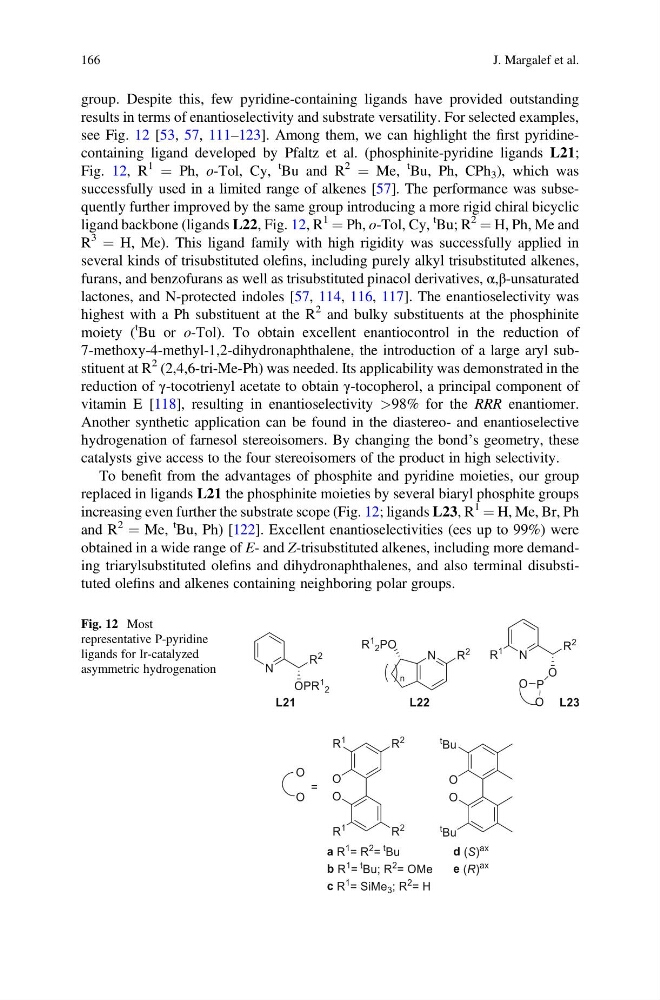
see Fig. 12 [53, 57, 111–123]. Among them, we can highlight the first pyridinecontaining ligand developed by Pfaltz et al. (phosphinite-pyridine ligands L21;
Fig. 12, R
1
¼ Ph, o-Tol, Cy,
t Bu and R
2
¼ Me,
t Bu, Ph, CPh 3 ), which was
successfully used in a limited range of alkenes [57]. The performance was subsequently further improved by the same group introducing a more rigid chiral bicyclic
ligand backbone (ligands L22, Fig. 12, R
1
¼ Ph, o-Tol, Cy,
t Bu; R
2
¼ H, Ph, Me and
R
3
¼ H, Me). This ligand family with high rigidity was successfully applied in
several kinds of trisubstituted olefins, including purely alkyl trisubstituted alkenes,
furans, and benzofurans as well as trisubstituted pinacol derivatives, α,β-unsaturated
lactones, and N-protected indoles [57, 114, 116, 117]. The enantioselectivity was
highest with a Ph substituent at the R
2 and bulky substituents at the phosphinite
moiety (
t
Bu or o-Tol). To obtain excellent enantiocontrol in the reduction of
7-methoxy-4-methyl-1,2-dihydronaphthalene, the introduction of a large aryl substituent at R
2 (2,4,6-tri-Me-Ph) was needed. Its applicability was demonstrated in the
reduction of γ-tocotrienyl acetate to obtain γ-tocopherol, a principal component of
vitamin E [118], resulting in enantioselectivity >98% for the RRR enantiomer.
Another synthetic application can be found in the diastereo- and enantioselective
hydrogenation of farnesol stereoisomers. By changing the bond’s geometry, these
catalysts give access to the four stereoisomers of the product in high selectivity.
To benefit from the advantages of phosphite and pyridine moieties, our group
replaced in ligands L21 the phosphinite moieties by several biaryl phosphite groups
increasing even further the substrate scope (Fig. 12; ligands L23, R
1
¼ H, Me, Br, Ph
and R
2
¼ Me,
t Bu, Ph) [122]. Excellent enantioselectivities (ees up to 99%) were
obtained in a wide range of E- and Z-trisubstituted alkenes, including more demanding triarylsubstituted olefins and dihydronaphthalenes, and also terminal disubstituted olefins and alkenes containing neighboring polar groups.
Fig. 12 Most
representative P-pyridine
ligands for Ir-catalyzed
asymmetric hydrogenation
166
J. Margalef et al.
results in terms of enantioselectivity and substrate versatility. For selected examples,
see Fig. 12 [53, 57, 111–123]. Among them, we can highlight the first pyridinecontaining ligand developed by Pfaltz et al. (phosphinite-pyridine ligands L21;
Fig. 12, R
1
¼ Ph, o-Tol, Cy,
t Bu and R
2
¼ Me,
t Bu, Ph, CPh 3 ), which was
successfully used in a limited range of alkenes [57]. The performance was subsequently further improved by the same group introducing a more rigid chiral bicyclic
ligand backbone (ligands L22, Fig. 12, R
1
¼ Ph, o-Tol, Cy,
t Bu; R
2
¼ H, Ph, Me and
R
3
¼ H, Me). This ligand family with high rigidity was successfully applied in
several kinds of trisubstituted olefins, including purely alkyl trisubstituted alkenes,
furans, and benzofurans as well as trisubstituted pinacol derivatives, α,β-unsaturated
lactones, and N-protected indoles [57, 114, 116, 117]. The enantioselectivity was
highest with a Ph substituent at the R
2 and bulky substituents at the phosphinite
moiety (
t
Bu or o-Tol). To obtain excellent enantiocontrol in the reduction of
7-methoxy-4-methyl-1,2-dihydronaphthalene, the introduction of a large aryl substituent at R
2 (2,4,6-tri-Me-Ph) was needed. Its applicability was demonstrated in the
reduction of γ-tocotrienyl acetate to obtain γ-tocopherol, a principal component of
vitamin E [118], resulting in enantioselectivity >98% for the RRR enantiomer.
Another synthetic application can be found in the diastereo- and enantioselective
hydrogenation of farnesol stereoisomers. By changing the bond’s geometry, these
catalysts give access to the four stereoisomers of the product in high selectivity.
To benefit from the advantages of phosphite and pyridine moieties, our group
replaced in ligands L21 the phosphinite moieties by several biaryl phosphite groups
increasing even further the substrate scope (Fig. 12; ligands L23, R
1
¼ H, Me, Br, Ph
and R
2
¼ Me,
t Bu, Ph) [122]. Excellent enantioselectivities (ees up to 99%) were
obtained in a wide range of E- and Z-trisubstituted alkenes, including more demanding triarylsubstituted olefins and dihydronaphthalenes, and also terminal disubstituted olefins and alkenes containing neighboring polar groups.
Fig. 12 Most
representative P-pyridine
ligands for Ir-catalyzed
asymmetric hydrogenation
166
J. Margalef et al.