

for trisubstituted olefins. Whereas Ir/L20g catalyst provided the best
enantioselectivities for linear and cyclic olefins and a α,β-unsaturated ester, the
best ees for the more demanding Z-isomers and allylic alcohol and acetate were
obtained with Ir/20a catalyst. This high catalytic performance was also extended to
the hydrogenation of the more challenging 1,1
0 -disubstituted olefins (29 compounds,
Fig. 11), surpassing the previous family L19 and becoming one of the best catalysts
for the reduction of this type of substrates. High enantioselectivities were achieved in
a broad range of aryl-alkyl (ees up to >99%), even with substrates bearing decreasingly sterically alkyl substituents, and heteroaromatic-alkyl (ees up to >99%)
olefins. These catalyst precursors also tolerate very well the presence of neighboring
polar groups. High enantioselectivities were achieved in the reduction of allylic
alcohols and an allylic silane. Interestingly, the reaction showed no loss of
enantioselectivity when dichloromethane was replaced by propylene carbonate.
In addition, the use of propylene carbonate allowed the catalysts to be recycled
up to five times by a simple two-phase extraction maintaining the excellent
enantioselectivities [107].
2.1.5 Phosphorus-Other Nitrogen Donor Ligands
In the recent years, the research has also focused on the design of ligands containing
more robust groups than oxazolines. A collection of the most representative
phosphorus-other nitrogen donor ligands will be next presented.
As an alternative to P-oxazoline ligands, pyridine-containing ligands have
attracted interest due to the robustness and the easy incorporation of pyridine
Fig. 11 Representative results achieved with Ir/L20 catalysts in the hydrogenation of 1,10 -disubstituted substrates
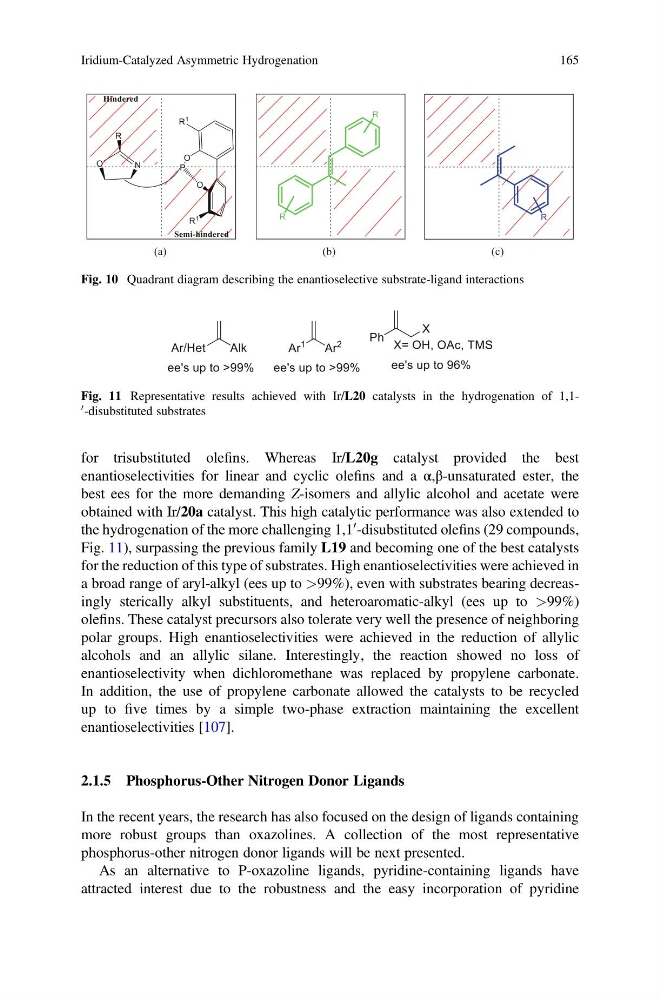
Fig. 10 Quadrant diagram describing the enantioselective substrate-ligand interactions
Iridium-Catalyzed Asymmetric Hydrogenation
165
enantioselectivities for linear and cyclic olefins and a α,β-unsaturated ester, the
best ees for the more demanding Z-isomers and allylic alcohol and acetate were
obtained with Ir/20a catalyst. This high catalytic performance was also extended to
the hydrogenation of the more challenging 1,1
0 -disubstituted olefins (29 compounds,
Fig. 11), surpassing the previous family L19 and becoming one of the best catalysts
for the reduction of this type of substrates. High enantioselectivities were achieved in
a broad range of aryl-alkyl (ees up to >99%), even with substrates bearing decreasingly sterically alkyl substituents, and heteroaromatic-alkyl (ees up to >99%)
olefins. These catalyst precursors also tolerate very well the presence of neighboring
polar groups. High enantioselectivities were achieved in the reduction of allylic
alcohols and an allylic silane. Interestingly, the reaction showed no loss of
enantioselectivity when dichloromethane was replaced by propylene carbonate.
In addition, the use of propylene carbonate allowed the catalysts to be recycled
up to five times by a simple two-phase extraction maintaining the excellent
enantioselectivities [107].
2.1.5 Phosphorus-Other Nitrogen Donor Ligands
In the recent years, the research has also focused on the design of ligands containing
more robust groups than oxazolines. A collection of the most representative
phosphorus-other nitrogen donor ligands will be next presented.
As an alternative to P-oxazoline ligands, pyridine-containing ligands have
attracted interest due to the robustness and the easy incorporation of pyridine
Fig. 11 Representative results achieved with Ir/L20 catalysts in the hydrogenation of 1,10 -disubstituted substrates
Fig. 10 Quadrant diagram describing the enantioselective substrate-ligand interactions
Iridium-Catalyzed Asymmetric Hydrogenation
165