

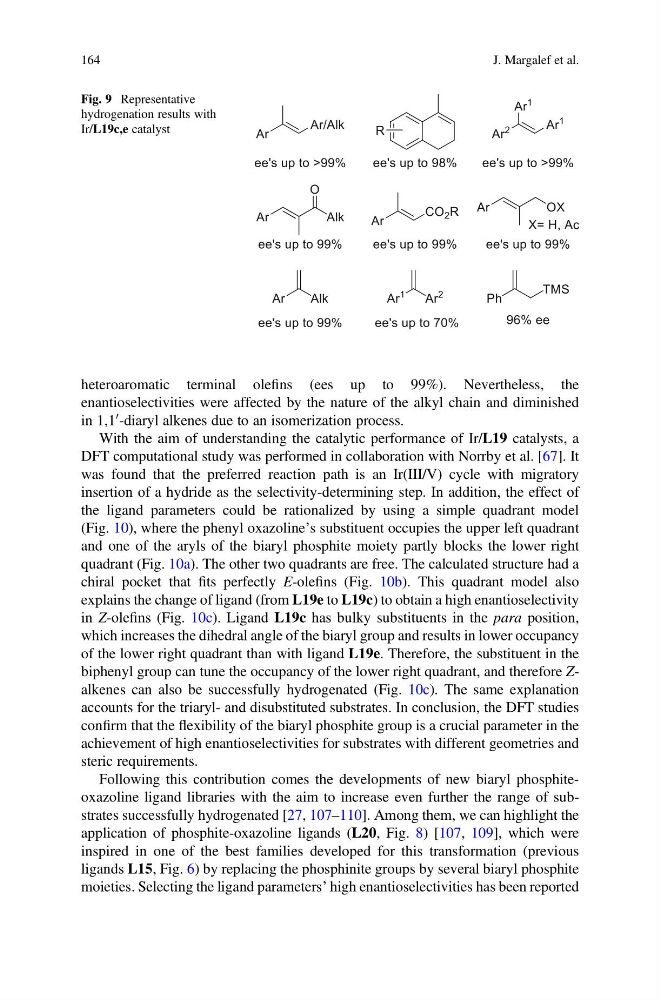
heteroaromatic terminal olefins (ees up to 99%). Nevertheless, the
enantioselectivities were affected by the nature of the alkyl chain and diminished
in 1,1
0 -diaryl alkenes due to an isomerization process.
With the aim of understanding the catalytic performance of Ir/L19 catalysts, a
DFT computational study was performed in collaboration with Norrby et al. [67]. It
was found that the preferred reaction path is an Ir(III/V) cycle with migratory
insertion of a hydride as the selectivity-determining step. In addition, the effect of
the ligand parameters could be rationalized by using a simple quadrant model
(Fig. 10), where the phenyl oxazoline’s substituent occupies the upper left quadrant
and one of the aryls of the biaryl phosphite moiety partly blocks the lower right
quadrant (Fig. 10a). The other two quadrants are free. The calculated structure had a
chiral pocket that fits perfectly E-olefins (Fig. 10b). This quadrant model also
explains the change of ligand (from L19e to L19c) to obtain a high enantioselectivity
in Z-olefins (Fig. 10c). Ligand L19c has bulky substituents in the para position,
which increases the dihedral angle of the biaryl group and results in lower occupancy
of the lower right quadrant than with ligand L19e. Therefore, the substituent in the
biphenyl group can tune the occupancy of the lower right quadrant, and therefore Zalkenes can also be successfully hydrogenated (Fig. 10c). The same explanation
accounts for the triaryl- and disubstituted substrates. In conclusion, the DFT studies
confirm that the flexibility of the biaryl phosphite group is a crucial parameter in the
achievement of high enantioselectivities for substrates with different geometries and
steric requirements.
Following this contribution comes the developments of new biaryl phosphiteoxazoline ligand libraries with the aim to increase even further the range of substrates successfully hydrogenated [27, 107–110]. Among them, we can highlight the
application of phosphite-oxazoline ligands (L20, Fig. 8) [107, 109], which were
inspired in one of the best families developed for this transformation (previous
ligands L15, Fig. 6) by replacing the phosphinite groups by several biaryl phosphite
moieties. Selecting the ligand parameters’ high enantioselectivities has been reported
Fig. 9 Representative
hydrogenation results with
Ir/L19c,e catalyst
164
J. Margalef et al.
enantioselectivities were affected by the nature of the alkyl chain and diminished
in 1,1
0 -diaryl alkenes due to an isomerization process.
With the aim of understanding the catalytic performance of Ir/L19 catalysts, a
DFT computational study was performed in collaboration with Norrby et al. [67]. It
was found that the preferred reaction path is an Ir(III/V) cycle with migratory
insertion of a hydride as the selectivity-determining step. In addition, the effect of
the ligand parameters could be rationalized by using a simple quadrant model
(Fig. 10), where the phenyl oxazoline’s substituent occupies the upper left quadrant
and one of the aryls of the biaryl phosphite moiety partly blocks the lower right
quadrant (Fig. 10a). The other two quadrants are free. The calculated structure had a
chiral pocket that fits perfectly E-olefins (Fig. 10b). This quadrant model also
explains the change of ligand (from L19e to L19c) to obtain a high enantioselectivity
in Z-olefins (Fig. 10c). Ligand L19c has bulky substituents in the para position,
which increases the dihedral angle of the biaryl group and results in lower occupancy
of the lower right quadrant than with ligand L19e. Therefore, the substituent in the
biphenyl group can tune the occupancy of the lower right quadrant, and therefore Zalkenes can also be successfully hydrogenated (Fig. 10c). The same explanation
accounts for the triaryl- and disubstituted substrates. In conclusion, the DFT studies
confirm that the flexibility of the biaryl phosphite group is a crucial parameter in the
achievement of high enantioselectivities for substrates with different geometries and
steric requirements.
Following this contribution comes the developments of new biaryl phosphiteoxazoline ligand libraries with the aim to increase even further the range of substrates successfully hydrogenated [27, 107–110]. Among them, we can highlight the
application of phosphite-oxazoline ligands (L20, Fig. 8) [107, 109], which were
inspired in one of the best families developed for this transformation (previous
ligands L15, Fig. 6) by replacing the phosphinite groups by several biaryl phosphite
moieties. Selecting the ligand parameters’ high enantioselectivities has been reported
Fig. 9 Representative
hydrogenation results with
Ir/L19c,e catalyst
164
J. Margalef et al.