

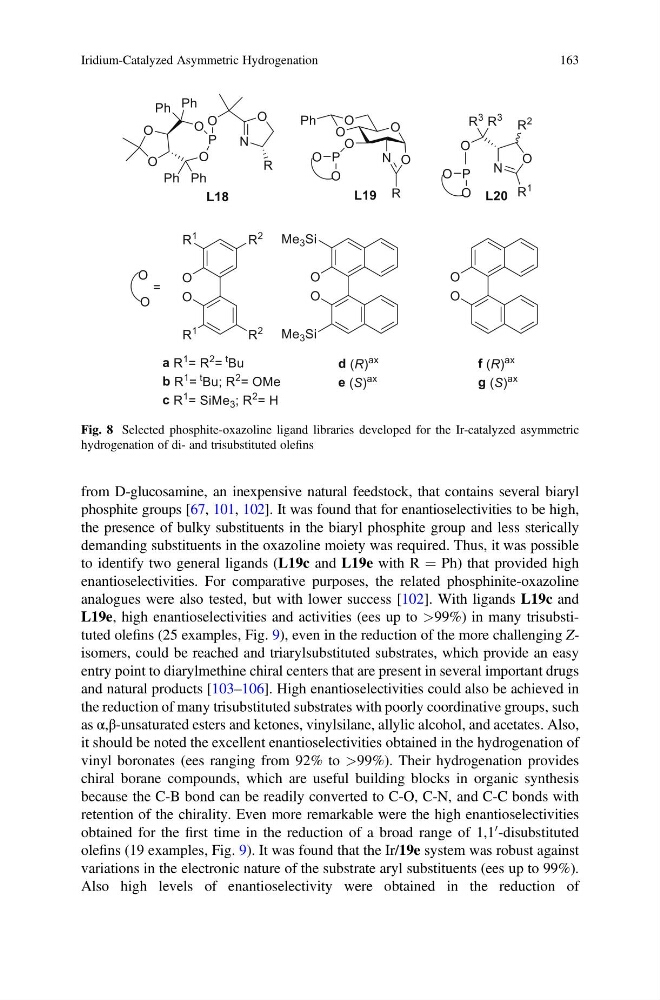
from D-glucosamine, an inexpensive natural feedstock, that contains several biaryl
phosphite groups [67, 101, 102]. It was found that for enantioselectivities to be high,
the presence of bulky substituents in the biaryl phosphite group and less sterically
demanding substituents in the oxazoline moiety was required. Thus, it was possible
to identify two general ligands (L19c and L19e with R ¼ Ph) that provided high
enantioselectivities. For comparative purposes, the related phosphinite-oxazoline
analogues were also tested, but with lower success [102]. With ligands L19c and
L19e, high enantioselectivities and activities (ees up to >99%) in many trisubstituted olefins (25 examples, Fig. 9), even in the reduction of the more challenging Zisomers, could be reached and triarylsubstituted substrates, which provide an easy
entry point to diarylmethine chiral centers that are present in several important drugs
and natural products [103–106]. High enantioselectivities could also be achieved in
the reduction of many trisubstituted substrates with poorly coordinative groups, such
as α,β-unsaturated esters and ketones, vinylsilane, allylic alcohol, and acetates. Also,
it should be noted the excellent enantioselectivities obtained in the hydrogenation of
vinyl boronates (ees ranging from 92% to >99%). Their hydrogenation provides
chiral borane compounds, which are useful building blocks in organic synthesis
because the C-B bond can be readily converted to C-O, C-N, and C-C bonds with
retention of the chirality. Even more remarkable were the high enantioselectivities
obtained for the first time in the reduction of a broad range of 1,1
0 -disubstituted
olefins (19 examples, Fig. 9). It was found that the Ir/19e system was robust against
variations in the electronic nature of the substrate aryl substituents (ees up to 99%).
Also high levels of enantioselectivity were obtained in the reduction of
Fig. 8 Selected phosphite-oxazoline ligand libraries developed for the Ir-catalyzed asymmetric
hydrogenation of di- and trisubstituted olefins
Iridium-Catalyzed Asymmetric Hydrogenation
163
phosphite groups [67, 101, 102]. It was found that for enantioselectivities to be high,
the presence of bulky substituents in the biaryl phosphite group and less sterically
demanding substituents in the oxazoline moiety was required. Thus, it was possible
to identify two general ligands (L19c and L19e with R ¼ Ph) that provided high
enantioselectivities. For comparative purposes, the related phosphinite-oxazoline
analogues were also tested, but with lower success [102]. With ligands L19c and
L19e, high enantioselectivities and activities (ees up to >99%) in many trisubstituted olefins (25 examples, Fig. 9), even in the reduction of the more challenging Zisomers, could be reached and triarylsubstituted substrates, which provide an easy
entry point to diarylmethine chiral centers that are present in several important drugs
and natural products [103–106]. High enantioselectivities could also be achieved in
the reduction of many trisubstituted substrates with poorly coordinative groups, such
as α,β-unsaturated esters and ketones, vinylsilane, allylic alcohol, and acetates. Also,
it should be noted the excellent enantioselectivities obtained in the hydrogenation of
vinyl boronates (ees ranging from 92% to >99%). Their hydrogenation provides
chiral borane compounds, which are useful building blocks in organic synthesis
because the C-B bond can be readily converted to C-O, C-N, and C-C bonds with
retention of the chirality. Even more remarkable were the high enantioselectivities
obtained for the first time in the reduction of a broad range of 1,1
0 -disubstituted
olefins (19 examples, Fig. 9). It was found that the Ir/19e system was robust against
variations in the electronic nature of the substrate aryl substituents (ees up to 99%).
Also high levels of enantioselectivity were obtained in the reduction of
Fig. 8 Selected phosphite-oxazoline ligand libraries developed for the Ir-catalyzed asymmetric
hydrogenation of di- and trisubstituted olefins
Iridium-Catalyzed Asymmetric Hydrogenation
163