

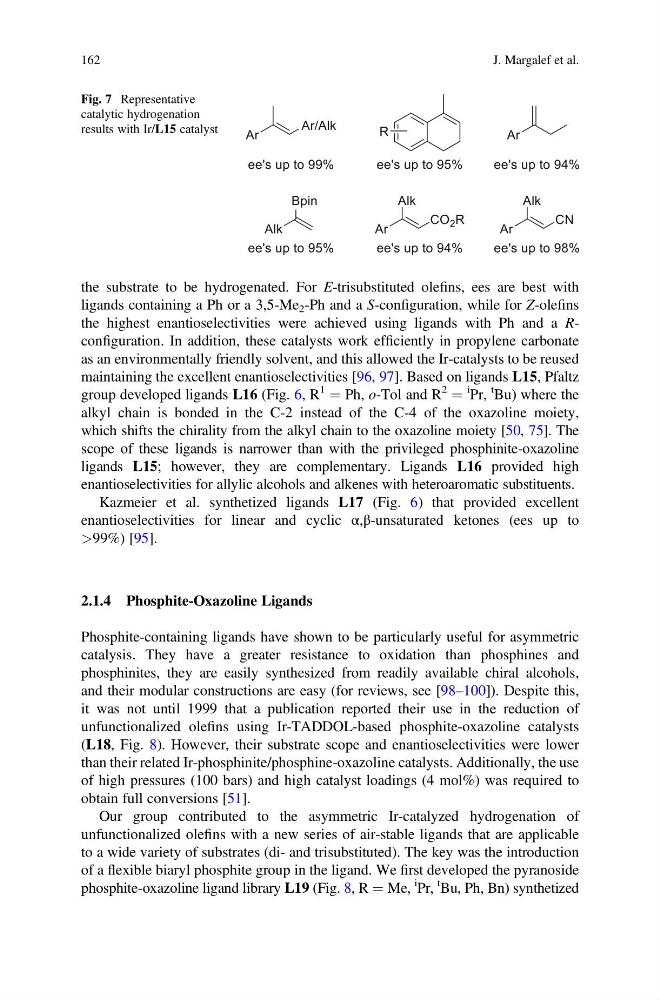
the substrate to be hydrogenated. For E-trisubstituted olefins, ees are best with
ligands containing a Ph or a 3,5-Me 2 -Ph and a S-configuration, while for Z-olefins
the highest enantioselectivities were achieved using ligands with Ph and a Rconfiguration. In addition, these catalysts work efficiently in propylene carbonate
as an environmentally friendly solvent, and this allowed the Ir-catalysts to be reused
maintaining the excellent enantioselectivities [96, 97]. Based on ligands L15, Pfaltz
group developed ligands L16 (Fig. 6, R
1
¼ Ph, o-Tol and R
2
¼
i
Pr,
t Bu) where the
alkyl chain is bonded in the C-2 instead of the C-4 of the oxazoline moiety,
which shifts the chirality from the alkyl chain to the oxazoline moiety [50, 75]. The
scope of these ligands is narrower than with the privileged phosphinite-oxazoline
ligands L15; however, they are complementary. Ligands L16 provided high
enantioselectivities for allylic alcohols and alkenes with heteroaromatic substituents.
Kazmeier et al. synthetized ligands L17 (Fig. 6) that provided excellent
enantioselectivities for linear and cyclic α,β-unsaturated ketones (ees up to
>99%) [95].
2.1.4 Phosphite-Oxazoline Ligands
Phosphite-containing ligands have shown to be particularly useful for asymmetric
catalysis. They have a greater resistance to oxidation than phosphines and
phosphinites, they are easily synthesized from readily available chiral alcohols,
and their modular constructions are easy (for reviews, see [98–100]). Despite this,
it was not until 1999 that a publication reported their use in the reduction of
unfunctionalized olefins using Ir-TADDOL-based phosphite-oxazoline catalysts
(L18, Fig. 8). However, their substrate scope and enantioselectivities were lower
than their related Ir-phosphinite/phosphine-oxazoline catalysts. Additionally, the use
of high pressures (100 bars) and high catalyst loadings (4 mol%) was required to
obtain full conversions [51].
Our group contributed to the asymmetric Ir-catalyzed hydrogenation of
unfunctionalized olefins with a new series of air-stable ligands that are applicable
to a wide variety of substrates (di- and trisubstituted). The key was the introduction
of a flexible biaryl phosphite group in the ligand. We first developed the pyranoside
phosphite-oxazoline ligand library L19 (Fig. 8, R ¼ Me,
i
Pr,
t
Bu, Ph, Bn) synthetized
Fig. 7 Representative
catalytic hydrogenation
results with Ir/L15 catalyst
162
J. Margalef et al.
ligands containing a Ph or a 3,5-Me 2 -Ph and a S-configuration, while for Z-olefins
the highest enantioselectivities were achieved using ligands with Ph and a Rconfiguration. In addition, these catalysts work efficiently in propylene carbonate
as an environmentally friendly solvent, and this allowed the Ir-catalysts to be reused
maintaining the excellent enantioselectivities [96, 97]. Based on ligands L15, Pfaltz
group developed ligands L16 (Fig. 6, R
1
¼ Ph, o-Tol and R
2
¼
i
Pr,
t Bu) where the
alkyl chain is bonded in the C-2 instead of the C-4 of the oxazoline moiety,
which shifts the chirality from the alkyl chain to the oxazoline moiety [50, 75]. The
scope of these ligands is narrower than with the privileged phosphinite-oxazoline
ligands L15; however, they are complementary. Ligands L16 provided high
enantioselectivities for allylic alcohols and alkenes with heteroaromatic substituents.
Kazmeier et al. synthetized ligands L17 (Fig. 6) that provided excellent
enantioselectivities for linear and cyclic α,β-unsaturated ketones (ees up to
>99%) [95].
2.1.4 Phosphite-Oxazoline Ligands
Phosphite-containing ligands have shown to be particularly useful for asymmetric
catalysis. They have a greater resistance to oxidation than phosphines and
phosphinites, they are easily synthesized from readily available chiral alcohols,
and their modular constructions are easy (for reviews, see [98–100]). Despite this,
it was not until 1999 that a publication reported their use in the reduction of
unfunctionalized olefins using Ir-TADDOL-based phosphite-oxazoline catalysts
(L18, Fig. 8). However, their substrate scope and enantioselectivities were lower
than their related Ir-phosphinite/phosphine-oxazoline catalysts. Additionally, the use
of high pressures (100 bars) and high catalyst loadings (4 mol%) was required to
obtain full conversions [51].
Our group contributed to the asymmetric Ir-catalyzed hydrogenation of
unfunctionalized olefins with a new series of air-stable ligands that are applicable
to a wide variety of substrates (di- and trisubstituted). The key was the introduction
of a flexible biaryl phosphite group in the ligand. We first developed the pyranoside
phosphite-oxazoline ligand library L19 (Fig. 8, R ¼ Me,
i
Pr,
t
Bu, Ph, Bn) synthetized
Fig. 7 Representative
catalytic hydrogenation
results with Ir/L15 catalyst
162
J. Margalef et al.