

2.1.3 Phosphinite-Oxazoline Ligands
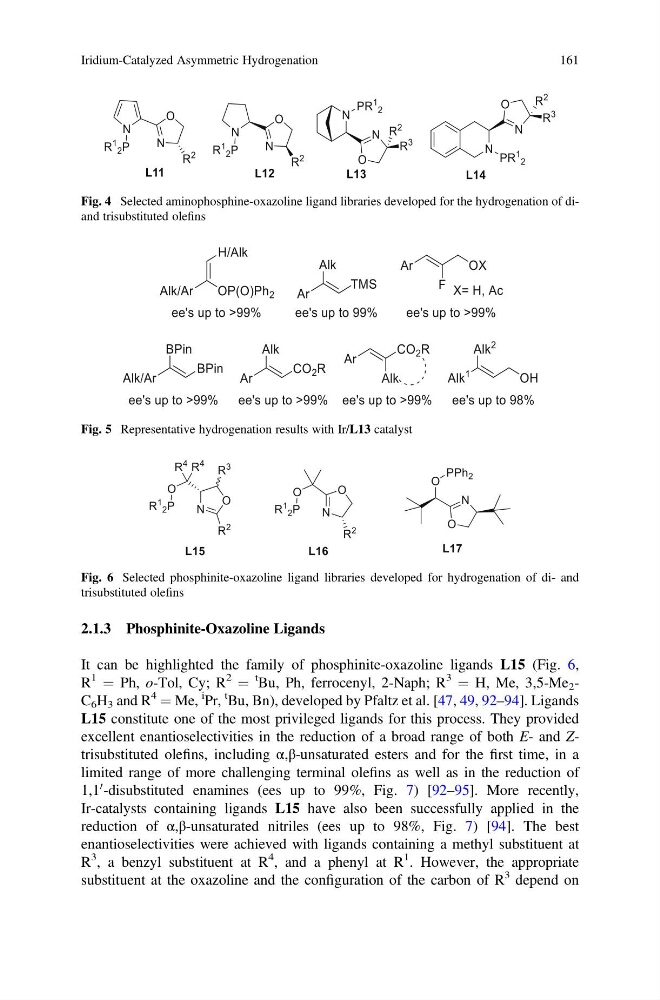
It can be highlighted the family of phosphinite-oxazoline ligands L15 (Fig. 6,
R
1
¼ Ph, o-Tol, Cy; R
2
¼
t Bu, Ph, ferrocenyl, 2-Naph; R
3
¼ H, Me, 3,5-Me 2 -
C 6 H 3 and R
4
¼ Me,
i
Pr,
t Bu, Bn), developed by Pfaltz et al. [47, 49, 92–94]. Ligands
L15 constitute one of the most privileged ligands for this process. They provided
excellent enantioselectivities in the reduction of a broad range of both E- and Ztrisubstituted olefins, including α,β-unsaturated esters and for the first time, in a
limited range of more challenging terminal olefins as well as in the reduction of
1,1
0 -disubstituted enamines (ees up to 99%, Fig. 7) [92–95]. More recently,
Ir-catalysts containing ligands L15 have also been successfully applied in the
reduction of α,β-unsaturated nitriles (ees up to 98%, Fig. 7) [94]. The best
enantioselectivities were achieved with ligands containing a methyl substituent at
R
3 , a benzyl substituent at R
4 , and a phenyl at R
1 . However, the appropriate
substituent at the oxazoline and the configuration of the carbon of R
3 depend on
Fig. 4 Selected aminophosphine-oxazoline ligand libraries developed for the hydrogenation of diand trisubstituted olefins
Fig. 5 Representative hydrogenation results with Ir/L13 catalyst
Fig. 6 Selected phosphinite-oxazoline ligand libraries developed for hydrogenation of di- and
trisubstituted olefins
Iridium-Catalyzed Asymmetric Hydrogenation
161
It can be highlighted the family of phosphinite-oxazoline ligands L15 (Fig. 6,
R
1
¼ Ph, o-Tol, Cy; R
2
¼
t Bu, Ph, ferrocenyl, 2-Naph; R
3
¼ H, Me, 3,5-Me 2 -
C 6 H 3 and R
4
¼ Me,
i
Pr,
t Bu, Bn), developed by Pfaltz et al. [47, 49, 92–94]. Ligands
L15 constitute one of the most privileged ligands for this process. They provided
excellent enantioselectivities in the reduction of a broad range of both E- and Ztrisubstituted olefins, including α,β-unsaturated esters and for the first time, in a
limited range of more challenging terminal olefins as well as in the reduction of
1,1
0 -disubstituted enamines (ees up to 99%, Fig. 7) [92–95]. More recently,
Ir-catalysts containing ligands L15 have also been successfully applied in the
reduction of α,β-unsaturated nitriles (ees up to 98%, Fig. 7) [94]. The best
enantioselectivities were achieved with ligands containing a methyl substituent at
R
3 , a benzyl substituent at R
4 , and a phenyl at R
1 . However, the appropriate
substituent at the oxazoline and the configuration of the carbon of R
3 depend on
Fig. 4 Selected aminophosphine-oxazoline ligand libraries developed for the hydrogenation of diand trisubstituted olefins
Fig. 5 Representative hydrogenation results with Ir/L13 catalyst
Fig. 6 Selected phosphinite-oxazoline ligand libraries developed for hydrogenation of di- and
trisubstituted olefins
Iridium-Catalyzed Asymmetric Hydrogenation
161