

Another interesting change in the nitrogen donor group is the replacement of the
oxazoline by imidazole, oxazole, thiazole, thiazoline, and sulfoximine [124] groups.
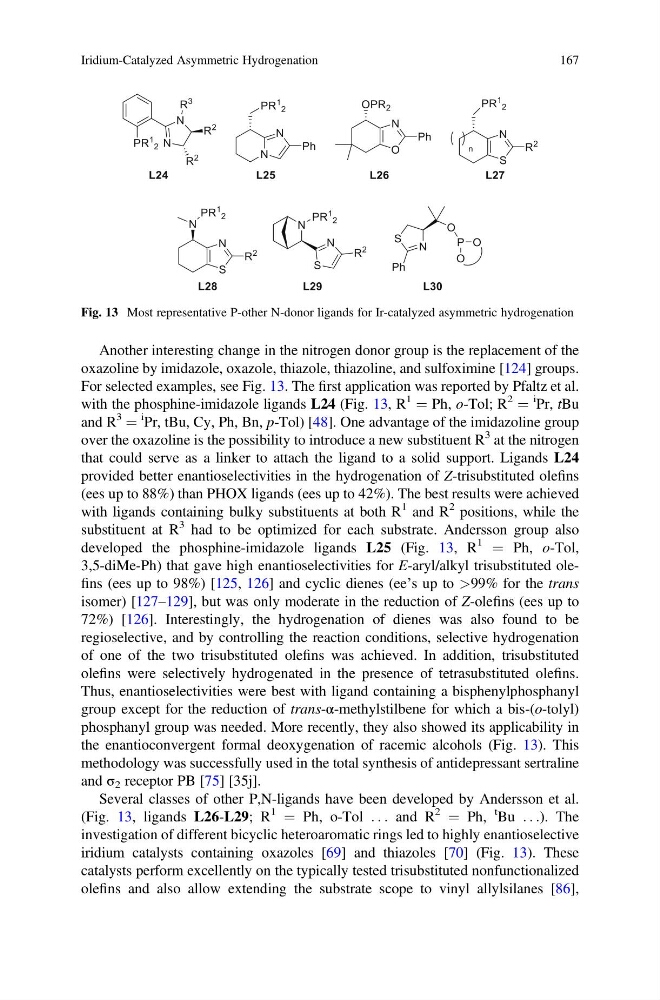
For selected examples, see Fig. 13. The first application was reported by Pfaltz et al.
with the phosphine-imidazole ligands L24 (Fig. 13, R
1
¼ Ph, o-Tol; R
2
¼
i Pr, tBu
and R
3
¼
i Pr, tBu, Cy, Ph, Bn, p-Tol) [48]. One advantage of the imidazoline group
over the oxazoline is the possibility to introduce a new substituent R
3 at the nitrogen
that could serve as a linker to attach the ligand to a solid support. Ligands L24
provided better enantioselectivities in the hydrogenation of Z-trisubstituted olefins
(ees up to 88%) than PHOX ligands (ees up to 42%). The best results were achieved
with ligands containing bulky substituents at both R
1 and R
2 positions, while the
substituent at R
3 had to be optimized for each substrate. Andersson group also
developed the phosphine-imidazole ligands L25 (Fig. 13, R
1
¼ Ph, o-Tol,
3,5-diMe-Ph) that gave high enantioselectivities for E-aryl/alkyl trisubstituted olefins (ees up to 98%) [125, 126] and cyclic dienes (ee’s up to >99% for the trans
isomer) [127–129], but was only moderate in the reduction of Z-olefins (ees up to
72%) [126]. Interestingly, the hydrogenation of dienes was also found to be
regioselective, and by controlling the reaction conditions, selective hydrogenation
of one of the two trisubstituted olefins was achieved. In addition, trisubstituted
olefins were selectively hydrogenated in the presence of tetrasubstituted olefins.
Thus, enantioselectivities were best with ligand containing a bisphenylphosphanyl
group except for the reduction of trans-α-methylstilbene for which a bis-(o-tolyl)
phosphanyl group was needed. More recently, they also showed its applicability in
the enantioconvergent formal deoxygenation of racemic alcohols (Fig. 13). This
methodology was successfully used in the total synthesis of antidepressant sertraline
and σ 2 receptor PB [75] [35j].
Several classes of other P,N-ligands have been developed by Andersson et al.
(Fig. 13, ligands L26-L29; R
1
¼ Ph, o-Tol . . . and R
2
¼ Ph,
t Bu . . .). The
investigation of different bicyclic heteroaromatic rings led to highly enantioselective
iridium catalysts containing oxazoles [69] and thiazoles [70] (Fig. 13). These
catalysts perform excellently on the typically tested trisubstituted nonfunctionalized
olefins and also allow extending the substrate scope to vinyl allylsilanes [86],
Fig. 13 Most representative P-other N-donor ligands for Ir-catalyzed asymmetric hydrogenation
Iridium-Catalyzed Asymmetric Hydrogenation
167
oxazoline by imidazole, oxazole, thiazole, thiazoline, and sulfoximine [124] groups.
For selected examples, see Fig. 13. The first application was reported by Pfaltz et al.
with the phosphine-imidazole ligands L24 (Fig. 13, R
1
¼ Ph, o-Tol; R
2
¼
i Pr, tBu
and R
3
¼
i Pr, tBu, Cy, Ph, Bn, p-Tol) [48]. One advantage of the imidazoline group
over the oxazoline is the possibility to introduce a new substituent R
3 at the nitrogen
that could serve as a linker to attach the ligand to a solid support. Ligands L24
provided better enantioselectivities in the hydrogenation of Z-trisubstituted olefins
(ees up to 88%) than PHOX ligands (ees up to 42%). The best results were achieved
with ligands containing bulky substituents at both R
1 and R
2 positions, while the
substituent at R
3 had to be optimized for each substrate. Andersson group also
developed the phosphine-imidazole ligands L25 (Fig. 13, R
1
¼ Ph, o-Tol,
3,5-diMe-Ph) that gave high enantioselectivities for E-aryl/alkyl trisubstituted olefins (ees up to 98%) [125, 126] and cyclic dienes (ee’s up to >99% for the trans
isomer) [127–129], but was only moderate in the reduction of Z-olefins (ees up to
72%) [126]. Interestingly, the hydrogenation of dienes was also found to be
regioselective, and by controlling the reaction conditions, selective hydrogenation
of one of the two trisubstituted olefins was achieved. In addition, trisubstituted
olefins were selectively hydrogenated in the presence of tetrasubstituted olefins.
Thus, enantioselectivities were best with ligand containing a bisphenylphosphanyl
group except for the reduction of trans-α-methylstilbene for which a bis-(o-tolyl)
phosphanyl group was needed. More recently, they also showed its applicability in
the enantioconvergent formal deoxygenation of racemic alcohols (Fig. 13). This
methodology was successfully used in the total synthesis of antidepressant sertraline
and σ 2 receptor PB [75] [35j].
Several classes of other P,N-ligands have been developed by Andersson et al.
(Fig. 13, ligands L26-L29; R
1
¼ Ph, o-Tol . . . and R
2
¼ Ph,
t Bu . . .). The
investigation of different bicyclic heteroaromatic rings led to highly enantioselective
iridium catalysts containing oxazoles [69] and thiazoles [70] (Fig. 13). These
catalysts perform excellently on the typically tested trisubstituted nonfunctionalized
olefins and also allow extending the substrate scope to vinyl allylsilanes [86],
Fig. 13 Most representative P-other N-donor ligands for Ir-catalyzed asymmetric hydrogenation
Iridium-Catalyzed Asymmetric Hydrogenation
167