

fragrances, agrochemicals, and drugs). Substrate scope has also been extended to
1,1-diaryl or 1,1,2-triaryl substituted substrates (i.e., 1-(1,2-diphenyl-vinyl)-3,5dimethyl-benzene) and more recently to 1,4- and cyclic dienes (i.e., 1,5-dimethylcyclohexa-1,4-diene), linear and cyclic sulfones, and alkyl fluorides, which are
present in several important drugs and natural products.
Unlike trisubstituted olefins, a large range of 1,1-disubstituted olefins have not
been successfully asymmetrically hydrogenated until very recently [10–15]. This is
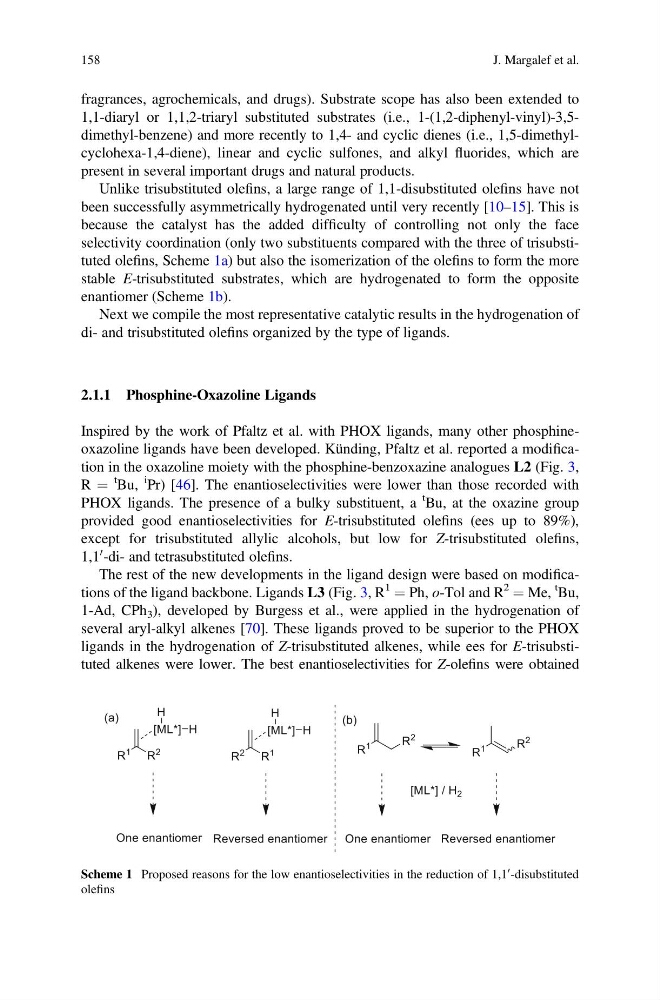
because the catalyst has the added difficulty of controlling not only the face
selectivity coordination (only two substituents compared with the three of trisubstituted olefins, Scheme 1a) but also the isomerization of the olefins to form the more
stable E-trisubstituted substrates, which are hydrogenated to form the opposite
enantiomer (Scheme 1b).
Next we compile the most representative catalytic results in the hydrogenation of
di- and trisubstituted olefins organized by the type of ligands.
2.1.1 Phosphine-Oxazoline Ligands
Inspired by the work of Pfaltz et al. with PHOX ligands, many other phosphineoxazoline ligands have been developed. Künding, Pfaltz et al. reported a modification in the oxazoline moiety with the phosphine-benzoxazine analogues L2 (Fig. 3,
R ¼
t
Bu,
i Pr) [46]. The enantioselectivities were lower than those recorded with
PHOX ligands. The presence of a bulky substituent, a
t Bu, at the oxazine group
provided good enantioselectivities for E-trisubstituted olefins (ees up to 89%),
except for trisubstituted allylic alcohols, but low for Z-trisubstituted olefins,
1,1
0 -di- and tetrasubstituted olefins.
The rest of the new developments in the ligand design were based on modifications of the ligand backbone. Ligands L3 (Fig. 3, R
1
¼ Ph, o-Tol and R
2
¼ Me,
t Bu,
1-Ad, CPh 3 ), developed by Burgess et al., were applied in the hydrogenation of
several aryl-alkyl alkenes [70]. These ligands proved to be superior to the PHOX
ligands in the hydrogenation of Z-trisubstituted alkenes, while ees for E-trisubstituted alkenes were lower. The best enantioselectivities for Z-olefins were obtained
Scheme 1 Proposed reasons for the low enantioselectivities in the reduction of 1,1
0 -disubstituted
olefins
158
J. Margalef et al.
1,1-diaryl or 1,1,2-triaryl substituted substrates (i.e., 1-(1,2-diphenyl-vinyl)-3,5dimethyl-benzene) and more recently to 1,4- and cyclic dienes (i.e., 1,5-dimethylcyclohexa-1,4-diene), linear and cyclic sulfones, and alkyl fluorides, which are
present in several important drugs and natural products.
Unlike trisubstituted olefins, a large range of 1,1-disubstituted olefins have not
been successfully asymmetrically hydrogenated until very recently [10–15]. This is
because the catalyst has the added difficulty of controlling not only the face
selectivity coordination (only two substituents compared with the three of trisubstituted olefins, Scheme 1a) but also the isomerization of the olefins to form the more
stable E-trisubstituted substrates, which are hydrogenated to form the opposite
enantiomer (Scheme 1b).
Next we compile the most representative catalytic results in the hydrogenation of
di- and trisubstituted olefins organized by the type of ligands.
2.1.1 Phosphine-Oxazoline Ligands
Inspired by the work of Pfaltz et al. with PHOX ligands, many other phosphineoxazoline ligands have been developed. Künding, Pfaltz et al. reported a modification in the oxazoline moiety with the phosphine-benzoxazine analogues L2 (Fig. 3,
R ¼
t
Bu,
i Pr) [46]. The enantioselectivities were lower than those recorded with
PHOX ligands. The presence of a bulky substituent, a
t Bu, at the oxazine group
provided good enantioselectivities for E-trisubstituted olefins (ees up to 89%),
except for trisubstituted allylic alcohols, but low for Z-trisubstituted olefins,
1,1
0 -di- and tetrasubstituted olefins.
The rest of the new developments in the ligand design were based on modifications of the ligand backbone. Ligands L3 (Fig. 3, R
1
¼ Ph, o-Tol and R
2
¼ Me,
t Bu,
1-Ad, CPh 3 ), developed by Burgess et al., were applied in the hydrogenation of
several aryl-alkyl alkenes [70]. These ligands proved to be superior to the PHOX
ligands in the hydrogenation of Z-trisubstituted alkenes, while ees for E-trisubstituted alkenes were lower. The best enantioselectivities for Z-olefins were obtained
Scheme 1 Proposed reasons for the low enantioselectivities in the reduction of 1,1
0 -disubstituted
olefins
158
J. Margalef et al.