

with a
t
Bu group at the oxazoline and a diphenylphosphanyl group, while for E-olefins
a bis(o-tolyl)phosphanyl group was needed (ees up to 80%). A further modification of
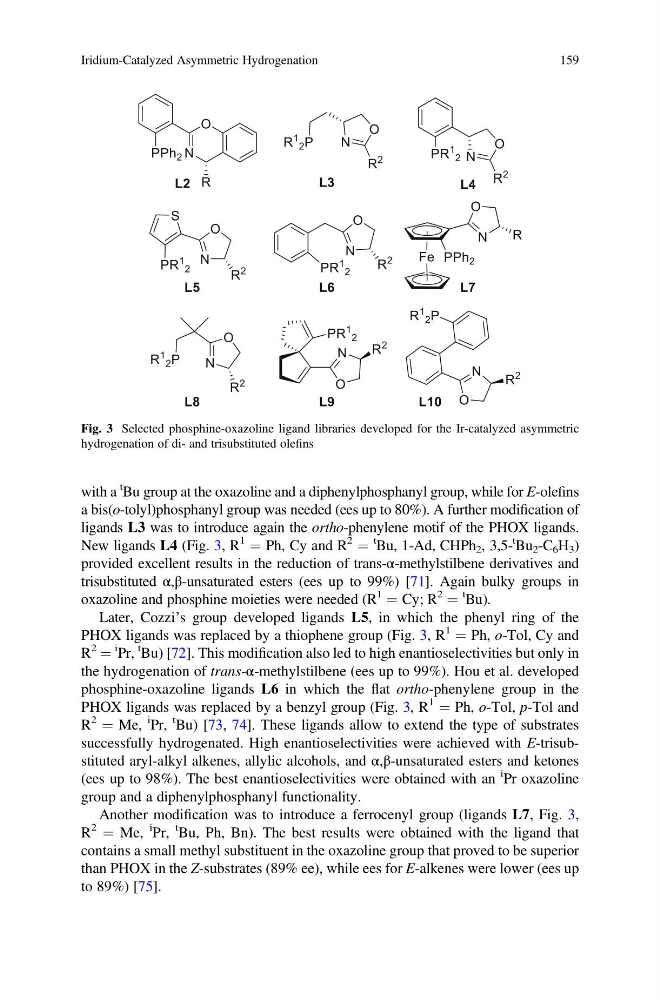
ligands L3 was to introduce again the ortho-phenylene motif of the PHOX ligands.
New ligands L4 (Fig. 3, R
1
¼ Ph, Cy and R
2
¼
t
Bu, 1-Ad, CHPh 2 , 3,5t
Bu 2 -C 6 H 3 )
provided excellent results in the reduction of trans-α-methylstilbene derivatives and
trisubstituted α,β-unsaturated esters (ees up to 99%) [71]. Again bulky groups in
oxazoline and phosphine moieties were needed (R
1
¼ Cy; R
2
¼
t
Bu).
Later, Cozzi’s group developed ligands L5, in which the phenyl ring of the
PHOX ligands was replaced by a thiophene group (Fig. 3, R
1
¼ Ph, o-Tol, Cy and
R
2
¼
i
Pr,
t Bu) [72]. This modification also led to high enantioselectivities but only in
the hydrogenation of trans-α-methylstilbene (ees up to 99%). Hou et al. developed
phosphine-oxazoline ligands L6 in which the flat ortho-phenylene group in the
PHOX ligands was replaced by a benzyl group (Fig. 3, R
1
¼ Ph, o-Tol, p-Tol and
R
2
¼ Me,
i Pr,
t
Bu) [73, 74]. These ligands allow to extend the type of substrates
successfully hydrogenated. High enantioselectivities were achieved with E-trisubstituted aryl-alkyl alkenes, allylic alcohols, and α,β-unsaturated esters and ketones
(ees up to 98%). The best enantioselectivities were obtained with an
i
Pr oxazoline
group and a diphenylphosphanyl functionality.
Another modification was to introduce a ferrocenyl group (ligands L7, Fig. 3,
R
2
¼ Me,
i Pr,
t Bu, Ph, Bn). The best results were obtained with the ligand that
contains a small methyl substituent in the oxazoline group that proved to be superior
than PHOX in the Z-substrates (89% ee), while ees for E-alkenes were lower (ees up
to 89%) [75].
Fig. 3 Selected phosphine-oxazoline ligand libraries developed for the Ir-catalyzed asymmetric
hydrogenation of di- and trisubstituted olefins
Iridium-Catalyzed Asymmetric Hydrogenation
159
t
Bu group at the oxazoline and a diphenylphosphanyl group, while for E-olefins
a bis(o-tolyl)phosphanyl group was needed (ees up to 80%). A further modification of
ligands L3 was to introduce again the ortho-phenylene motif of the PHOX ligands.
New ligands L4 (Fig. 3, R
1
¼ Ph, Cy and R
2
¼
t
Bu, 1-Ad, CHPh 2 , 3,5t
Bu 2 -C 6 H 3 )
provided excellent results in the reduction of trans-α-methylstilbene derivatives and
trisubstituted α,β-unsaturated esters (ees up to 99%) [71]. Again bulky groups in
oxazoline and phosphine moieties were needed (R
1
¼ Cy; R
2
¼
t
Bu).
Later, Cozzi’s group developed ligands L5, in which the phenyl ring of the
PHOX ligands was replaced by a thiophene group (Fig. 3, R
1
¼ Ph, o-Tol, Cy and
R
2
¼
i
Pr,
t Bu) [72]. This modification also led to high enantioselectivities but only in
the hydrogenation of trans-α-methylstilbene (ees up to 99%). Hou et al. developed
phosphine-oxazoline ligands L6 in which the flat ortho-phenylene group in the
PHOX ligands was replaced by a benzyl group (Fig. 3, R
1
¼ Ph, o-Tol, p-Tol and
R
2
¼ Me,
i Pr,
t
Bu) [73, 74]. These ligands allow to extend the type of substrates
successfully hydrogenated. High enantioselectivities were achieved with E-trisubstituted aryl-alkyl alkenes, allylic alcohols, and α,β-unsaturated esters and ketones
(ees up to 98%). The best enantioselectivities were obtained with an
i
Pr oxazoline
group and a diphenylphosphanyl functionality.
Another modification was to introduce a ferrocenyl group (ligands L7, Fig. 3,
R
2
¼ Me,
i Pr,
t Bu, Ph, Bn). The best results were obtained with the ligand that
contains a small methyl substituent in the oxazoline group that proved to be superior
than PHOX in the Z-substrates (89% ee), while ees for E-alkenes were lower (ees up
to 89%) [75].
Fig. 3 Selected phosphine-oxazoline ligand libraries developed for the Ir-catalyzed asymmetric
hydrogenation of di- and trisubstituted olefins
Iridium-Catalyzed Asymmetric Hydrogenation
159