

2.1 Di- and Trisubstituted Unfunctionalized Olefins or
with Poorly Coordinative Groups
Aryl/alkyl trisubstituted alkenes have become the model substrates for evaluating the
efficiency of new catalytic systems. In general, the hydrogenation of 1,2-diarylalkenes
(i.e., trans α-methylstilbene) proceeded with higher enantioselectivities than
monoarylated ones (such as E-2-(4-methoxyphenyl)-2-butene) for which only a limited number of catalysts provided high enantioselectivities [10–15]. The geometry of
the olefin also affects the catalytic performance. Z-Trisubstituted olefins are usually
hydrogenated less enantioselectively than the related E-trisubstituted olefins. The
lower enantioselectivities can be mainly attributed to a Z/E isomerization process to
form the more stable E-alkene, which gives the opposite enantiomer of the hydrogenated product [10–15]. Z-2-(4-Methoxyphenyl)-2-butene and dihydronaphthalenes
(i.e., 7-methoxy-4-methyl-1,2-dihydronaphthalene) are frequently used to study the
ligand scope in the hydrogenation of Z-alkenes. Dihydronaphthalenes have recently
received much attention because the corresponding chiral tetraline motif is found in
numerous natural products [69]. Trialkyl substituted alkenes have been much less
studied. This is due in part to the difficulty in developing methods for ee determination
and also the lack of an aryl group that could direct the reaction via π-stacking
interaction between the substrate and the chiral catalyst. The best results have been
reported in the reduction of 1-methoxy-4-(3-methyl-pent-3-enyl)-benzene (ees up to
95%) [54].
Nowadays, Ir-catalysts have also been able to reduce olefins with a variety of
relevant poorly coordinative groups such as α,β-unsaturated esters, ketones, and
lactames and vinyl boronates, among others [10–15]. The effective hydrogenation of
such a range of olefins is of great importance since their reduced products are key
structural chiral units found in many high-value chemicals (e.g., α- and β-chiral
ketones and carboxylic acid derivatives are ubiquitous in natural products,
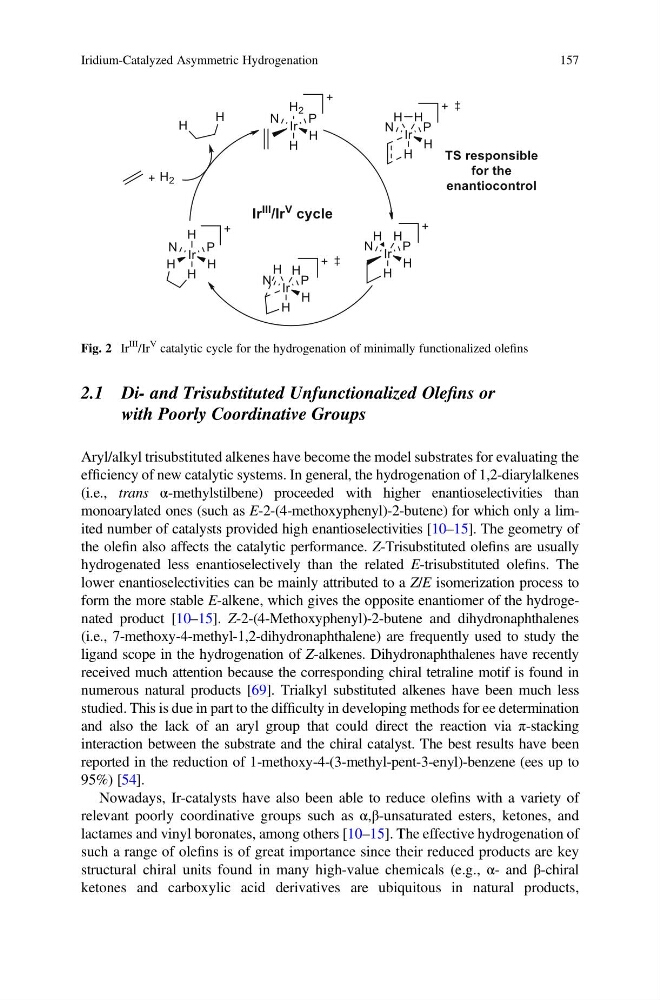
Fig. 2 Ir
III /Ir
V catalytic cycle for the hydrogenation of minimally functionalized olefins
Iridium-Catalyzed Asymmetric Hydrogenation
157
with Poorly Coordinative Groups
Aryl/alkyl trisubstituted alkenes have become the model substrates for evaluating the
efficiency of new catalytic systems. In general, the hydrogenation of 1,2-diarylalkenes
(i.e., trans α-methylstilbene) proceeded with higher enantioselectivities than
monoarylated ones (such as E-2-(4-methoxyphenyl)-2-butene) for which only a limited number of catalysts provided high enantioselectivities [10–15]. The geometry of
the olefin also affects the catalytic performance. Z-Trisubstituted olefins are usually
hydrogenated less enantioselectively than the related E-trisubstituted olefins. The
lower enantioselectivities can be mainly attributed to a Z/E isomerization process to
form the more stable E-alkene, which gives the opposite enantiomer of the hydrogenated product [10–15]. Z-2-(4-Methoxyphenyl)-2-butene and dihydronaphthalenes
(i.e., 7-methoxy-4-methyl-1,2-dihydronaphthalene) are frequently used to study the
ligand scope in the hydrogenation of Z-alkenes. Dihydronaphthalenes have recently
received much attention because the corresponding chiral tetraline motif is found in
numerous natural products [69]. Trialkyl substituted alkenes have been much less
studied. This is due in part to the difficulty in developing methods for ee determination
and also the lack of an aryl group that could direct the reaction via π-stacking
interaction between the substrate and the chiral catalyst. The best results have been
reported in the reduction of 1-methoxy-4-(3-methyl-pent-3-enyl)-benzene (ees up to
95%) [54].
Nowadays, Ir-catalysts have also been able to reduce olefins with a variety of
relevant poorly coordinative groups such as α,β-unsaturated esters, ketones, and
lactames and vinyl boronates, among others [10–15]. The effective hydrogenation of
such a range of olefins is of great importance since their reduced products are key
structural chiral units found in many high-value chemicals (e.g., α- and β-chiral
ketones and carboxylic acid derivatives are ubiquitous in natural products,
Fig. 2 Ir
III /Ir
V catalytic cycle for the hydrogenation of minimally functionalized olefins
Iridium-Catalyzed Asymmetric Hydrogenation
157