

α,β-unsaturated esters [56], furan derivatives [57], boronic esters [58], and
tetrasubstituted olefins [59].
Other groups also provided new successful ligand libraries, by modifying the
chiral backbone and by replacing either the P-group by a N-heterocyclic carbene
moiety or the oxazoline moiety by other N-donor groups (such as oxazole, thiazole,
and imidazole) and by O- and S-donor groups [14, 15, 60, 61]. All these modifications allow to further extend the substrate scope.
Concerning mechanistic aspects, although the mechanism of olefin hydrogenation by Rh-catalysts is well understood, the mechanism when Ir-catalysts are used
has not been fully determined until recently. In this context, computational and
experimental research with P,N- and C,N- ligands have shown that the hydrogenation of minimally functionalized olefins proceeds via an Ir
III /Ir
V migratory-insertion/
reductive-elimination catalytic cycle (Fig. 2) [62–67]. Very recently, Pfaltz’s group,
based on mechanistic studies under hydrogenation conditions, was able to detect the
Ir(III) dihydride alkene intermediates responsible for the catalytic performance for
the first time [68]. They found that, similar to the classical Halpern mechanism for
asymmetric hydrogenation with Rh-catalysts, the minor intermediate, which is less
stable, is converted to the major product enantiomer.
In the next sections, we collect the catalytic results on the asymmetric hydrogenation of unfunctionalized olefins or with poorly coordinative groups.
61
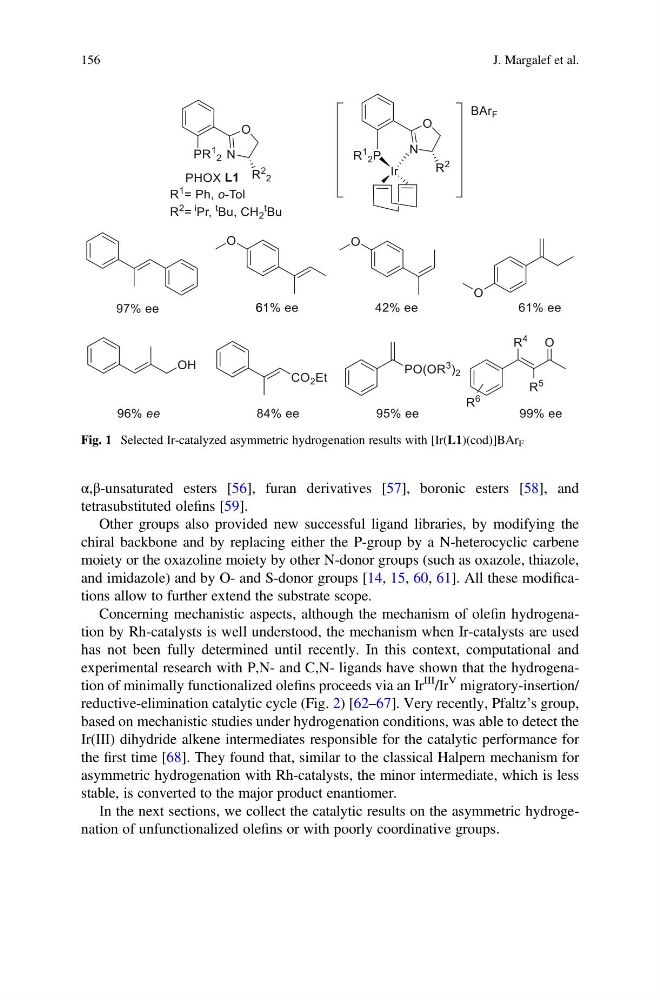
Fig. 1 Selected Ir-catalyzed asymmetric hydrogenation results with [Ir(L1)(cod)]BAr F
156
J. Margalef et al.
tetrasubstituted olefins [59].
Other groups also provided new successful ligand libraries, by modifying the
chiral backbone and by replacing either the P-group by a N-heterocyclic carbene
moiety or the oxazoline moiety by other N-donor groups (such as oxazole, thiazole,
and imidazole) and by O- and S-donor groups [14, 15, 60, 61]. All these modifications allow to further extend the substrate scope.
Concerning mechanistic aspects, although the mechanism of olefin hydrogenation by Rh-catalysts is well understood, the mechanism when Ir-catalysts are used
has not been fully determined until recently. In this context, computational and
experimental research with P,N- and C,N- ligands have shown that the hydrogenation of minimally functionalized olefins proceeds via an Ir
III /Ir
V migratory-insertion/
reductive-elimination catalytic cycle (Fig. 2) [62–67]. Very recently, Pfaltz’s group,
based on mechanistic studies under hydrogenation conditions, was able to detect the
Ir(III) dihydride alkene intermediates responsible for the catalytic performance for
the first time [68]. They found that, similar to the classical Halpern mechanism for
asymmetric hydrogenation with Rh-catalysts, the minor intermediate, which is less
stable, is converted to the major product enantiomer.
In the next sections, we collect the catalytic results on the asymmetric hydrogenation of unfunctionalized olefins or with poorly coordinative groups.
61
Fig. 1 Selected Ir-catalyzed asymmetric hydrogenation results with [Ir(L1)(cod)]BAr F
156
J. Margalef et al.