

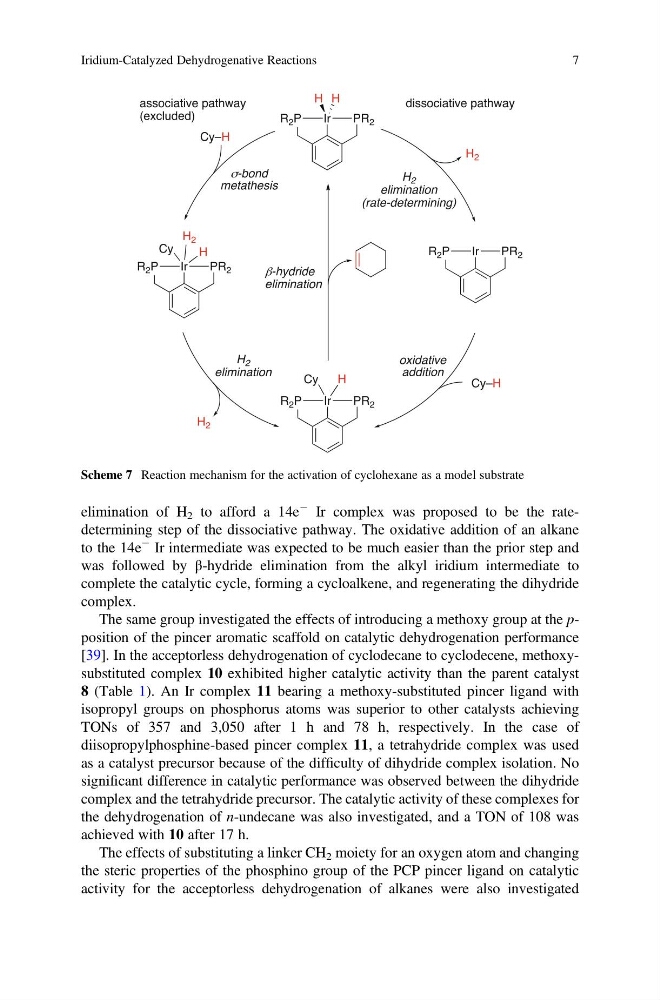
elimination of H 2 to afford a 14e
À Ir complex was proposed to be the ratedetermining step of the dissociative pathway. The oxidative addition of an alkane
to the 14e
À Ir intermediate was expected to be much easier than the prior step and
was followed by β-hydride elimination from the alkyl iridium intermediate to
complete the catalytic cycle, forming a cycloalkene, and regenerating the dihydride
complex.
The same group investigated the effects of introducing a methoxy group at the pposition of the pincer aromatic scaffold on catalytic dehydrogenation performance
[39]. In the acceptorless dehydrogenation of cyclodecane to cyclodecene, methoxysubstituted complex 10 exhibited higher catalytic activity than the parent catalyst
8 (Table 1). An Ir complex 11 bearing a methoxy-substituted pincer ligand with
isopropyl groups on phosphorus atoms was superior to other catalysts achieving
TONs of 357 and 3,050 after 1 h and 78 h, respectively. In the case of
diisopropylphosphine-based pincer complex 11, a tetrahydride complex was used
as a catalyst precursor because of the difficulty of dihydride complex isolation. No
significant difference in catalytic performance was observed between the dihydride
complex and the tetrahydride precursor. The catalytic activity of these complexes for
the dehydrogenation of n-undecane was also investigated, and a TON of 108 was
achieved with 10 after 17 h.
The effects of substituting a linker CH 2 moiety for an oxygen atom and changing
the steric properties of the phosphino group of the PCP pincer ligand on catalytic
activity for the acceptorless dehydrogenation of alkanes were also investigated
Scheme 7 Reaction mechanism for the activation of cyclohexane as a model substrate
Iridium-Catalyzed Dehydrogenative Reactions
7
À Ir complex was proposed to be the ratedetermining step of the dissociative pathway. The oxidative addition of an alkane
to the 14e
À Ir intermediate was expected to be much easier than the prior step and
was followed by β-hydride elimination from the alkyl iridium intermediate to
complete the catalytic cycle, forming a cycloalkene, and regenerating the dihydride
complex.
The same group investigated the effects of introducing a methoxy group at the pposition of the pincer aromatic scaffold on catalytic dehydrogenation performance
[39]. In the acceptorless dehydrogenation of cyclodecane to cyclodecene, methoxysubstituted complex 10 exhibited higher catalytic activity than the parent catalyst
8 (Table 1). An Ir complex 11 bearing a methoxy-substituted pincer ligand with
isopropyl groups on phosphorus atoms was superior to other catalysts achieving
TONs of 357 and 3,050 after 1 h and 78 h, respectively. In the case of
diisopropylphosphine-based pincer complex 11, a tetrahydride complex was used
as a catalyst precursor because of the difficulty of dihydride complex isolation. No
significant difference in catalytic performance was observed between the dihydride
complex and the tetrahydride precursor. The catalytic activity of these complexes for
the dehydrogenation of n-undecane was also investigated, and a TON of 108 was
achieved with 10 after 17 h.
The effects of substituting a linker CH 2 moiety for an oxygen atom and changing
the steric properties of the phosphino group of the PCP pincer ligand on catalytic
activity for the acceptorless dehydrogenation of alkanes were also investigated
Scheme 7 Reaction mechanism for the activation of cyclohexane as a model substrate
Iridium-Catalyzed Dehydrogenative Reactions
7