

360 were obtained after 4 and 24 h, respectively), and cyclodecene was produced as
a 3:1 mixture of cis- and trans-isomers. The decrease of the dehydrogenation rate
with time was ascribed to the concomitantly increasing content of the alkene product
and not to catalyst decomposition as confirmed by the fact that the addition of 10%
cyclooctene in cyclooctane completely stopped the dehydrogenation reaction.
The promising performance of the above PCP pincer complex for catalytic alkane
dehydrogenation has inspired the development of other catalysts based on pincer Ir
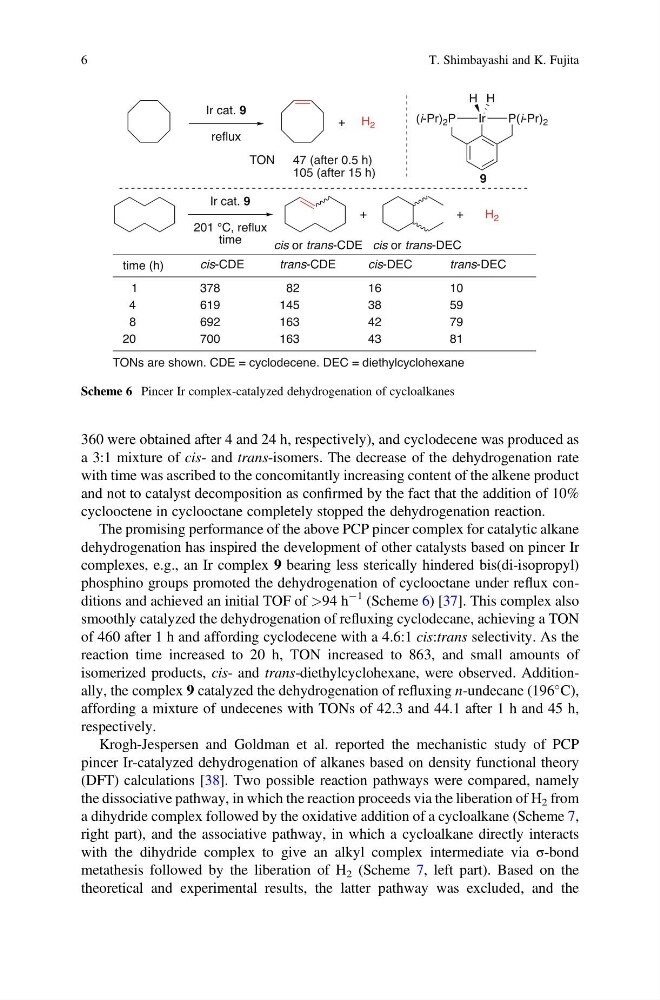
complexes, e.g., an Ir complex 9 bearing less sterically hindered bis(di-isopropyl)
phosphino groups promoted the dehydrogenation of cyclooctane under reflux conditions and achieved an initial TOF of >94 h
À1 (Scheme 6) [37]. This complex also
smoothly catalyzed the dehydrogenation of refluxing cyclodecane, achieving a TON
of 460 after 1 h and affording cyclodecene with a 4.6:1 cis:trans selectivity. As the
reaction time increased to 20 h, TON increased to 863, and small amounts of
isomerized products, cis- and trans-diethylcyclohexane, were observed. Additionally, the complex 9 catalyzed the dehydrogenation of refluxing n-undecane (196
C),
affording a mixture of undecenes with TONs of 42.3 and 44.1 after 1 h and 45 h,
respectively.
Krogh-Jespersen and Goldman et al. reported the mechanistic study of PCP
pincer Ir-catalyzed dehydrogenation of alkanes based on density functional theory
(DFT) calculations [38]. Two possible reaction pathways were compared, namely
the dissociative pathway, in which the reaction proceeds via the liberation of H 2 from
a dihydride complex followed by the oxidative addition of a cycloalkane (Scheme 7,
right part), and the associative pathway, in which a cycloalkane directly interacts
with the dihydride complex to give an alkyl complex intermediate via σ-bond
metathesis followed by the liberation of H 2 (Scheme 7, left part). Based on the
theoretical and experimental results, the latter pathway was excluded, and the
Scheme 6 Pincer Ir complex-catalyzed dehydrogenation of cycloalkanes
6
T. Shimbayashi and K. Fujita
a 3:1 mixture of cis- and trans-isomers. The decrease of the dehydrogenation rate
with time was ascribed to the concomitantly increasing content of the alkene product
and not to catalyst decomposition as confirmed by the fact that the addition of 10%
cyclooctene in cyclooctane completely stopped the dehydrogenation reaction.
The promising performance of the above PCP pincer complex for catalytic alkane
dehydrogenation has inspired the development of other catalysts based on pincer Ir
complexes, e.g., an Ir complex 9 bearing less sterically hindered bis(di-isopropyl)
phosphino groups promoted the dehydrogenation of cyclooctane under reflux conditions and achieved an initial TOF of >94 h
À1 (Scheme 6) [37]. This complex also
smoothly catalyzed the dehydrogenation of refluxing cyclodecane, achieving a TON
of 460 after 1 h and affording cyclodecene with a 4.6:1 cis:trans selectivity. As the
reaction time increased to 20 h, TON increased to 863, and small amounts of
isomerized products, cis- and trans-diethylcyclohexane, were observed. Additionally, the complex 9 catalyzed the dehydrogenation of refluxing n-undecane (196
C),
affording a mixture of undecenes with TONs of 42.3 and 44.1 after 1 h and 45 h,
respectively.
Krogh-Jespersen and Goldman et al. reported the mechanistic study of PCP
pincer Ir-catalyzed dehydrogenation of alkanes based on density functional theory
(DFT) calculations [38]. Two possible reaction pathways were compared, namely
the dissociative pathway, in which the reaction proceeds via the liberation of H 2 from
a dihydride complex followed by the oxidative addition of a cycloalkane (Scheme 7,
right part), and the associative pathway, in which a cycloalkane directly interacts
with the dihydride complex to give an alkyl complex intermediate via σ-bond
metathesis followed by the liberation of H 2 (Scheme 7, left part). Based on the
theoretical and experimental results, the latter pathway was excluded, and the
Scheme 6 Pincer Ir complex-catalyzed dehydrogenation of cycloalkanes
6
T. Shimbayashi and K. Fujita