

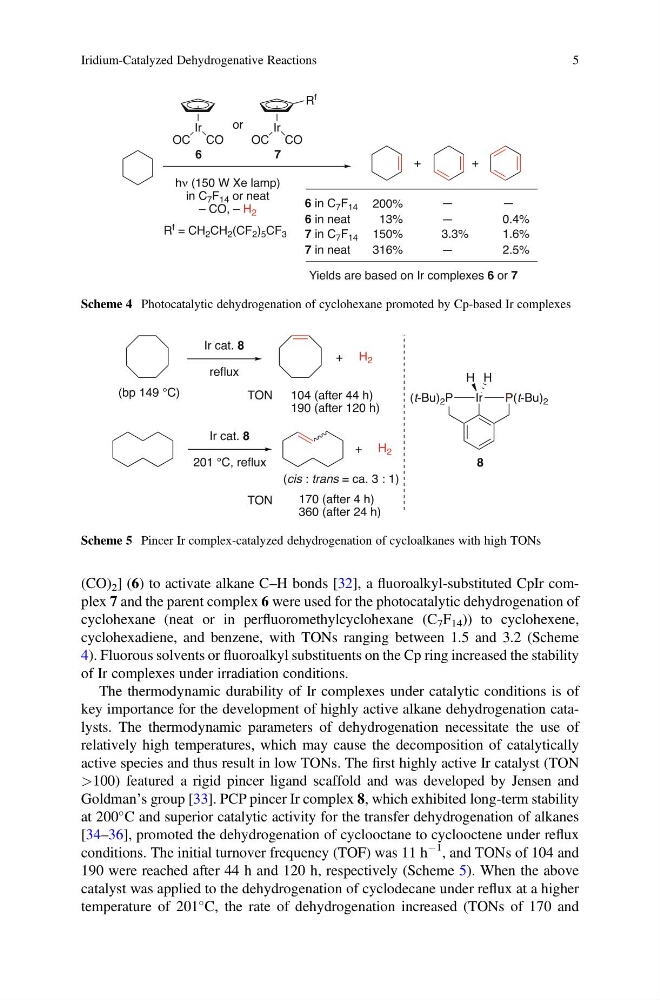
(CO) 2 ] (6) to activate alkane C–H bonds [32], a fluoroalkyl-substituted CpIr complex 7 and the parent complex 6 were used for the photocatalytic dehydrogenation of
cyclohexane (neat or in perfluoromethylcyclohexane (C 7 F 14 )) to cyclohexene,
cyclohexadiene, and benzene, with TONs ranging between 1.5 and 3.2 (Scheme
4). Fluorous solvents or fluoroalkyl substituents on the Cp ring increased the stability
of Ir complexes under irradiation conditions.
The thermodynamic durability of Ir complexes under catalytic conditions is of
key importance for the development of highly active alkane dehydrogenation catalysts. The thermodynamic parameters of dehydrogenation necessitate the use of
relatively high temperatures, which may cause the decomposition of catalytically
active species and thus result in low TONs. The first highly active Ir catalyst (TON
>100) featured a rigid pincer ligand scaffold and was developed by Jensen and
Goldman’s group [33]. PCP pincer Ir complex 8, which exhibited long-term stability
at 200
C and superior catalytic activity for the transfer dehydrogenation of alkanes
[34–36], promoted the dehydrogenation of cyclooctane to cyclooctene under reflux
conditions. The initial turnover frequency (TOF) was 11 h
À1 , and TONs of 104 and
190 were reached after 44 h and 120 h, respectively (Scheme 5). When the above
catalyst was applied to the dehydrogenation of cyclodecane under reflux at a higher
temperature of 201
C, the rate of dehydrogenation increased (TONs of 170 and
Scheme 4 Photocatalytic dehydrogenation of cyclohexane promoted by Cp-based Ir complexes
P
Scheme 5 Pincer Ir complex-catalyzed dehydrogenation of cycloalkanes with high TONs
Iridium-Catalyzed Dehydrogenative Reactions
5
cyclohexane (neat or in perfluoromethylcyclohexane (C 7 F 14 )) to cyclohexene,
cyclohexadiene, and benzene, with TONs ranging between 1.5 and 3.2 (Scheme
4). Fluorous solvents or fluoroalkyl substituents on the Cp ring increased the stability
of Ir complexes under irradiation conditions.
The thermodynamic durability of Ir complexes under catalytic conditions is of
key importance for the development of highly active alkane dehydrogenation catalysts. The thermodynamic parameters of dehydrogenation necessitate the use of
relatively high temperatures, which may cause the decomposition of catalytically
active species and thus result in low TONs. The first highly active Ir catalyst (TON
>100) featured a rigid pincer ligand scaffold and was developed by Jensen and
Goldman’s group [33]. PCP pincer Ir complex 8, which exhibited long-term stability
at 200
C and superior catalytic activity for the transfer dehydrogenation of alkanes
[34–36], promoted the dehydrogenation of cyclooctane to cyclooctene under reflux
conditions. The initial turnover frequency (TOF) was 11 h
À1 , and TONs of 104 and
190 were reached after 44 h and 120 h, respectively (Scheme 5). When the above
catalyst was applied to the dehydrogenation of cyclodecane under reflux at a higher
temperature of 201
C, the rate of dehydrogenation increased (TONs of 170 and
Scheme 4 Photocatalytic dehydrogenation of cyclohexane promoted by Cp-based Ir complexes
P
Scheme 5 Pincer Ir complex-catalyzed dehydrogenation of cycloalkanes with high TONs
Iridium-Catalyzed Dehydrogenative Reactions
5