

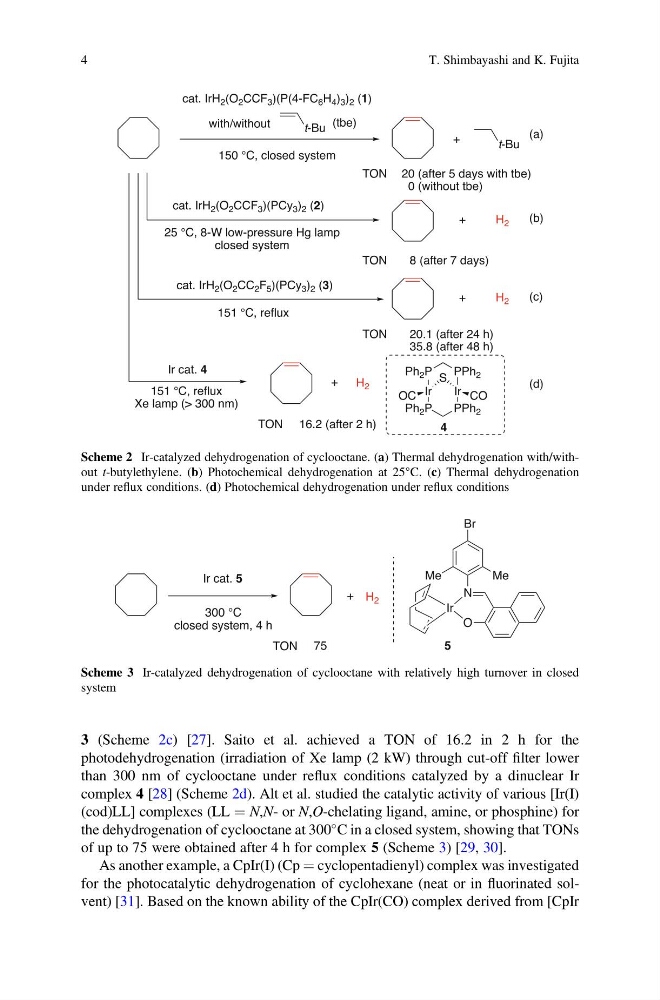
3 (Scheme 2c) [27]. Saito et al. achieved a TON of 16.2 in 2 h for the
photodehydrogenation (irradiation of Xe lamp (2 kW) through cut-off filter lower
than 300 nm of cyclooctane under reflux conditions catalyzed by a dinuclear Ir
complex 4 [28] (Scheme 2d). Alt et al. studied the catalytic activity of various [Ir(I)
(cod)LL] complexes (LL ¼ N,N- or N,O-chelating ligand, amine, or phosphine) for
the dehydrogenation of cyclooctane at 300
C in a closed system, showing that TONs
of up to 75 were obtained after 4 h for complex 5 (Scheme 3) [29, 30].
As another example, a CpIr(I) (Cp ¼ cyclopentadienyl) complex was investigated
for the photocatalytic dehydrogenation of cyclohexane (neat or in fluorinated solvent) [31]. Based on the known ability of the CpIr(CO) complex derived from [CpIr
Scheme 2 Ir-catalyzed dehydrogenation of cyclooctane. (a) Thermal dehydrogenation with/without t-butylethylene. (b) Photochemical dehydrogenation at 25°C. (c) Thermal dehydrogenation
under reflux conditions. (d) Photochemical dehydrogenation under reflux conditions
Scheme 3 Ir-catalyzed dehydrogenation of cyclooctane with relatively high turnover in closed
system
4
T. Shimbayashi and K. Fujita
photodehydrogenation (irradiation of Xe lamp (2 kW) through cut-off filter lower
than 300 nm of cyclooctane under reflux conditions catalyzed by a dinuclear Ir
complex 4 [28] (Scheme 2d). Alt et al. studied the catalytic activity of various [Ir(I)
(cod)LL] complexes (LL ¼ N,N- or N,O-chelating ligand, amine, or phosphine) for
the dehydrogenation of cyclooctane at 300
C in a closed system, showing that TONs
of up to 75 were obtained after 4 h for complex 5 (Scheme 3) [29, 30].
As another example, a CpIr(I) (Cp ¼ cyclopentadienyl) complex was investigated
for the photocatalytic dehydrogenation of cyclohexane (neat or in fluorinated solvent) [31]. Based on the known ability of the CpIr(CO) complex derived from [CpIr
Scheme 2 Ir-catalyzed dehydrogenation of cyclooctane. (a) Thermal dehydrogenation with/without t-butylethylene. (b) Photochemical dehydrogenation at 25°C. (c) Thermal dehydrogenation
under reflux conditions. (d) Photochemical dehydrogenation under reflux conditions
Scheme 3 Ir-catalyzed dehydrogenation of cyclooctane with relatively high turnover in closed
system
4
T. Shimbayashi and K. Fujita