

and inert C–H σ-bonds. Considering the wide availability of alkanes, which are
produced on an industrial scale by hydrotreatment of crude oil, dehydrogenation of
alkanes is the most straightforward and atom-economical route to alkenes. Compared to the well-documented reverse hydrogenation, which can be carried out even
under ambient conditions, the dehydrogenation of alkanes to alkenes requires high
temperatures to overcome the enthalpic barrier of going from two C–H σ-bonds to
one H–H σ-bond and a C–C π-bond. Despite this challenge, catalytic dehydrogenation of alkanes has attracted much attention because of its fascinating nature.
The Ir complex-catalyzed homogeneous dehydrogenation of alkyl functionalities
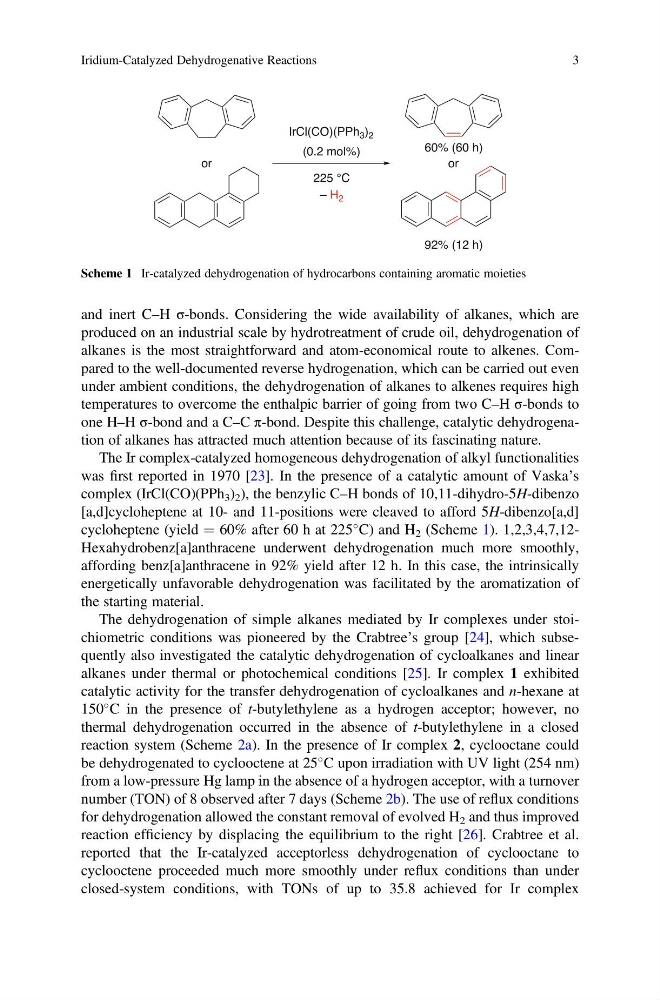
was first reported in 1970 [23]. In the presence of a catalytic amount of Vaska’s
complex (IrCl(CO)(PPh 3 ) 2 ), the benzylic C–H bonds of 10,11-dihydro-5H-dibenzo
[a,d]cycloheptene at 10- and 11-positions were cleaved to afford 5H-dibenzo[a,d]
cycloheptene (yield ¼ 60% after 60 h at 225
C) and H 2 (Scheme 1). 1,2,3,4,7,12Hexahydrobenz[a]anthracene underwent dehydrogenation much more smoothly,
affording benz[a]anthracene in 92% yield after 12 h. In this case, the intrinsically
energetically unfavorable dehydrogenation was facilitated by the aromatization of
the starting material.
The dehydrogenation of simple alkanes mediated by Ir complexes under stoichiometric conditions was pioneered by the Crabtree’s group [24], which subsequently also investigated the catalytic dehydrogenation of cycloalkanes and linear
alkanes under thermal or photochemical conditions [25]. Ir complex 1 exhibited
catalytic activity for the transfer dehydrogenation of cycloalkanes and n-hexane at
150
C in the presence of t-butylethylene as a hydrogen acceptor; however, no
thermal dehydrogenation occurred in the absence of t-butylethylene in a closed
reaction system (Scheme 2a). In the presence of Ir complex 2, cyclooctane could
be dehydrogenated to cyclooctene at 25
C upon irradiation with UV light (254 nm)
from a low-pressure Hg lamp in the absence of a hydrogen acceptor, with a turnover
number (TON) of 8 observed after 7 days (Scheme 2b). The use of reflux conditions
for dehydrogenation allowed the constant removal of evolved H 2 and thus improved
reaction efficiency by displacing the equilibrium to the right [26]. Crabtree et al.
reported that the Ir-catalyzed acceptorless dehydrogenation of cyclooctane to
cyclooctene proceeded much more smoothly under reflux conditions than under
closed-system conditions, with TONs of up to 35.8 achieved for Ir complex
Scheme 1 Ir-catalyzed dehydrogenation of hydrocarbons containing aromatic moieties
Iridium-Catalyzed Dehydrogenative Reactions
3
produced on an industrial scale by hydrotreatment of crude oil, dehydrogenation of
alkanes is the most straightforward and atom-economical route to alkenes. Compared to the well-documented reverse hydrogenation, which can be carried out even
under ambient conditions, the dehydrogenation of alkanes to alkenes requires high
temperatures to overcome the enthalpic barrier of going from two C–H σ-bonds to
one H–H σ-bond and a C–C π-bond. Despite this challenge, catalytic dehydrogenation of alkanes has attracted much attention because of its fascinating nature.
The Ir complex-catalyzed homogeneous dehydrogenation of alkyl functionalities
was first reported in 1970 [23]. In the presence of a catalytic amount of Vaska’s
complex (IrCl(CO)(PPh 3 ) 2 ), the benzylic C–H bonds of 10,11-dihydro-5H-dibenzo
[a,d]cycloheptene at 10- and 11-positions were cleaved to afford 5H-dibenzo[a,d]
cycloheptene (yield ¼ 60% after 60 h at 225
C) and H 2 (Scheme 1). 1,2,3,4,7,12Hexahydrobenz[a]anthracene underwent dehydrogenation much more smoothly,
affording benz[a]anthracene in 92% yield after 12 h. In this case, the intrinsically
energetically unfavorable dehydrogenation was facilitated by the aromatization of
the starting material.
The dehydrogenation of simple alkanes mediated by Ir complexes under stoichiometric conditions was pioneered by the Crabtree’s group [24], which subsequently also investigated the catalytic dehydrogenation of cycloalkanes and linear
alkanes under thermal or photochemical conditions [25]. Ir complex 1 exhibited
catalytic activity for the transfer dehydrogenation of cycloalkanes and n-hexane at
150
C in the presence of t-butylethylene as a hydrogen acceptor; however, no
thermal dehydrogenation occurred in the absence of t-butylethylene in a closed
reaction system (Scheme 2a). In the presence of Ir complex 2, cyclooctane could
be dehydrogenated to cyclooctene at 25
C upon irradiation with UV light (254 nm)
from a low-pressure Hg lamp in the absence of a hydrogen acceptor, with a turnover
number (TON) of 8 observed after 7 days (Scheme 2b). The use of reflux conditions
for dehydrogenation allowed the constant removal of evolved H 2 and thus improved
reaction efficiency by displacing the equilibrium to the right [26]. Crabtree et al.
reported that the Ir-catalyzed acceptorless dehydrogenation of cyclooctane to
cyclooctene proceeded much more smoothly under reflux conditions than under
closed-system conditions, with TONs of up to 35.8 achieved for Ir complex
Scheme 1 Ir-catalyzed dehydrogenation of hydrocarbons containing aromatic moieties
Iridium-Catalyzed Dehydrogenative Reactions
3