

(Scheme 78, cycle II), thus ruling out that this route could be operative under the
experimental conditions.
The TH of carbonyl compounds, imines and alkenes with a family of
triazolylidene iridium complexes (Scheme 79) has been studied by Pámies, Albrecht
and Diéguez [155]. A combination of isotope-labelling experiments, KIE measurements and Hammet parameter correlations reveals that the reaction takes place via a
monohydride route and that the turn-over limiting step is the hydride transfer from
the metal to the substrate.
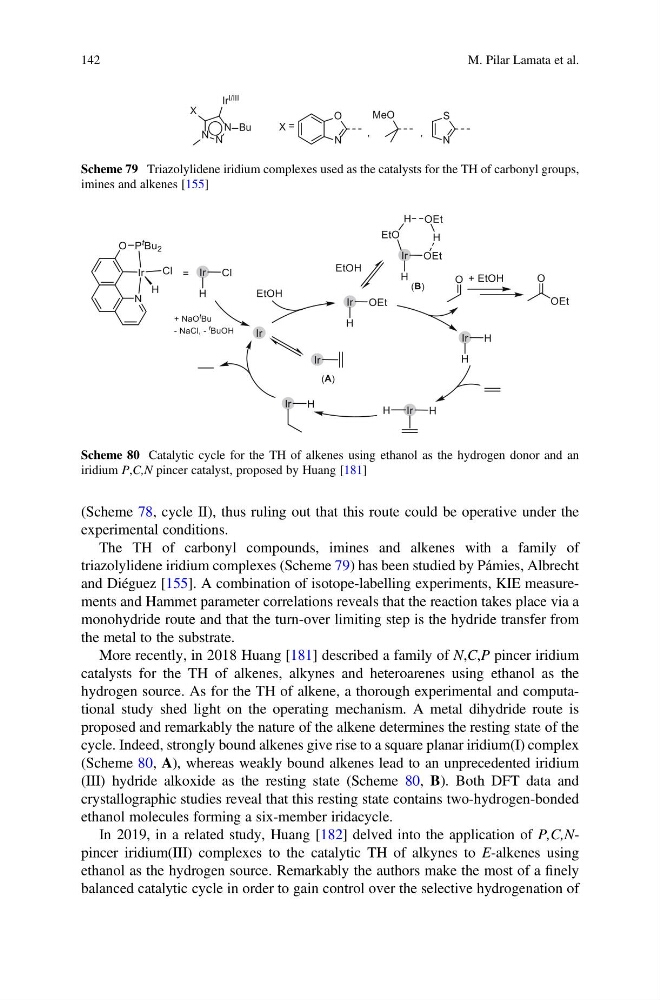
More recently, in 2018 Huang [181] described a family of N,C,P pincer iridium
catalysts for the TH of alkenes, alkynes and heteroarenes using ethanol as the
hydrogen source. As for the TH of alkene, a thorough experimental and computational study shed light on the operating mechanism. A metal dihydride route is
proposed and remarkably the nature of the alkene determines the resting state of the
cycle. Indeed, strongly bound alkenes give rise to a square planar iridium(I) complex
(Scheme 80, A), whereas weakly bound alkenes lead to an unprecedented iridium
(III) hydride alkoxide as the resting state (Scheme 80, B). Both DFT data and
crystallographic studies reveal that this resting state contains two-hydrogen-bonded
ethanol molecules forming a six-member iridacycle.
In 2019, in a related study, Huang [182] delved into the application of P,C,Npincer iridium(III) complexes to the catalytic TH of alkynes to E-alkenes using
ethanol as the hydrogen source. Remarkably the authors make the most of a finely
balanced catalytic cycle in order to gain control over the selective hydrogenation of
N N
N
X
Ir I/III
Bu
X =
N
O
MeO
N
S
,
,
Scheme 79 Triazolylidene iridium complexes used as the catalysts for the TH of carbonyl groups,
imines and alkenes [155]
Scheme 80 Catalytic cycle for the TH of alkenes using ethanol as the hydrogen donor and an
iridium P,C,N pincer catalyst, proposed by Huang [181]
142
M. Pilar Lamata et al.
experimental conditions.
The TH of carbonyl compounds, imines and alkenes with a family of
triazolylidene iridium complexes (Scheme 79) has been studied by Pámies, Albrecht
and Diéguez [155]. A combination of isotope-labelling experiments, KIE measurements and Hammet parameter correlations reveals that the reaction takes place via a
monohydride route and that the turn-over limiting step is the hydride transfer from
the metal to the substrate.
More recently, in 2018 Huang [181] described a family of N,C,P pincer iridium
catalysts for the TH of alkenes, alkynes and heteroarenes using ethanol as the
hydrogen source. As for the TH of alkene, a thorough experimental and computational study shed light on the operating mechanism. A metal dihydride route is
proposed and remarkably the nature of the alkene determines the resting state of the
cycle. Indeed, strongly bound alkenes give rise to a square planar iridium(I) complex
(Scheme 80, A), whereas weakly bound alkenes lead to an unprecedented iridium
(III) hydride alkoxide as the resting state (Scheme 80, B). Both DFT data and
crystallographic studies reveal that this resting state contains two-hydrogen-bonded
ethanol molecules forming a six-member iridacycle.
In 2019, in a related study, Huang [182] delved into the application of P,C,Npincer iridium(III) complexes to the catalytic TH of alkynes to E-alkenes using
ethanol as the hydrogen source. Remarkably the authors make the most of a finely
balanced catalytic cycle in order to gain control over the selective hydrogenation of
N N
N
X
Ir I/III
Bu
X =
N
O
MeO
N
S
,
,
Scheme 79 Triazolylidene iridium complexes used as the catalysts for the TH of carbonyl groups,
imines and alkenes [155]
Scheme 80 Catalytic cycle for the TH of alkenes using ethanol as the hydrogen donor and an
iridium P,C,N pincer catalyst, proposed by Huang [181]
142
M. Pilar Lamata et al.