

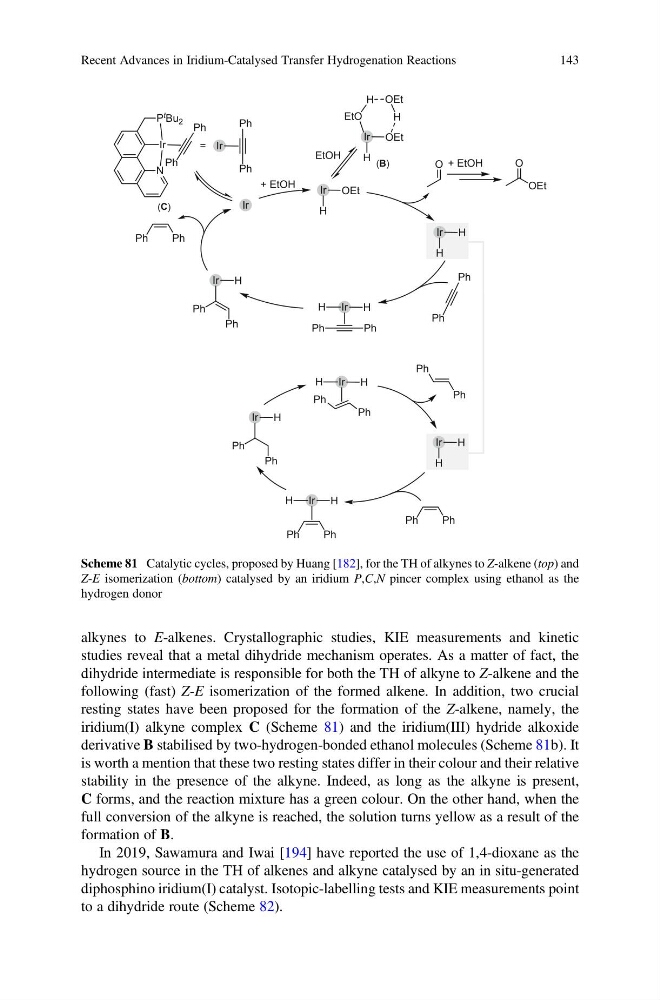
alkynes to E-alkenes. Crystallographic studies, KIE measurements and kinetic
studies reveal that a metal dihydride mechanism operates. As a matter of fact, the
dihydride intermediate is responsible for both the TH of alkyne to Z-alkene and the
following (fast) Z-E isomerization of the formed alkene. In addition, two crucial
resting states have been proposed for the formation of the Z-alkene, namely, the
iridium(I) alkyne complex C (Scheme 81) and the iridium(III) hydride alkoxide
derivative B stabilised by two-hydrogen-bonded ethanol molecules (Scheme 81b). It
is worth a mention that these two resting states differ in their colour and their relative
stability in the presence of the alkyne. Indeed, as long as the alkyne is present,
C forms, and the reaction mixture has a green colour. On the other hand, when the
full conversion of the alkyne is reached, the solution turns yellow as a result of the
formation of B.
In 2019, Sawamura and Iwai [194] have reported the use of 1,4-dioxane as the
hydrogen source in the TH of alkenes and alkyne catalysed by an in situ-generated
diphosphino iridium(I) catalyst. Isotopic-labelling tests and KIE measurements point
to a dihydride route (Scheme 82).
Ph
Ph
Ir OEt
H
N
Ir
P t Bu 2
=
Ir
Ir H
H
Ir H
H
Ir H
EtOH
O + EtOH
O
OEt
Ir
Ir OEt
H
H
OEt
H
EtO
+ EtOH
Ph
Ph
Ph
Ph
Ph
Ph
Ph
Ph
Ph
Ph
Ir H
H
Ph
Ph
Ir H
Ph
Ph
Ir H
H
Ir H
H
Ph
Ph
Ph
Ph
Ph
Ph
(C)
(B)
Scheme 81 Catalytic cycles, proposed by Huang [182], for the TH of alkynes to Z-alkene (top) and
Z-E isomerization (bottom) catalysed by an iridium P,C,N pincer complex using ethanol as the
hydrogen donor
Recent Advances in Iridium-Catalysed Transfer Hydrogenation Reactions
143
studies reveal that a metal dihydride mechanism operates. As a matter of fact, the
dihydride intermediate is responsible for both the TH of alkyne to Z-alkene and the
following (fast) Z-E isomerization of the formed alkene. In addition, two crucial
resting states have been proposed for the formation of the Z-alkene, namely, the
iridium(I) alkyne complex C (Scheme 81) and the iridium(III) hydride alkoxide
derivative B stabilised by two-hydrogen-bonded ethanol molecules (Scheme 81b). It
is worth a mention that these two resting states differ in their colour and their relative
stability in the presence of the alkyne. Indeed, as long as the alkyne is present,
C forms, and the reaction mixture has a green colour. On the other hand, when the
full conversion of the alkyne is reached, the solution turns yellow as a result of the
formation of B.
In 2019, Sawamura and Iwai [194] have reported the use of 1,4-dioxane as the
hydrogen source in the TH of alkenes and alkyne catalysed by an in situ-generated
diphosphino iridium(I) catalyst. Isotopic-labelling tests and KIE measurements point
to a dihydride route (Scheme 82).
Ph
Ph
Ir OEt
H
N
Ir
P t Bu 2
=
Ir
Ir H
H
Ir H
H
Ir H
EtOH
O + EtOH
O
OEt
Ir
Ir OEt
H
H
OEt
H
EtO
+ EtOH
Ph
Ph
Ph
Ph
Ph
Ph
Ph
Ph
Ph
Ph
Ir H
H
Ph
Ph
Ir H
Ph
Ph
Ir H
H
Ir H
H
Ph
Ph
Ph
Ph
Ph
Ph
(C)
(B)
Scheme 81 Catalytic cycles, proposed by Huang [182], for the TH of alkynes to Z-alkene (top) and
Z-E isomerization (bottom) catalysed by an iridium P,C,N pincer complex using ethanol as the
hydrogen donor
Recent Advances in Iridium-Catalysed Transfer Hydrogenation Reactions
143