

calculations nicely confirm that the activation barrier for the classical bifunctional
mechanism is higher than that calculated for the outer sphere hydrogen transfer from
the alkoxide moiety to the iminium ion (stabilised by a hydrogen-bonded phosphate
anion). In addition, the hydride route is discarded due to the significantly higher
barrier calculated for the formation of the hydride via either β-hydrogen elimination
in the alkoxide intermediate or transfer from the hydrogen source.
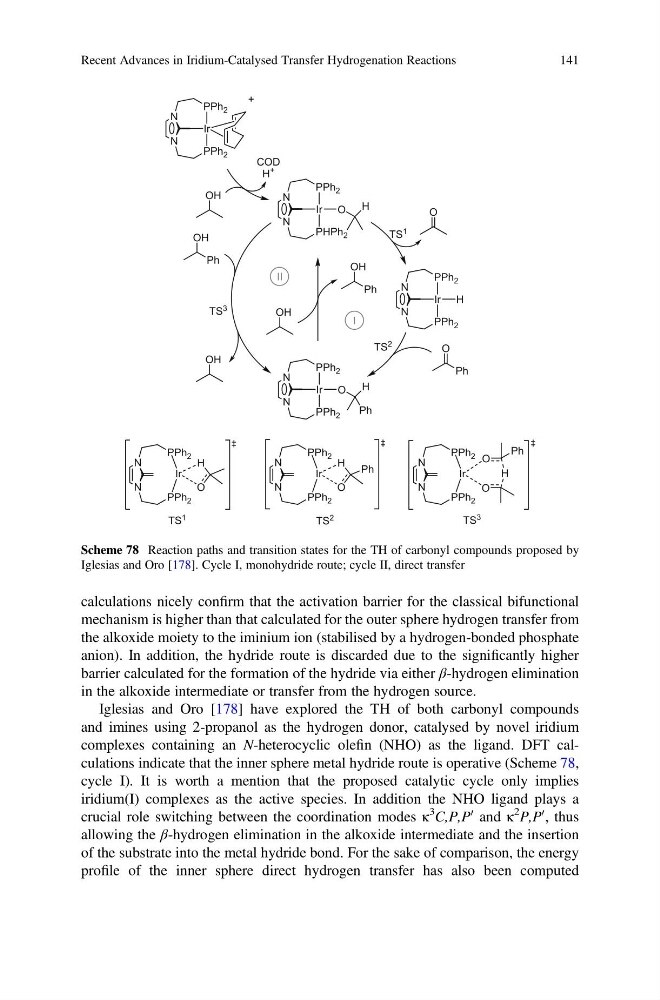
Iglesias and Oro [178] have explored the TH of both carbonyl compounds
and imines using 2-propanol as the hydrogen donor, catalysed by novel iridium
complexes containing an N-heterocyclic olefin (NHO) as the ligand. DFT calculations indicate that the inner sphere metal hydride route is operative (Scheme 78,
cycle I). It is worth a mention that the proposed catalytic cycle only implies
iridium(I) complexes as the active species. In addition the NHO ligand plays a
crucial role switching between the coordination modes κ
3 C,P,P
0 and κ
2 P,P
0 , thus
allowing the β-hydrogen elimination in the alkoxide intermediate and the insertion
of the substrate into the metal hydride bond. For the sake of comparison, the energy
profile of the inner sphere direct hydrogen transfer has also been computed
Ir O
PHPh 2
PPh 2
N
N
H
Ir H
PPh 2
PPh 2
N
N
Ir O
PPh 2
PPh 2
N
N
Ph
H
Ir
PPh 2
PPh 2
N
N
+
O
O
Ph
OH
OH
Ph
TS
1
TS 2
Ir
O
PPh 2
PPh 2
N
N
H
Ir
O
PPh 2
PPh 2
N
N
Ph
H
Ir
O
PPh 2
PPh 2
N
N
H
O
Ph
OH
Ph
TS 3
OH
I
II
OH
COD
H
+
TS 3
TS
1
TS
2
Scheme 78 Reaction paths and transition states for the TH of carbonyl compounds proposed by
Iglesias and Oro [178]. Cycle I, monohydride route; cycle II, direct transfer
Recent Advances in Iridium-Catalysed Transfer Hydrogenation Reactions
141
mechanism is higher than that calculated for the outer sphere hydrogen transfer from
the alkoxide moiety to the iminium ion (stabilised by a hydrogen-bonded phosphate
anion). In addition, the hydride route is discarded due to the significantly higher
barrier calculated for the formation of the hydride via either β-hydrogen elimination
in the alkoxide intermediate or transfer from the hydrogen source.
Iglesias and Oro [178] have explored the TH of both carbonyl compounds
and imines using 2-propanol as the hydrogen donor, catalysed by novel iridium
complexes containing an N-heterocyclic olefin (NHO) as the ligand. DFT calculations indicate that the inner sphere metal hydride route is operative (Scheme 78,
cycle I). It is worth a mention that the proposed catalytic cycle only implies
iridium(I) complexes as the active species. In addition the NHO ligand plays a
crucial role switching between the coordination modes κ
3 C,P,P
0 and κ
2 P,P
0 , thus
allowing the β-hydrogen elimination in the alkoxide intermediate and the insertion
of the substrate into the metal hydride bond. For the sake of comparison, the energy
profile of the inner sphere direct hydrogen transfer has also been computed
Ir O
PHPh 2
PPh 2
N
N
H
Ir H
PPh 2
PPh 2
N
N
Ir O
PPh 2
PPh 2
N
N
Ph
H
Ir
PPh 2
PPh 2
N
N
+
O
O
Ph
OH
OH
Ph
TS
1
TS 2
Ir
O
PPh 2
PPh 2
N
N
H
Ir
O
PPh 2
PPh 2
N
N
Ph
H
Ir
O
PPh 2
PPh 2
N
N
H
O
Ph
OH
Ph
TS 3
OH
I
II
OH
COD
H
+
TS 3
TS
1
TS
2
Scheme 78 Reaction paths and transition states for the TH of carbonyl compounds proposed by
Iglesias and Oro [178]. Cycle I, monohydride route; cycle II, direct transfer
Recent Advances in Iridium-Catalysed Transfer Hydrogenation Reactions
141