

formation of the two enantiomers, but there should exist different rate-limiting steps
for each one, namely, the slow dissociation of the S enantiomer, leading to a cero
order kinetics, and the slow hydride transfer when the R enantiomer forms, leading to
a first order kinetics. Nonetheless, Stirling does not rule out the possibility that two
different catalytic species could form, each one leading to a different enantiomer
with its own activity.
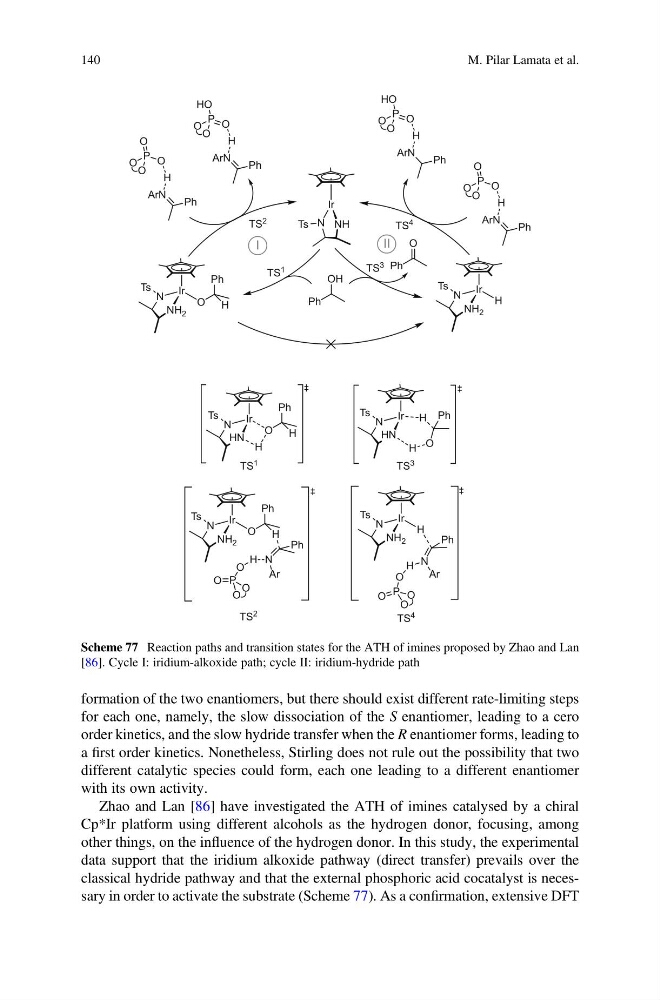
Zhao and Lan [86] have investigated the ATH of imines catalysed by a chiral
Cp*Ir platform using different alcohols as the hydrogen donor, focusing, among
other things, on the influence of the hydrogen donor. In this study, the experimental
data support that the iridium alkoxide pathway (direct transfer) prevails over the
classical hydride pathway and that the external phosphoric acid cocatalyst is necessary in order to activate the substrate (Scheme 77). As a confirmation, extensive DFT
Ir
NH 2
O
N
Ts
Ir
NH
N
Ts
H
Ph
Ir
NH 2
O
N
Ts
H
Ph
N
Ph
Ar
H
O
P
O
O
O
Ir
NH 2
H
N
Ts
N
Ph
Ar
H
O
P
O O
O
Ir
NH 2
H
N
Ts
O
Ph
ArN
Ph
H
O
P
O
O O
OH
Ph
ArN
Ph
H
O
P
HO
O O
ArN
Ph
H
O
P
O
O O
ArN
Ph
H
O
P
HO
O O
TS
1
TS 2
TS
4
TS 1
TS 3
Ir
HN
O
N
Ts
H
Ph
H
Ir
HN
H
N
Ts
H O
Ph
TS 3
TS 2
TS
4
I
II
Scheme 77 Reaction paths and transition states for the ATH of imines proposed by Zhao and Lan
[86]. Cycle I: iridium-alkoxide path; cycle II: iridium-hydride path
140
M. Pilar Lamata et al.
for each one, namely, the slow dissociation of the S enantiomer, leading to a cero
order kinetics, and the slow hydride transfer when the R enantiomer forms, leading to
a first order kinetics. Nonetheless, Stirling does not rule out the possibility that two
different catalytic species could form, each one leading to a different enantiomer
with its own activity.
Zhao and Lan [86] have investigated the ATH of imines catalysed by a chiral
Cp*Ir platform using different alcohols as the hydrogen donor, focusing, among
other things, on the influence of the hydrogen donor. In this study, the experimental
data support that the iridium alkoxide pathway (direct transfer) prevails over the
classical hydride pathway and that the external phosphoric acid cocatalyst is necessary in order to activate the substrate (Scheme 77). As a confirmation, extensive DFT
Ir
NH 2
O
N
Ts
Ir
NH
N
Ts
H
Ph
Ir
NH 2
O
N
Ts
H
Ph
N
Ph
Ar
H
O
P
O
O
O
Ir
NH 2
H
N
Ts
N
Ph
Ar
H
O
P
O O
O
Ir
NH 2
H
N
Ts
O
Ph
ArN
Ph
H
O
P
O
O O
OH
Ph
ArN
Ph
H
O
P
HO
O O
ArN
Ph
H
O
P
O
O O
ArN
Ph
H
O
P
HO
O O
TS
1
TS 2
TS
4
TS 1
TS 3
Ir
HN
O
N
Ts
H
Ph
H
Ir
HN
H
N
Ts
H O
Ph
TS 3
TS 2
TS
4
I
II
Scheme 77 Reaction paths and transition states for the ATH of imines proposed by Zhao and Lan
[86]. Cycle I: iridium-alkoxide path; cycle II: iridium-hydride path
140
M. Pilar Lamata et al.