

B6, B18, B21, B22, B28, and B47; methyl alkyl ketones B93–B95, B97, and B109
and naphthyl aldehyde were reduced. It was found that bimetallic complexes 77
were more active than monometallic complex 78. Yields higher than 90% within
15–30 min were obtained [193].
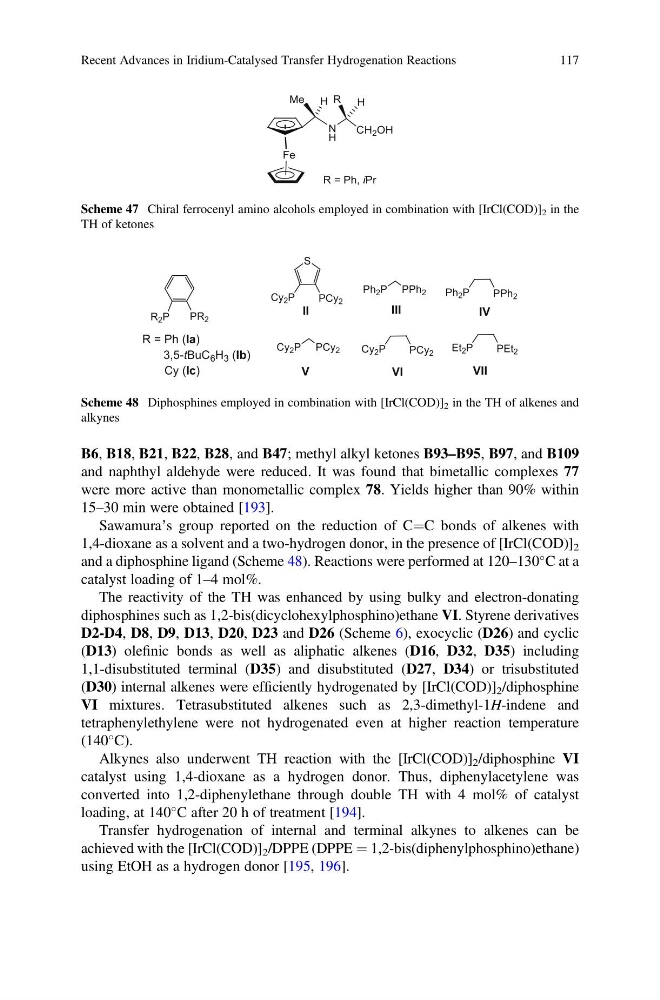
Sawamura’s group reported on the reduction of C¼C bonds of alkenes with
1,4-dioxane as a solvent and a two-hydrogen donor, in the presence of [IrCl(COD)] 2
and a diphosphine ligand (Scheme 48). Reactions were performed at 120–130
C at a
catalyst loading of 1–4 mol%.
The reactivity of the TH was enhanced by using bulky and electron-donating
diphosphines such as 1,2-bis(dicyclohexylphosphino)ethane VI. Styrene derivatives
D2-D4, D8, D9, D13, D20, D23 and D26 (Scheme 6), exocyclic (D26) and cyclic
(D13) olefinic bonds as well as aliphatic alkenes (D16, D32, D35) including
1,1-disubstituted terminal (D35) and disubstituted (D27, D34) or trisubstituted
(D30) internal alkenes were efficiently hydrogenated by [IrCl(COD)] 2 /diphosphine
VI mixtures. Tetrasubstituted alkenes such as 2,3-dimethyl-1H-indene and
tetraphenylethylene were not hydrogenated even at higher reaction temperature
(140
C).
Alkynes also underwent TH reaction with the [IrCl(COD)] 2 /diphosphine VI
catalyst using 1,4-dioxane as a hydrogen donor. Thus, diphenylacetylene was
converted into 1,2-diphenylethane through double TH with 4 mol% of catalyst
loading, at 140
C after 20 h of treatment [194].
Transfer hydrogenation of internal and terminal alkynes to alkenes can be
achieved with the [IrCl(COD)] 2 /DPPE (DPPE ¼ 1,2-bis(diphenylphosphino)ethane)
using EtOH as a hydrogen donor [195, 196].
N
H
CH 2 OH
Fe
Me H
H
R
R = Ph, iPr
Scheme 47 Chiral ferrocenyl amino alcohols employed in combination with [IrCl(COD)] 2 in the
TH of ketones
R 2 P
PR 2
S
PCy 2
Cy 2 P
R = Ph (Ia)
3,5-tBuC 6 H 3 (Ib)
Cy (Ic)
PPh 2
Ph 2 P
PPh 2
Ph 2 P
PCy 2
Cy 2 P
PCy 2
Cy 2 P
PEt 2
Et 2 P
II
III
IV
V
VI
VII
Scheme 48 Diphosphines employed in combination with [IrCl(COD)] 2 in the TH of alkenes and
alkynes
Recent Advances in Iridium-Catalysed Transfer Hydrogenation Reactions
117
and naphthyl aldehyde were reduced. It was found that bimetallic complexes 77
were more active than monometallic complex 78. Yields higher than 90% within
15–30 min were obtained [193].
Sawamura’s group reported on the reduction of C¼C bonds of alkenes with
1,4-dioxane as a solvent and a two-hydrogen donor, in the presence of [IrCl(COD)] 2
and a diphosphine ligand (Scheme 48). Reactions were performed at 120–130
C at a
catalyst loading of 1–4 mol%.
The reactivity of the TH was enhanced by using bulky and electron-donating
diphosphines such as 1,2-bis(dicyclohexylphosphino)ethane VI. Styrene derivatives
D2-D4, D8, D9, D13, D20, D23 and D26 (Scheme 6), exocyclic (D26) and cyclic
(D13) olefinic bonds as well as aliphatic alkenes (D16, D32, D35) including
1,1-disubstituted terminal (D35) and disubstituted (D27, D34) or trisubstituted
(D30) internal alkenes were efficiently hydrogenated by [IrCl(COD)] 2 /diphosphine
VI mixtures. Tetrasubstituted alkenes such as 2,3-dimethyl-1H-indene and
tetraphenylethylene were not hydrogenated even at higher reaction temperature
(140
C).
Alkynes also underwent TH reaction with the [IrCl(COD)] 2 /diphosphine VI
catalyst using 1,4-dioxane as a hydrogen donor. Thus, diphenylacetylene was
converted into 1,2-diphenylethane through double TH with 4 mol% of catalyst
loading, at 140
C after 20 h of treatment [194].
Transfer hydrogenation of internal and terminal alkynes to alkenes can be
achieved with the [IrCl(COD)] 2 /DPPE (DPPE ¼ 1,2-bis(diphenylphosphino)ethane)
using EtOH as a hydrogen donor [195, 196].
N
H
CH 2 OH
Fe
Me H
H
R
R = Ph, iPr
Scheme 47 Chiral ferrocenyl amino alcohols employed in combination with [IrCl(COD)] 2 in the
TH of ketones
R 2 P
PR 2
S
PCy 2
Cy 2 P
R = Ph (Ia)
3,5-tBuC 6 H 3 (Ib)
Cy (Ic)
PPh 2
Ph 2 P
PPh 2
Ph 2 P
PCy 2
Cy 2 P
PCy 2
Cy 2 P
PEt 2
Et 2 P
II
III
IV
V
VI
VII
Scheme 48 Diphosphines employed in combination with [IrCl(COD)] 2 in the TH of alkenes and
alkynes
Recent Advances in Iridium-Catalysed Transfer Hydrogenation Reactions
117