

Internal alkynes were reduced to E-alkenes in THF, at 120
C using 2.5 mol% of
[IrCl(COD)] 2 , 20 mol% of DPPE and 20 equiv. of EtOH. Under these conditions, a
variety of diaryl alkynes (D57, D61, D70-D74, D78, D100-D102, D104-D117,
D121, Scheme 6) were converted into E-alkenes in 73–92% yield, with E/Z molar
ratios from 4/1 to >99/1, within 22 h under N 2 atmosphere. Notably, the E/Z ratio
can be inverted in favour of the Z isomer working under the conditions above
indicated but adding to the reaction medium 2 equiv. of COD. Thus, yields between
71 and 95% with Z/E molar ratios from 4/1 to >99/1 were achieved in the TH of the
diaryl alkynes D57, D61, D67, D69, D78, D100, D101 D103-D105, D107, D109
and D118 (Scheme 6). The observed change in the alkene selectivity was attributed
to the increase of the steric hindrance at the metal centre generated by the addition of
the diolefin [195].
Under comparable conditions (THF, 70
C, 2.5 mol% of [IrCl(COD)] 2 , 20 mol%
of DPPE, 2 equiv. of EtOH) terminal alkynes were reduced to alkenes [196]. A series
of activated (D130-D155) and unactivated (D156-D159) terminal alkynes were
reduced in 67–94% yield within 24 or 48 h, respectively. The reaction of the
nonactivated alkynes was carried out at 100
C.
6 Transfer Hydrogenation of α,β-Unsaturated (and
Non-conjugated) Alkene-Carbonyl Substrates
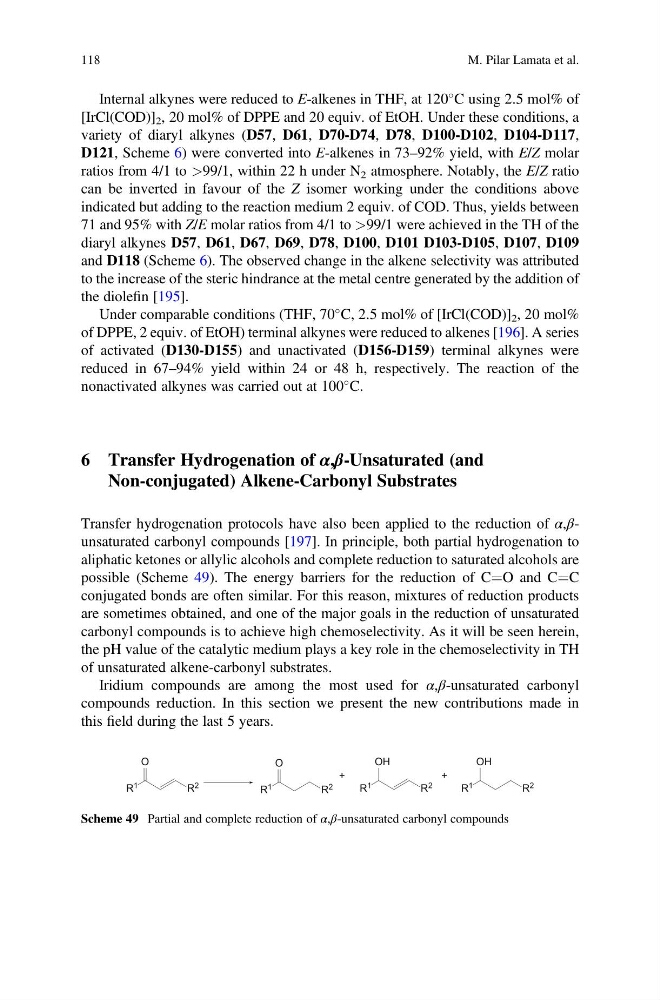
Transfer hydrogenation protocols have also been applied to the reduction of α,βunsaturated carbonyl compounds [197]. In principle, both partial hydrogenation to
aliphatic ketones or allylic alcohols and complete reduction to saturated alcohols are
possible (Scheme 49). The energy barriers for the reduction of C¼O and C¼C
conjugated bonds are often similar. For this reason, mixtures of reduction products
are sometimes obtained, and one of the major goals in the reduction of unsaturated
carbonyl compounds is to achieve high chemoselectivity. As it will be seen herein,
the pH value of the catalytic medium plays a key role in the chemoselectivity in TH
of unsaturated alkene-carbonyl substrates.
Iridium compounds are among the most used for α,β-unsaturated carbonyl
compounds reduction. In this section we present the new contributions made in
this field during the last 5 years.
R 1
R 2
O
R 1
R 2
O
R 1
R 2
OH
R 1
R 2
OH
+
+
Scheme 49 Partial and complete reduction of α,β-unsaturated carbonyl compounds
118
M. Pilar Lamata et al.
C using 2.5 mol% of
[IrCl(COD)] 2 , 20 mol% of DPPE and 20 equiv. of EtOH. Under these conditions, a
variety of diaryl alkynes (D57, D61, D70-D74, D78, D100-D102, D104-D117,
D121, Scheme 6) were converted into E-alkenes in 73–92% yield, with E/Z molar
ratios from 4/1 to >99/1, within 22 h under N 2 atmosphere. Notably, the E/Z ratio
can be inverted in favour of the Z isomer working under the conditions above
indicated but adding to the reaction medium 2 equiv. of COD. Thus, yields between
71 and 95% with Z/E molar ratios from 4/1 to >99/1 were achieved in the TH of the
diaryl alkynes D57, D61, D67, D69, D78, D100, D101 D103-D105, D107, D109
and D118 (Scheme 6). The observed change in the alkene selectivity was attributed
to the increase of the steric hindrance at the metal centre generated by the addition of
the diolefin [195].
Under comparable conditions (THF, 70
C, 2.5 mol% of [IrCl(COD)] 2 , 20 mol%
of DPPE, 2 equiv. of EtOH) terminal alkynes were reduced to alkenes [196]. A series
of activated (D130-D155) and unactivated (D156-D159) terminal alkynes were
reduced in 67–94% yield within 24 or 48 h, respectively. The reaction of the
nonactivated alkynes was carried out at 100
C.
6 Transfer Hydrogenation of α,β-Unsaturated (and
Non-conjugated) Alkene-Carbonyl Substrates
Transfer hydrogenation protocols have also been applied to the reduction of α,βunsaturated carbonyl compounds [197]. In principle, both partial hydrogenation to
aliphatic ketones or allylic alcohols and complete reduction to saturated alcohols are
possible (Scheme 49). The energy barriers for the reduction of C¼O and C¼C
conjugated bonds are often similar. For this reason, mixtures of reduction products
are sometimes obtained, and one of the major goals in the reduction of unsaturated
carbonyl compounds is to achieve high chemoselectivity. As it will be seen herein,
the pH value of the catalytic medium plays a key role in the chemoselectivity in TH
of unsaturated alkene-carbonyl substrates.
Iridium compounds are among the most used for α,β-unsaturated carbonyl
compounds reduction. In this section we present the new contributions made in
this field during the last 5 years.
R 1
R 2
O
R 1
R 2
O
R 1
R 2
OH
R 1
R 2
OH
+
+
Scheme 49 Partial and complete reduction of α,β-unsaturated carbonyl compounds
118
M. Pilar Lamata et al.