

wide range of ketones were hydrogenated. Generally, yields greater than 90% with e.
r.’s > 98/2 were achieved, within 8–36 h [188].
Acetophenones with electro-donating or electro-withdrawing groups (B1, B2,
B15, B18, B21, B29, B34, Scheme 4), aromatic ketones containing a naphthyl
moiety (B37) heteroaromatic ring (B41-B46), larger aliphatic groups (B47-B49) or
an additional ester functionality (B62) as well as a cyclic ketone B121 provided both
high yield and good e.r. Diaryl ketones B68 and B69 also afforded satisfactory
results. Dialkyl ketones B107 and B110 gave the corresponding alcohol in high yield
(> 90%) but with low e.r. (< 30%). However, ketone B111 with a bulky alkyl
substituent gave the desired alcohol with 93% yield and 97/3 e.r. The catalytic
system also works at a lower catalyst loading. Thus, 2-acetyl benzothiophene was
completely reduced to the corresponding alcohol within 108 h at a catalyst loading as
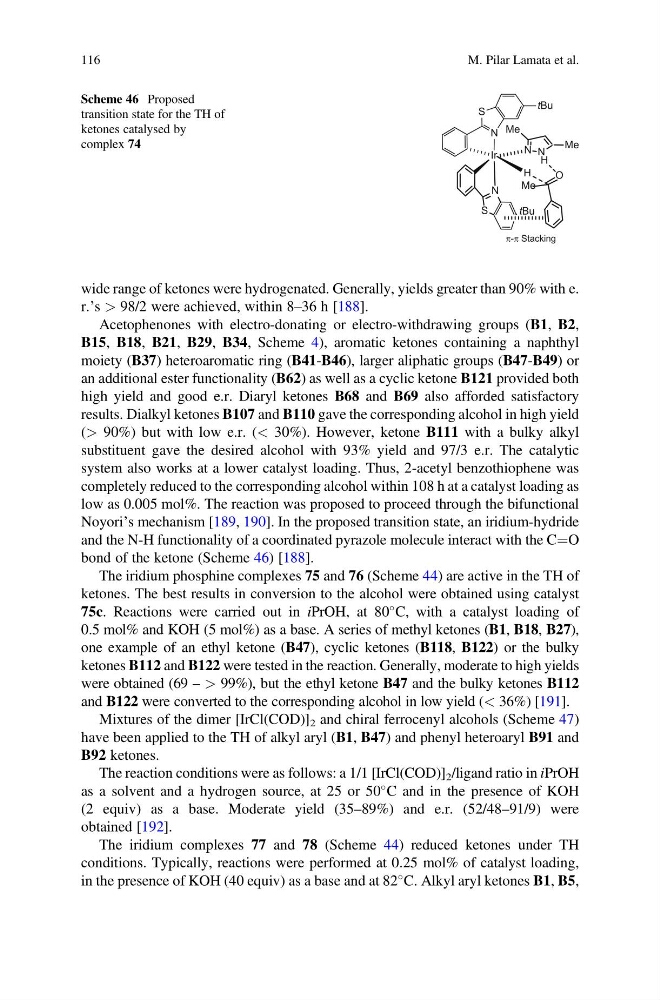
low as 0.005 mol%. The reaction was proposed to proceed through the bifunctional
Noyori’s mechanism [189, 190]. In the proposed transition state, an iridium-hydride
and the N-H functionality of a coordinated pyrazole molecule interact with the C¼O
bond of the ketone (Scheme 46) [188].
The iridium phosphine complexes 75 and 76 (Scheme 44) are active in the TH of
ketones. The best results in conversion to the alcohol were obtained using catalyst
75c. Reactions were carried out in iPrOH, at 80
C, with a catalyst loading of
0.5 mol% and KOH (5 mol%) as a base. A series of methyl ketones (B1, B18, B27),
one example of an ethyl ketone (B47), cyclic ketones (B118, B122) or the bulky
ketones B112 and B122 were tested in the reaction. Generally, moderate to high yields
were obtained (69 – > 99%), but the ethyl ketone B47 and the bulky ketones B112
and B122 were converted to the corresponding alcohol in low yield (< 36%) [191].
Mixtures of the dimer [IrCl(COD)] 2 and chiral ferrocenyl alcohols (Scheme 47)
have been applied to the TH of alkyl aryl (B1, B47) and phenyl heteroaryl B91 and
B92 ketones.
The reaction conditions were as follows: a 1/1 [IrCl(COD)] 2 /ligand ratio in iPrOH
as a solvent and a hydrogen source, at 25 or 50
C and in the presence of KOH
(2 equiv) as a base. Moderate yield (35–89%) and e.r. (52/48–91/9) were
obtained [192].
The iridium complexes 77 and 78 (Scheme 44) reduced ketones under TH
conditions. Typically, reactions were performed at 0.25 mol% of catalyst loading,
in the presence of KOH (40 equiv) as a base and at 82
C. Alkyl aryl ketones B1, B5,
Ir
N
S
tBu
S
N
tBu
O
Me
N N
H
H
Me
- Stacking
Me
Scheme 46 Proposed
transition state for the TH of
ketones catalysed by
complex 74
116
M. Pilar Lamata et al.
r.’s > 98/2 were achieved, within 8–36 h [188].
Acetophenones with electro-donating or electro-withdrawing groups (B1, B2,
B15, B18, B21, B29, B34, Scheme 4), aromatic ketones containing a naphthyl
moiety (B37) heteroaromatic ring (B41-B46), larger aliphatic groups (B47-B49) or
an additional ester functionality (B62) as well as a cyclic ketone B121 provided both
high yield and good e.r. Diaryl ketones B68 and B69 also afforded satisfactory
results. Dialkyl ketones B107 and B110 gave the corresponding alcohol in high yield
(> 90%) but with low e.r. (< 30%). However, ketone B111 with a bulky alkyl
substituent gave the desired alcohol with 93% yield and 97/3 e.r. The catalytic
system also works at a lower catalyst loading. Thus, 2-acetyl benzothiophene was
completely reduced to the corresponding alcohol within 108 h at a catalyst loading as
low as 0.005 mol%. The reaction was proposed to proceed through the bifunctional
Noyori’s mechanism [189, 190]. In the proposed transition state, an iridium-hydride
and the N-H functionality of a coordinated pyrazole molecule interact with the C¼O
bond of the ketone (Scheme 46) [188].
The iridium phosphine complexes 75 and 76 (Scheme 44) are active in the TH of
ketones. The best results in conversion to the alcohol were obtained using catalyst
75c. Reactions were carried out in iPrOH, at 80
C, with a catalyst loading of
0.5 mol% and KOH (5 mol%) as a base. A series of methyl ketones (B1, B18, B27),
one example of an ethyl ketone (B47), cyclic ketones (B118, B122) or the bulky
ketones B112 and B122 were tested in the reaction. Generally, moderate to high yields
were obtained (69 – > 99%), but the ethyl ketone B47 and the bulky ketones B112
and B122 were converted to the corresponding alcohol in low yield (< 36%) [191].
Mixtures of the dimer [IrCl(COD)] 2 and chiral ferrocenyl alcohols (Scheme 47)
have been applied to the TH of alkyl aryl (B1, B47) and phenyl heteroaryl B91 and
B92 ketones.
The reaction conditions were as follows: a 1/1 [IrCl(COD)] 2 /ligand ratio in iPrOH
as a solvent and a hydrogen source, at 25 or 50
C and in the presence of KOH
(2 equiv) as a base. Moderate yield (35–89%) and e.r. (52/48–91/9) were
obtained [192].
The iridium complexes 77 and 78 (Scheme 44) reduced ketones under TH
conditions. Typically, reactions were performed at 0.25 mol% of catalyst loading,
in the presence of KOH (40 equiv) as a base and at 82
C. Alkyl aryl ketones B1, B5,
Ir
N
S
tBu
S
N
tBu
O
Me
N N
H
H
Me
- Stacking
Me
Scheme 46 Proposed
transition state for the TH of
ketones catalysed by
complex 74
116
M. Pilar Lamata et al.