

B15, B18, B23, B47, B52, B66, B118) including heterocyclic ketones (B38-B42,
B45) were reduced in high yield (81–99%) with TOFs in the 260–1,800 h
À1 range,
measured after 5 min of reaction. As usual, conversion increases both when the steric
demand decreases and when the electro-withdrawing character of ketone substituents increases.
Several aldehydes (A1, A3, A12, A17, A24, A32, A64, A68) were also reduced
by catalyst 63 under the same reaction conditions. The activity follows the same
trend as that observed for the reduction of ketones, although, in general, when using
complex 63, aldehydes are reduced significantly faster than ketones.
Complex 63 was also applied to the TH of the imines N-benzylideneaniline and
N-2-methyl benzylideneaniline, under the optimised reaction conditions above indicated. The TOF (770 h
À1
) measured for the aldimine was significantly greater than
that observed for the ketimine (30 h
À1 ), which was rationalised in terms of the higher
steric demand of the ketimine.
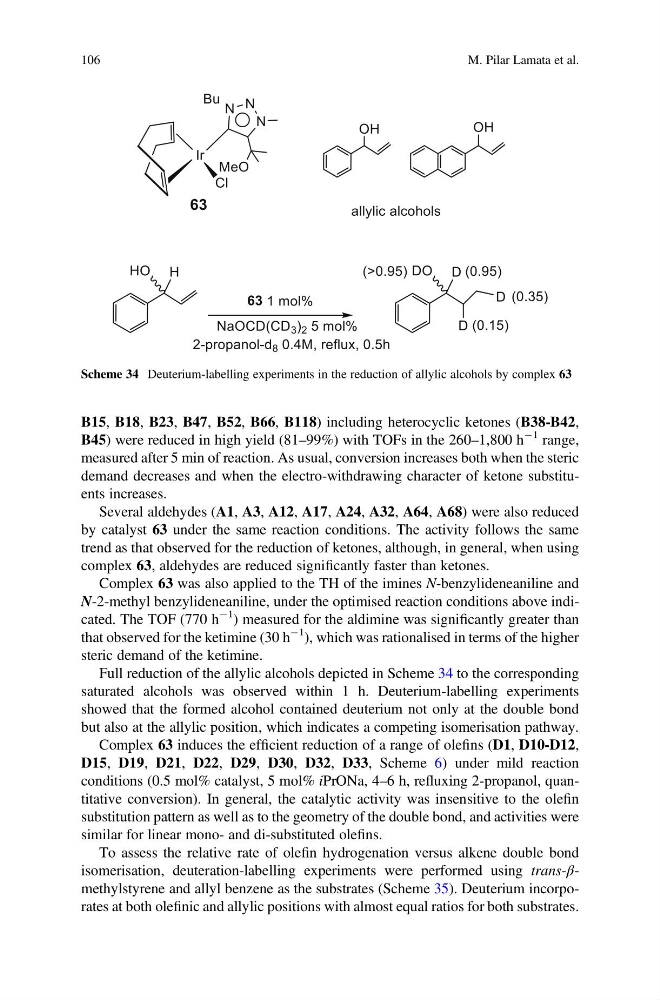
Full reduction of the allylic alcohols depicted in Scheme 34 to the corresponding
saturated alcohols was observed within 1 h. Deuterium-labelling experiments
showed that the formed alcohol contained deuterium not only at the double bond
but also at the allylic position, which indicates a competing isomerisation pathway.
Complex 63 induces the efficient reduction of a range of olefins (D1, D10-D12,
D15, D19, D21, D22, D29, D30, D32, D33, Scheme 6) under mild reaction
conditions (0.5 mol% catalyst, 5 mol% iPrONa, 4–6 h, refluxing 2-propanol, quantitative conversion). In general, the catalytic activity was insensitive to the olefin
substitution pattern as well as to the geometry of the double bond, and activities were
similar for linear mono- and di-substituted olefins.
To assess the relative rate of olefin hydrogenation versus alkene double bond
isomerisation, deuteration-labelling experiments were performed using trans-βmethylstyrene and allyl benzene as the substrates (Scheme 35). Deuterium incorporates at both olefinic and allylic positions with almost equal ratios for both substrates.
Scheme 34 Deuterium-labelling experiments in the reduction of allylic alcohols by complex 63
106
M. Pilar Lamata et al.
B45) were reduced in high yield (81–99%) with TOFs in the 260–1,800 h
À1 range,
measured after 5 min of reaction. As usual, conversion increases both when the steric
demand decreases and when the electro-withdrawing character of ketone substituents increases.
Several aldehydes (A1, A3, A12, A17, A24, A32, A64, A68) were also reduced
by catalyst 63 under the same reaction conditions. The activity follows the same
trend as that observed for the reduction of ketones, although, in general, when using
complex 63, aldehydes are reduced significantly faster than ketones.
Complex 63 was also applied to the TH of the imines N-benzylideneaniline and
N-2-methyl benzylideneaniline, under the optimised reaction conditions above indicated. The TOF (770 h
À1
) measured for the aldimine was significantly greater than
that observed for the ketimine (30 h
À1 ), which was rationalised in terms of the higher
steric demand of the ketimine.
Full reduction of the allylic alcohols depicted in Scheme 34 to the corresponding
saturated alcohols was observed within 1 h. Deuterium-labelling experiments
showed that the formed alcohol contained deuterium not only at the double bond
but also at the allylic position, which indicates a competing isomerisation pathway.
Complex 63 induces the efficient reduction of a range of olefins (D1, D10-D12,
D15, D19, D21, D22, D29, D30, D32, D33, Scheme 6) under mild reaction
conditions (0.5 mol% catalyst, 5 mol% iPrONa, 4–6 h, refluxing 2-propanol, quantitative conversion). In general, the catalytic activity was insensitive to the olefin
substitution pattern as well as to the geometry of the double bond, and activities were
similar for linear mono- and di-substituted olefins.
To assess the relative rate of olefin hydrogenation versus alkene double bond
isomerisation, deuteration-labelling experiments were performed using trans-βmethylstyrene and allyl benzene as the substrates (Scheme 35). Deuterium incorporates at both olefinic and allylic positions with almost equal ratios for both substrates.
Scheme 34 Deuterium-labelling experiments in the reduction of allylic alcohols by complex 63
106
M. Pilar Lamata et al.