

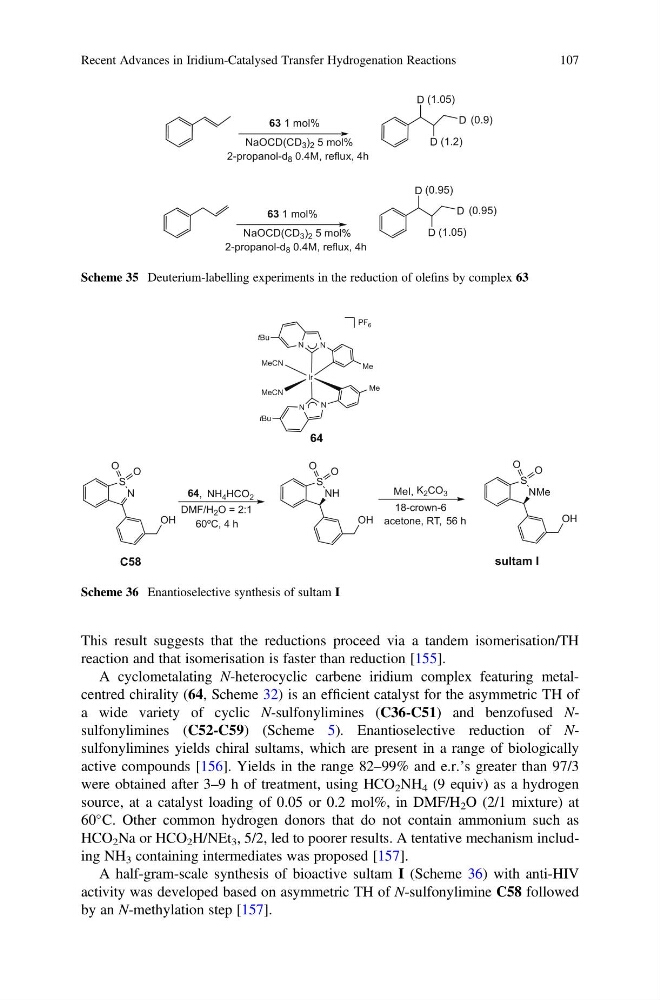
This result suggests that the reductions proceed via a tandem isomerisation/TH
reaction and that isomerisation is faster than reduction [155].
A cyclometalating N-heterocyclic carbene iridium complex featuring metalcentred chirality (64, Scheme 32) is an efficient catalyst for the asymmetric TH of
a wide variety of cyclic N-sulfonylimines (C36-C51) and benzofused Nsulfonylimines (C52-C59) (Scheme 5). Enantioselective reduction of Nsulfonylimines yields chiral sultams, which are present in a range of biologically
active compounds [156]. Yields in the range 82–99% and e.r.’s greater than 97/3
were obtained after 3–9 h of treatment, using HCO 2 NH 4 (9 equiv) as a hydrogen
source, at a catalyst loading of 0.05 or 0.2 mol%, in DMF/H 2 O (2/1 mixture) at
60
C. Other common hydrogen donors that do not contain ammonium such as
HCO 2 Na or HCO 2 H/NEt 3 , 5/2, led to poorer results. A tentative mechanism including NH 3 containing intermediates was proposed [157].
A half-gram-scale synthesis of bioactive sultam I (Scheme 36) with anti-HIV
activity was developed based on asymmetric TH of N-sulfonylimine C58 followed
by an N-methylation step [157].
NaOCD(CD 3 ) 2 5 mol%
63 1 mol%
D
2-propanol-d 8 0.4M, reflux, 4h
D
D
(1.05)
(0.9)
(1.2)
NaOCD(CD 3 ) 2 5 mol%
63 1 mol%
D
2-propanol-d 8 0.4M, reflux, 4h
D
D
(0.95)
(0.95)
(1.05)
Scheme 35 Deuterium-labelling experiments in the reduction of olefins by complex 63
DMF/H 2 O = 2:1
NH 4 HCO 2
60ºC, 4 h
MeCN
MeCN
PF 6
Ir
N
N
Me
tBu
N
N
Me
tBu
64
N
S
O O
OH
NH
S
O O
OH
NMe
S
O O
OH
18-crown-6
MeI, K 2 CO 3
acetone, RT, 56 h
64,
C58
sultam I
Scheme 36 Enantioselective synthesis of sultam I
Recent Advances in Iridium-Catalysed Transfer Hydrogenation Reactions
107
reaction and that isomerisation is faster than reduction [155].
A cyclometalating N-heterocyclic carbene iridium complex featuring metalcentred chirality (64, Scheme 32) is an efficient catalyst for the asymmetric TH of
a wide variety of cyclic N-sulfonylimines (C36-C51) and benzofused Nsulfonylimines (C52-C59) (Scheme 5). Enantioselective reduction of Nsulfonylimines yields chiral sultams, which are present in a range of biologically
active compounds [156]. Yields in the range 82–99% and e.r.’s greater than 97/3
were obtained after 3–9 h of treatment, using HCO 2 NH 4 (9 equiv) as a hydrogen
source, at a catalyst loading of 0.05 or 0.2 mol%, in DMF/H 2 O (2/1 mixture) at
60
C. Other common hydrogen donors that do not contain ammonium such as
HCO 2 Na or HCO 2 H/NEt 3 , 5/2, led to poorer results. A tentative mechanism including NH 3 containing intermediates was proposed [157].
A half-gram-scale synthesis of bioactive sultam I (Scheme 36) with anti-HIV
activity was developed based on asymmetric TH of N-sulfonylimine C58 followed
by an N-methylation step [157].
NaOCD(CD 3 ) 2 5 mol%
63 1 mol%
D
2-propanol-d 8 0.4M, reflux, 4h
D
D
(1.05)
(0.9)
(1.2)
NaOCD(CD 3 ) 2 5 mol%
63 1 mol%
D
2-propanol-d 8 0.4M, reflux, 4h
D
D
(0.95)
(0.95)
(1.05)
Scheme 35 Deuterium-labelling experiments in the reduction of olefins by complex 63
DMF/H 2 O = 2:1
NH 4 HCO 2
60ºC, 4 h
MeCN
MeCN
PF 6
Ir
N
N
Me
tBu
N
N
Me
tBu
64
N
S
O O
OH
NH
S
O O
OH
NMe
S
O O
OH
18-crown-6
MeI, K 2 CO 3
acetone, RT, 56 h
64,
C58
sultam I
Scheme 36 Enantioselective synthesis of sultam I
Recent Advances in Iridium-Catalysed Transfer Hydrogenation Reactions
107