

[143–146] and A549 [144–146] cancer cells. The increase of ROS appears to
contribute to the anticancer activity.
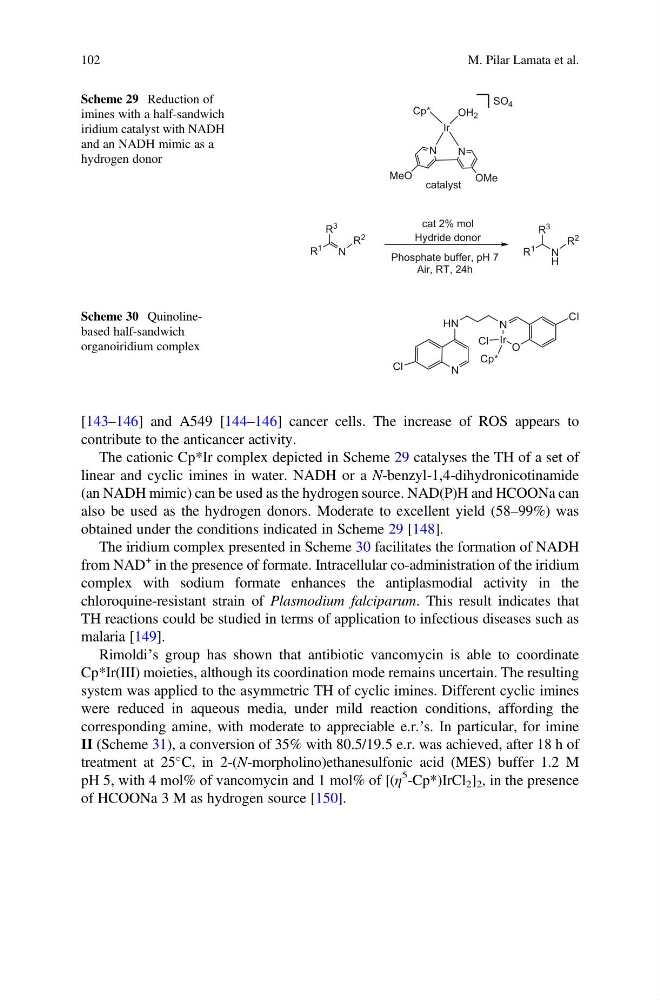
The cationic Cp*Ir complex depicted in Scheme 29 catalyses the TH of a set of
linear and cyclic imines in water. NADH or a N-benzyl-1,4-dihydronicotinamide
(an NADH mimic) can be used as the hydrogen source. NAD(P)H and HCOONa can
also be used as the hydrogen donors. Moderate to excellent yield (58–99%) was
obtained under the conditions indicated in Scheme 29 [148].
The iridium complex presented in Scheme 30 facilitates the formation of NADH
from NAD
+ in the presence of formate. Intracellular co-administration of the iridium
complex with sodium formate enhances the antiplasmodial activity in the
chloroquine-resistant strain of Plasmodium falciparum. This result indicates that
TH reactions could be studied in terms of application to infectious diseases such as
malaria [149].
Rimoldi’s group has shown that antibiotic vancomycin is able to coordinate
Cp*Ir(III) moieties, although its coordination mode remains uncertain. The resulting
system was applied to the asymmetric TH of cyclic imines. Different cyclic imines
were reduced in aqueous media, under mild reaction conditions, affording the
corresponding amine, with moderate to appreciable e.r.’s. In particular, for imine
II (Scheme 31), a conversion of 35% with 80.5/19.5 e.r. was achieved, after 18 h of
treatment at 25
C, in 2-(N-morpholino)ethanesulfonic acid (MES) buffer 1.2 M
pH 5, with 4 mol% of vancomycin and 1 mol% of [(η
5 -Cp*)IrCl 2 ] 2 , in the presence
of HCOONa 3 M as hydrogen source [150].
R
3
R
1
N
R
2
OH 2
Ir
N
cat 2% mol
Phosphate buffer, pH 7
Air, RT, 24h
R
3
R
1
N
H
R
2
Hydride donor
Cp*
MeO
N
OMe
SO 4
catalyst
Scheme 29 Reduction of
imines with a half-sandwich
iridium catalyst with NADH
and an NADH mimic as a
hydrogen donor
N
Cl
HN
N
Ir O
Cl
Cp*
Cl
Scheme 30 Quinolinebased half-sandwich
organoiridium complex
102
M. Pilar Lamata et al.
contribute to the anticancer activity.
The cationic Cp*Ir complex depicted in Scheme 29 catalyses the TH of a set of
linear and cyclic imines in water. NADH or a N-benzyl-1,4-dihydronicotinamide
(an NADH mimic) can be used as the hydrogen source. NAD(P)H and HCOONa can
also be used as the hydrogen donors. Moderate to excellent yield (58–99%) was
obtained under the conditions indicated in Scheme 29 [148].
The iridium complex presented in Scheme 30 facilitates the formation of NADH
from NAD
+ in the presence of formate. Intracellular co-administration of the iridium
complex with sodium formate enhances the antiplasmodial activity in the
chloroquine-resistant strain of Plasmodium falciparum. This result indicates that
TH reactions could be studied in terms of application to infectious diseases such as
malaria [149].
Rimoldi’s group has shown that antibiotic vancomycin is able to coordinate
Cp*Ir(III) moieties, although its coordination mode remains uncertain. The resulting
system was applied to the asymmetric TH of cyclic imines. Different cyclic imines
were reduced in aqueous media, under mild reaction conditions, affording the
corresponding amine, with moderate to appreciable e.r.’s. In particular, for imine
II (Scheme 31), a conversion of 35% with 80.5/19.5 e.r. was achieved, after 18 h of
treatment at 25
C, in 2-(N-morpholino)ethanesulfonic acid (MES) buffer 1.2 M
pH 5, with 4 mol% of vancomycin and 1 mol% of [(η
5 -Cp*)IrCl 2 ] 2 , in the presence
of HCOONa 3 M as hydrogen source [150].
R
3
R
1
N
R
2
OH 2
Ir
N
cat 2% mol
Phosphate buffer, pH 7
Air, RT, 24h
R
3
R
1
N
H
R
2
Hydride donor
Cp*
MeO
N
OMe
SO 4
catalyst
Scheme 29 Reduction of
imines with a half-sandwich
iridium catalyst with NADH
and an NADH mimic as a
hydrogen donor
N
Cl
HN
N
Ir O
Cl
Cp*
Cl
Scheme 30 Quinolinebased half-sandwich
organoiridium complex
102
M. Pilar Lamata et al.