

3 Carbene Iridium Complexes
The use of N-heterocyclic carbenes as ancillary ligands in catalysis and, in particular,
in TH has experienced a remarkable increase in the last years. In this section we will
discuss the contributions of the last 5 years in iridium complexes containing carbene
ligands that have been applied as TH catalysts. Note that the half-sandwich iridium
complexes bearing carbene ligands have been considered in Sect. 2.
Crabtree’s group explored the application of the iridium bis(N-heterocyclic
carbene) complexes 58 and 59 (Scheme 32) to the TH of ketones and imines using
MeOH as a hydrogen source.
The best results were achieved with catalyst 59a. Several aromatic ketones were
reduced using 5 mol% of 59a and 1–5 equiv. of KOH versus substrate. Reactions
were carried out under microwave irradiation (120
C) because this mode of heating
greatly improved yields compared to conventional heating at the same temperature.
Acetophenones (B1, B18, B23) gave generally poorer yields (28–70%, 5 h reaction)
than benzophenones (B66, B71, B72, 61 – >95%, 5 h) due to competing methylation of the α-CH 3 group [151].
Under the same reaction conditions, several imines were reduced using complex
59a as the catalyst precursor. N-benzylideneaniline was reduced to the
corresponding amine (> 95% yield); however, imines with R
2
6 ¼ Ph (Scheme 33)
underwent both reduction and N-methylation. When R
1
¼ H, a double methylation
at nitrogen was also observed [151].
N
Buffer
HCOONa 3M, RT, 18 h
N
H
[(
5 -Cp*)IrCl 2 ] 2 /Vancomycin
II
N
N
MeO
MeO
N
S
O O
II
I
III
O
O
H
N
NH 2
H
N
N
H
HN
O
O
O
HO
H
N
NH
O
O
Cl
O
O
OH
H 2 N
HO
HO
Cl
O
O
O
N
H
O
O
OH
OH
HO
OH
OH
OH
Vancomycin
Cyclic imines
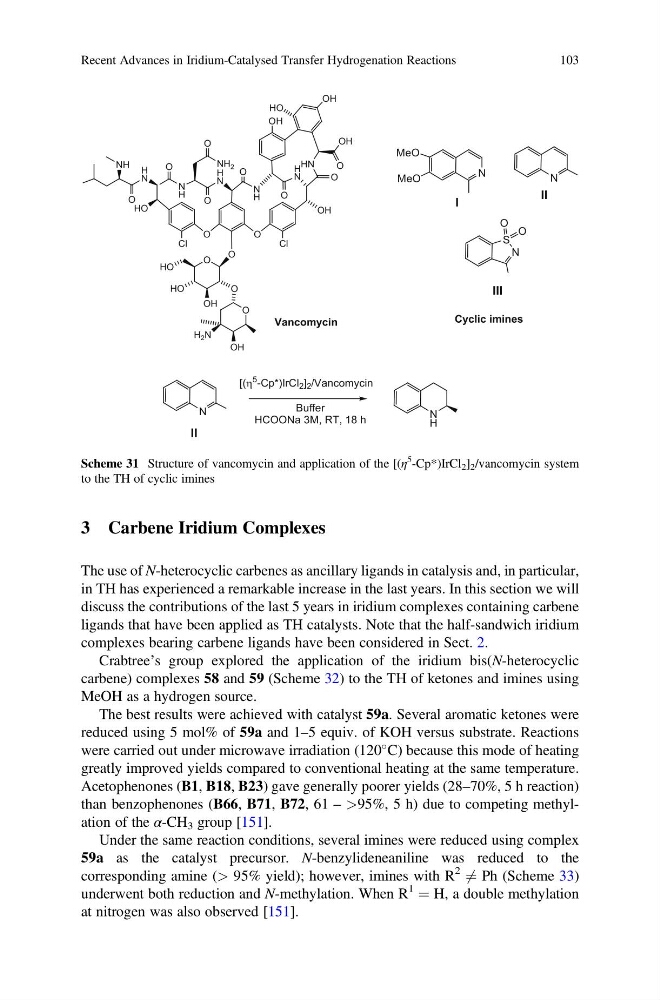
Scheme 31 Structure of vancomycin and application of the [(η
5
-Cp*)IrCl 2 ] 2 /vancomycin system
to the TH of cyclic imines
Recent Advances in Iridium-Catalysed Transfer Hydrogenation Reactions
103
The use of N-heterocyclic carbenes as ancillary ligands in catalysis and, in particular,
in TH has experienced a remarkable increase in the last years. In this section we will
discuss the contributions of the last 5 years in iridium complexes containing carbene
ligands that have been applied as TH catalysts. Note that the half-sandwich iridium
complexes bearing carbene ligands have been considered in Sect. 2.
Crabtree’s group explored the application of the iridium bis(N-heterocyclic
carbene) complexes 58 and 59 (Scheme 32) to the TH of ketones and imines using
MeOH as a hydrogen source.
The best results were achieved with catalyst 59a. Several aromatic ketones were
reduced using 5 mol% of 59a and 1–5 equiv. of KOH versus substrate. Reactions
were carried out under microwave irradiation (120
C) because this mode of heating
greatly improved yields compared to conventional heating at the same temperature.
Acetophenones (B1, B18, B23) gave generally poorer yields (28–70%, 5 h reaction)
than benzophenones (B66, B71, B72, 61 – >95%, 5 h) due to competing methylation of the α-CH 3 group [151].
Under the same reaction conditions, several imines were reduced using complex
59a as the catalyst precursor. N-benzylideneaniline was reduced to the
corresponding amine (> 95% yield); however, imines with R
2
6 ¼ Ph (Scheme 33)
underwent both reduction and N-methylation. When R
1
¼ H, a double methylation
at nitrogen was also observed [151].
N
Buffer
HCOONa 3M, RT, 18 h
N
H
[(
5 -Cp*)IrCl 2 ] 2 /Vancomycin
II
N
N
MeO
MeO
N
S
O O
II
I
III
O
O
H
N
NH 2
H
N
N
H
HN
O
O
O
HO
H
N
NH
O
O
Cl
O
O
OH
H 2 N
HO
HO
Cl
O
O
O
N
H
O
O
OH
OH
HO
OH
OH
OH
Vancomycin
Cyclic imines
Scheme 31 Structure of vancomycin and application of the [(η
5
-Cp*)IrCl 2 ] 2 /vancomycin system
to the TH of cyclic imines
Recent Advances in Iridium-Catalysed Transfer Hydrogenation Reactions
103