

not show an increase in fluorescence indicating that NADH acts as an endogenous
hydride source [140].
Chemosensitiser agents are compounds that added to drug cocktails make cells
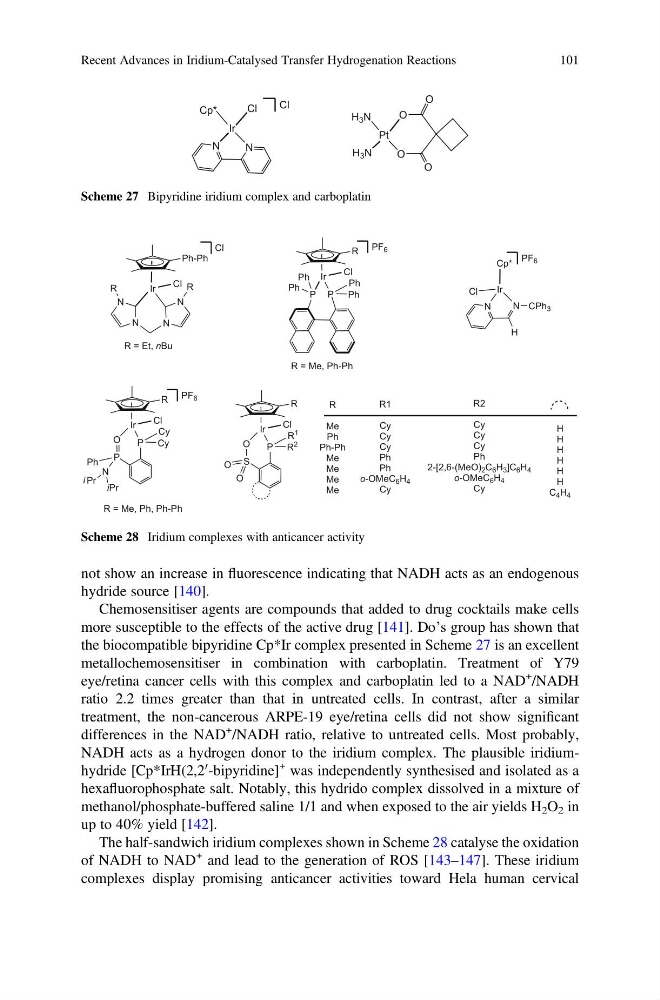
more susceptible to the effects of the active drug [141]. Do’s group has shown that
the biocompatible bipyridine Cp*Ir complex presented in Scheme 27 is an excellent
metallochemosensitiser in combination with carboplatin. Treatment of Y79
eye/retina cancer cells with this complex and carboplatin led to a NAD
+
/NADH
ratio 2.2 times greater than that in untreated cells. In contrast, after a similar
treatment, the non-cancerous ARPE-19 eye/retina cells did not show significant
differences in the NAD
+ /NADH ratio, relative to untreated cells. Most probably,
NADH acts as a hydrogen donor to the iridium complex. The plausible iridiumhydride [Cp*IrH(2,2
0 -bipyridine]
+ was independently synthesised and isolated as a
hexafluorophosphate salt. Notably, this hydrido complex dissolved in a mixture of
methanol/phosphate-buffered saline 1/1 and when exposed to the air yields H 2 O 2 in
up to 40% yield [142].
The half-sandwich iridium complexes shown in Scheme 28 catalyse the oxidation
of NADH to NAD
+ and lead to the generation of ROS [143–147]. These iridium
complexes display promising anticancer activities toward Hela human cervical
N
Ir
Cp*
Cl
N
Cl
H 3 N
Pt
H 3 N
O
O
O
O
Scheme 27 Bipyridine iridium complex and carboplatin
R = Et, nBu
P
Ph
Ir
Cl
P
Ph
Ph
Ph
R
R = Me, Ph-Ph
N
Ir
Cl
Cp*
CPh 3
N
H
PF 6
PF 6
Ir
Cl
P
Cy
P
Cy
R
R = Me, Ph, Ph-Ph
PF 6
O
Ph
N
Pr iPr
Ir
Cl
P
R
1
S
R
2
R
O
O
O
N
N
Ir
Cl
Ph-Ph
N
N
R
R
R
Me
Ph
Ph-Ph
Me
Me
Me
Me
R1
Cy
Cy
Cy
Ph
Ph
o-OMeC 6 H 4
Cy
R2
Cy
Cy
Cy
Ph
2-[2,6-(MeO) 2 C 6 H 3 ]C 6 H 4
o-OMeC 6 H 4
Cy
H
H
H
H
H
H
C 4 H 4
Cl
i
Scheme 28 Iridium complexes with anticancer activity
Recent Advances in Iridium-Catalysed Transfer Hydrogenation Reactions
101
hydride source [140].
Chemosensitiser agents are compounds that added to drug cocktails make cells
more susceptible to the effects of the active drug [141]. Do’s group has shown that
the biocompatible bipyridine Cp*Ir complex presented in Scheme 27 is an excellent
metallochemosensitiser in combination with carboplatin. Treatment of Y79
eye/retina cancer cells with this complex and carboplatin led to a NAD
+
/NADH
ratio 2.2 times greater than that in untreated cells. In contrast, after a similar
treatment, the non-cancerous ARPE-19 eye/retina cells did not show significant
differences in the NAD
+ /NADH ratio, relative to untreated cells. Most probably,
NADH acts as a hydrogen donor to the iridium complex. The plausible iridiumhydride [Cp*IrH(2,2
0 -bipyridine]
+ was independently synthesised and isolated as a
hexafluorophosphate salt. Notably, this hydrido complex dissolved in a mixture of
methanol/phosphate-buffered saline 1/1 and when exposed to the air yields H 2 O 2 in
up to 40% yield [142].
The half-sandwich iridium complexes shown in Scheme 28 catalyse the oxidation
of NADH to NAD
+ and lead to the generation of ROS [143–147]. These iridium
complexes display promising anticancer activities toward Hela human cervical
N
Ir
Cp*
Cl
N
Cl
H 3 N
Pt
H 3 N
O
O
O
O
Scheme 27 Bipyridine iridium complex and carboplatin
R = Et, nBu
P
Ph
Ir
Cl
P
Ph
Ph
Ph
R
R = Me, Ph-Ph
N
Ir
Cl
Cp*
CPh 3
N
H
PF 6
PF 6
Ir
Cl
P
Cy
P
Cy
R
R = Me, Ph, Ph-Ph
PF 6
O
Ph
N
Pr iPr
Ir
Cl
P
R
1
S
R
2
R
O
O
O
N
N
Ir
Cl
Ph-Ph
N
N
R
R
R
Me
Ph
Ph-Ph
Me
Me
Me
Me
R1
Cy
Cy
Cy
Ph
Ph
o-OMeC 6 H 4
Cy
R2
Cy
Cy
Cy
Ph
2-[2,6-(MeO) 2 C 6 H 3 ]C 6 H 4
o-OMeC 6 H 4
Cy
H
H
H
H
H
H
C 4 H 4
Cl
i
Scheme 28 Iridium complexes with anticancer activity
Recent Advances in Iridium-Catalysed Transfer Hydrogenation Reactions
101