

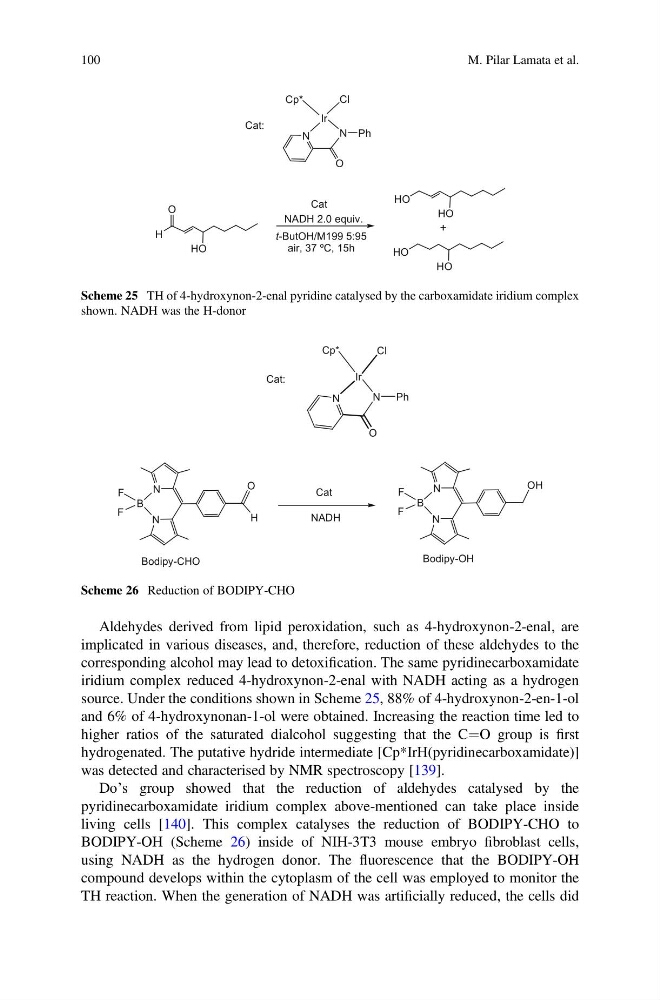
Aldehydes derived from lipid peroxidation, such as 4-hydroxynon-2-enal, are
implicated in various diseases, and, therefore, reduction of these aldehydes to the
corresponding alcohol may lead to detoxification. The same pyridinecarboxamidate
iridium complex reduced 4-hydroxynon-2-enal with NADH acting as a hydrogen
source. Under the conditions shown in Scheme 25, 88% of 4-hydroxynon-2-en-1-ol
and 6% of 4-hydroxynonan-1-ol were obtained. Increasing the reaction time led to
higher ratios of the saturated dialcohol suggesting that the C¼O group is first
hydrogenated. The putative hydride intermediate [Cp*IrH(pyridinecarboxamidate)]
was detected and characterised by NMR spectroscopy [139].
Do’s group showed that the reduction of aldehydes catalysed by the
pyridinecarboxamidate iridium complex above-mentioned can take place inside
living cells [140]. This complex catalyses the reduction of BODIPY-CHO to
BODIPY-OH (Scheme 26) inside of NIH-3T3 mouse embryo fibroblast cells,
using NADH as the hydrogen donor. The fluorescence that the BODIPY-OH
compound develops within the cytoplasm of the cell was employed to monitor the
TH reaction. When the generation of NADH was artificially reduced, the cells did
N
Ir
Cl
N
Cp*
O
Ph
HO
O
H
HO
HO
HO
HO
+
NADH 2.0 equiv.
Cat
t-ButOH/M199 5:95
air, 37 ºC, 15h
Cat:
Scheme 25 TH of 4-hydroxynon-2-enal pyridine catalysed by the carboxamidate iridium complex
shown. NADH was the H-donor
NADH
Cat
O
H
B
F
F
N
N
OH
B
F
F
N
N
Bodipy-CHO
Bodipy-OH
Cat:
N
Ir
Cp*
N
Cl
O
Ph
Scheme 26 Reduction of BODIPY-CHO
100
M. Pilar Lamata et al.
implicated in various diseases, and, therefore, reduction of these aldehydes to the
corresponding alcohol may lead to detoxification. The same pyridinecarboxamidate
iridium complex reduced 4-hydroxynon-2-enal with NADH acting as a hydrogen
source. Under the conditions shown in Scheme 25, 88% of 4-hydroxynon-2-en-1-ol
and 6% of 4-hydroxynonan-1-ol were obtained. Increasing the reaction time led to
higher ratios of the saturated dialcohol suggesting that the C¼O group is first
hydrogenated. The putative hydride intermediate [Cp*IrH(pyridinecarboxamidate)]
was detected and characterised by NMR spectroscopy [139].
Do’s group showed that the reduction of aldehydes catalysed by the
pyridinecarboxamidate iridium complex above-mentioned can take place inside
living cells [140]. This complex catalyses the reduction of BODIPY-CHO to
BODIPY-OH (Scheme 26) inside of NIH-3T3 mouse embryo fibroblast cells,
using NADH as the hydrogen donor. The fluorescence that the BODIPY-OH
compound develops within the cytoplasm of the cell was employed to monitor the
TH reaction. When the generation of NADH was artificially reduced, the cells did
N
Ir
Cl
N
Cp*
O
Ph
HO
O
H
HO
HO
HO
HO
+
NADH 2.0 equiv.
Cat
t-ButOH/M199 5:95
air, 37 ºC, 15h
Cat:
Scheme 25 TH of 4-hydroxynon-2-enal pyridine catalysed by the carboxamidate iridium complex
shown. NADH was the H-donor
NADH
Cat
O
H
B
F
F
N
N
OH
B
F
F
N
N
Bodipy-CHO
Bodipy-OH
Cat:
N
Ir
Cp*
N
Cl
O
Ph
Scheme 26 Reduction of BODIPY-CHO
100
M. Pilar Lamata et al.