

hydride from NADH completes the TH catalytic cycle. In particular, the hydride can
be transferred to molecular oxygen increasing the levels of hydrogen peroxide and
reactive oxygen species (ROS). Oxidative stress caused by generation of ROS is an
effective method of killing cancer cells [138].
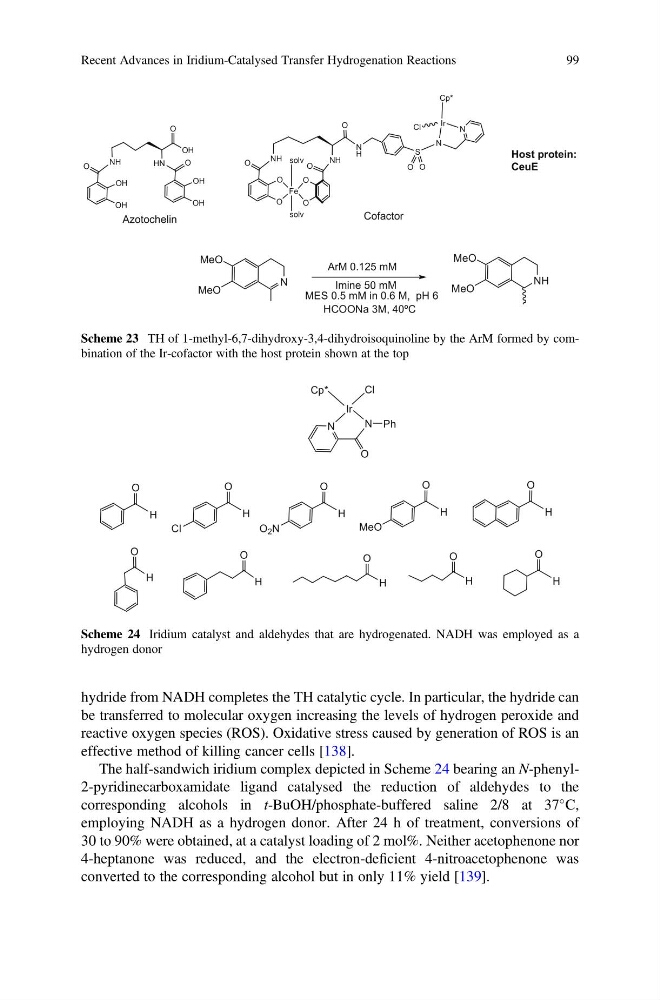
The half-sandwich iridium complex depicted in Scheme 24 bearing an N-phenyl2-pyridinecarboxamidate ligand catalysed the reduction of aldehydes to the
corresponding alcohols in t-BuOH/phosphate-buffered saline 2/8 at 37
C,
employing NADH as a hydrogen donor. After 24 h of treatment, conversions of
30 to 90% were obtained, at a catalyst loading of 2 mol%. Neither acetophenone nor
4-heptanone was reduced, and the electron-deficient 4-nitroacetophenone was
converted to the corresponding alcohol but in only 11% yield [139].
Ir
Cl
N
N
MeO
MeO
NH
MeO
MeO
Imine 50 mM
HCOONa 3M, 40ºC
MES 0.5 mM in 0.6 M, pH 6
Cp*
N
N
H
S
O O
O
Fe
O
O
O
O
solv
solv
NH
O
NH
O
Cofactor
ArM 0.125 mM
OH
OH
NH
O
O
OH
OH
OH
HN
O
Azotochelin
Host protein:
CeuE
Scheme 23 TH of 1-methyl-6,7-dihydroxy-3,4-dihydroisoquinoline by the ArM formed by combination of the Ir-cofactor with the host protein shown at the top
N
Ir
Cl
N
Cp*
O
Ph
O
H
O
H
Cl
O
H
O 2 N
O
H
MeO
O
H
H
H
O
H
O
O
H
O
H
O
Scheme 24 Iridium catalyst and aldehydes that are hydrogenated. NADH was employed as a
hydrogen donor
Recent Advances in Iridium-Catalysed Transfer Hydrogenation Reactions
99
be transferred to molecular oxygen increasing the levels of hydrogen peroxide and
reactive oxygen species (ROS). Oxidative stress caused by generation of ROS is an
effective method of killing cancer cells [138].
The half-sandwich iridium complex depicted in Scheme 24 bearing an N-phenyl2-pyridinecarboxamidate ligand catalysed the reduction of aldehydes to the
corresponding alcohols in t-BuOH/phosphate-buffered saline 2/8 at 37
C,
employing NADH as a hydrogen donor. After 24 h of treatment, conversions of
30 to 90% were obtained, at a catalyst loading of 2 mol%. Neither acetophenone nor
4-heptanone was reduced, and the electron-deficient 4-nitroacetophenone was
converted to the corresponding alcohol but in only 11% yield [139].
Ir
Cl
N
N
MeO
MeO
NH
MeO
MeO
Imine 50 mM
HCOONa 3M, 40ºC
MES 0.5 mM in 0.6 M, pH 6
Cp*
N
N
H
S
O O
O
Fe
O
O
O
O
solv
solv
NH
O
NH
O
Cofactor
ArM 0.125 mM
OH
OH
NH
O
O
OH
OH
OH
HN
O
Azotochelin
Host protein:
CeuE
Scheme 23 TH of 1-methyl-6,7-dihydroxy-3,4-dihydroisoquinoline by the ArM formed by combination of the Ir-cofactor with the host protein shown at the top
N
Ir
Cl
N
Cp*
O
Ph
O
H
O
H
Cl
O
H
O 2 N
O
H
MeO
O
H
H
H
O
H
O
O
H
O
H
O
Scheme 24 Iridium catalyst and aldehydes that are hydrogenated. NADH was employed as a
hydrogen donor
Recent Advances in Iridium-Catalysed Transfer Hydrogenation Reactions
99