

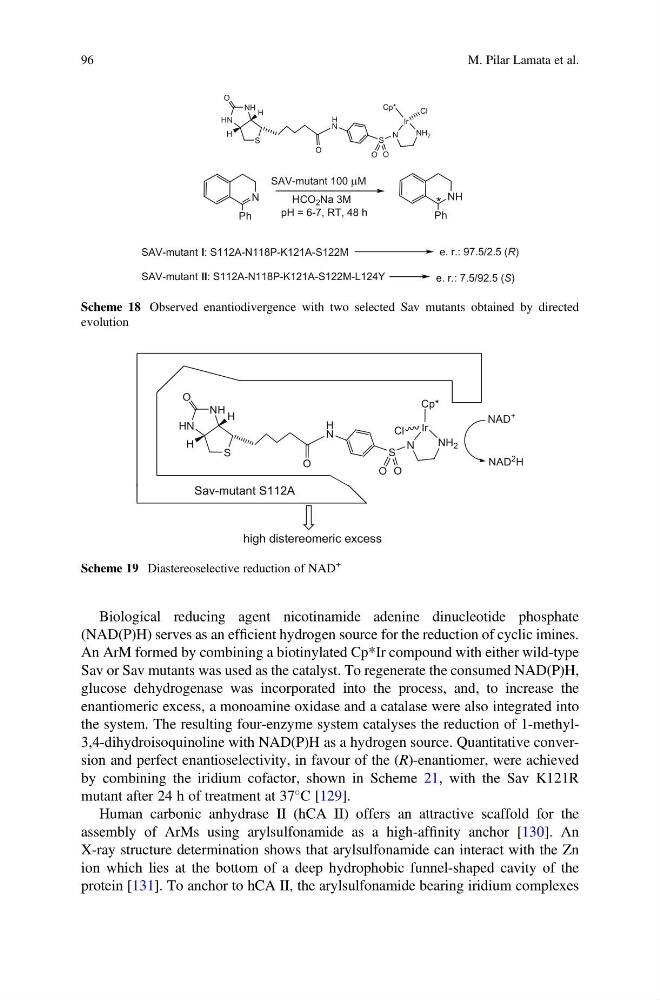
Biological reducing agent nicotinamide adenine dinucleotide phosphate
(NAD(P)H) serves as an efficient hydrogen source for the reduction of cyclic imines.
An ArM formed by combining a biotinylated Cp*Ir compound with either wild-type
Sav or Sav mutants was used as the catalyst. To regenerate the consumed NAD(P)H,
glucose dehydrogenase was incorporated into the process, and, to increase the
enantiomeric excess, a monoamine oxidase and a catalase were also integrated into
the system. The resulting four-enzyme system catalyses the reduction of 1-methyl3,4-dihydroisoquinoline with NAD(P)H as a hydrogen source. Quantitative conversion and perfect enantioselectivity, in favour of the (R)-enantiomer, were achieved
by combining the iridium cofactor, shown in Scheme 21, with the Sav K121R
mutant after 24 h of treatment at 37
C [129].
Human carbonic anhydrase II (hCA II) offers an attractive scaffold for the
assembly of ArMs using arylsulfonamide as a high-affinity anchor [130]. An
X-ray structure determination shows that arylsulfonamide can interact with the Zn
ion which lies at the bottom of a deep hydrophobic funnel-shaped cavity of the
protein [131]. To anchor to hCA II, the arylsulfonamide bearing iridium complexes
Cl
Ir
Cp*
N
NH 2
HN
NH
S
O
H
H
S
O O
H
N
O
N
Ph
NH
Ph
*
HCO 2 Na 3M
pH = 6-7, RT, 48 h
SAV-mutant 100 M
SAV-mutant I: S112A-N118P-K121A-S122M
SAV-mutant II: S112A-N118P-K121A-S122M-L124Y
e. r.: 97.5/2.5 (R)
e. r.: 7.5/92.5 (S)
Scheme 18 Observed enantiodivergence with two selected Sav mutants obtained by directed
evolution
Cl
Ir
Cp*
N
NH 2
HN
NH
S
O
H
H
S
O O
H
N
O
NAD
+
high distereomeric excess
Sav-mutant S112A
NAD
2 H
Scheme 19 Diastereoselective reduction of NAD
+
96
M. Pilar Lamata et al.
(NAD(P)H) serves as an efficient hydrogen source for the reduction of cyclic imines.
An ArM formed by combining a biotinylated Cp*Ir compound with either wild-type
Sav or Sav mutants was used as the catalyst. To regenerate the consumed NAD(P)H,
glucose dehydrogenase was incorporated into the process, and, to increase the
enantiomeric excess, a monoamine oxidase and a catalase were also integrated into
the system. The resulting four-enzyme system catalyses the reduction of 1-methyl3,4-dihydroisoquinoline with NAD(P)H as a hydrogen source. Quantitative conversion and perfect enantioselectivity, in favour of the (R)-enantiomer, were achieved
by combining the iridium cofactor, shown in Scheme 21, with the Sav K121R
mutant after 24 h of treatment at 37
C [129].
Human carbonic anhydrase II (hCA II) offers an attractive scaffold for the
assembly of ArMs using arylsulfonamide as a high-affinity anchor [130]. An
X-ray structure determination shows that arylsulfonamide can interact with the Zn
ion which lies at the bottom of a deep hydrophobic funnel-shaped cavity of the
protein [131]. To anchor to hCA II, the arylsulfonamide bearing iridium complexes
Cl
Ir
Cp*
N
NH 2
HN
NH
S
O
H
H
S
O O
H
N
O
N
Ph
NH
Ph
*
HCO 2 Na 3M
pH = 6-7, RT, 48 h
SAV-mutant 100 M
SAV-mutant I: S112A-N118P-K121A-S122M
SAV-mutant II: S112A-N118P-K121A-S122M-L124Y
e. r.: 97.5/2.5 (R)
e. r.: 7.5/92.5 (S)
Scheme 18 Observed enantiodivergence with two selected Sav mutants obtained by directed
evolution
Cl
Ir
Cp*
N
NH 2
HN
NH
S
O
H
H
S
O O
H
N
O
NAD
+
high distereomeric excess
Sav-mutant S112A
NAD
2 H
Scheme 19 Diastereoselective reduction of NAD
+
96
M. Pilar Lamata et al.