

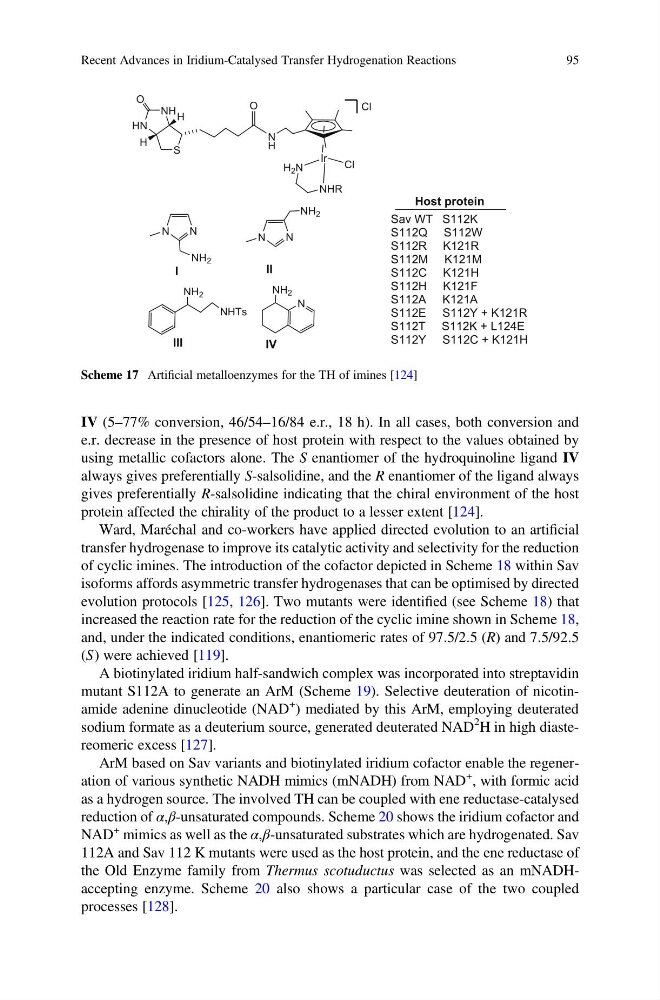
IV (5–77% conversion, 46/54–16/84 e.r., 18 h). In all cases, both conversion and
e.r. decrease in the presence of host protein with respect to the values obtained by
using metallic cofactors alone. The S enantiomer of the hydroquinoline ligand IV
always gives preferentially S-salsolidine, and the R enantiomer of the ligand always
gives preferentially R-salsolidine indicating that the chiral environment of the host
protein affected the chirality of the product to a lesser extent [124].
Ward, Maréchal and co-workers have applied directed evolution to an artificial
transfer hydrogenase to improve its catalytic activity and selectivity for the reduction
of cyclic imines. The introduction of the cofactor depicted in Scheme 18 within Sav
isoforms affords asymmetric transfer hydrogenases that can be optimised by directed
evolution protocols [125, 126]. Two mutants were identified (see Scheme 18) that
increased the reaction rate for the reduction of the cyclic imine shown in Scheme 18,
and, under the indicated conditions, enantiomeric rates of 97.5/2.5 (R) and 7.5/92.5
(S) were achieved [119].
A biotinylated iridium half-sandwich complex was incorporated into streptavidin
mutant S112A to generate an ArM (Scheme 19). Selective deuteration of nicotinamide adenine dinucleotide (NAD
+
) mediated by this ArM, employing deuterated
sodium formate as a deuterium source, generated deuterated NAD
2 H in high diastereomeric excess [127].
ArM based on Sav variants and biotinylated iridium cofactor enable the regeneration of various synthetic NADH mimics (mNADH) from NAD
+
, with formic acid
as a hydrogen source. The involved TH can be coupled with ene reductase-catalysed
reduction of α,β-unsaturated compounds. Scheme 20 shows the iridium cofactor and
NAD
+ mimics as well as the α,β-unsaturated substrates which are hydrogenated. Sav
112A and Sav 112 K mutants were used as the host protein, and the ene reductase of
the Old Enzyme family from Thermus scotuductus was selected as an mNADHaccepting enzyme. Scheme 20 also shows a particular case of the two coupled
processes [128].
Cl
Ir
H 2 N
NHR
HN
NH
S
O
H
H
N
H
O
NHTs
NH 2
Cl
III
N
NH 2
IV
N
N
NH 2
N
N
I
II
NH 2
Sav WT S112K
S112Q S112W
S112R K121R
S112M K121M
S112C K121H
S112H K121F
S112A K121A
S112E S112Y + K121R
S112T S112K + L124E
S112Y S112C + K121H
Host protein
Scheme 17 Artificial metalloenzymes for the TH of imines [124]
Recent Advances in Iridium-Catalysed Transfer Hydrogenation Reactions
95
e.r. decrease in the presence of host protein with respect to the values obtained by
using metallic cofactors alone. The S enantiomer of the hydroquinoline ligand IV
always gives preferentially S-salsolidine, and the R enantiomer of the ligand always
gives preferentially R-salsolidine indicating that the chiral environment of the host
protein affected the chirality of the product to a lesser extent [124].
Ward, Maréchal and co-workers have applied directed evolution to an artificial
transfer hydrogenase to improve its catalytic activity and selectivity for the reduction
of cyclic imines. The introduction of the cofactor depicted in Scheme 18 within Sav
isoforms affords asymmetric transfer hydrogenases that can be optimised by directed
evolution protocols [125, 126]. Two mutants were identified (see Scheme 18) that
increased the reaction rate for the reduction of the cyclic imine shown in Scheme 18,
and, under the indicated conditions, enantiomeric rates of 97.5/2.5 (R) and 7.5/92.5
(S) were achieved [119].
A biotinylated iridium half-sandwich complex was incorporated into streptavidin
mutant S112A to generate an ArM (Scheme 19). Selective deuteration of nicotinamide adenine dinucleotide (NAD
+
) mediated by this ArM, employing deuterated
sodium formate as a deuterium source, generated deuterated NAD
2 H in high diastereomeric excess [127].
ArM based on Sav variants and biotinylated iridium cofactor enable the regeneration of various synthetic NADH mimics (mNADH) from NAD
+
, with formic acid
as a hydrogen source. The involved TH can be coupled with ene reductase-catalysed
reduction of α,β-unsaturated compounds. Scheme 20 shows the iridium cofactor and
NAD
+ mimics as well as the α,β-unsaturated substrates which are hydrogenated. Sav
112A and Sav 112 K mutants were used as the host protein, and the ene reductase of
the Old Enzyme family from Thermus scotuductus was selected as an mNADHaccepting enzyme. Scheme 20 also shows a particular case of the two coupled
processes [128].
Cl
Ir
H 2 N
NHR
HN
NH
S
O
H
H
N
H
O
NHTs
NH 2
Cl
III
N
NH 2
IV
N
N
NH 2
N
N
I
II
NH 2
Sav WT S112K
S112Q S112W
S112R K121R
S112M K121M
S112C K121H
S112H K121F
S112A K121A
S112E S112Y + K121R
S112T S112K + L124E
S112Y S112C + K121H
Host protein
Scheme 17 Artificial metalloenzymes for the TH of imines [124]
Recent Advances in Iridium-Catalysed Transfer Hydrogenation Reactions
95