

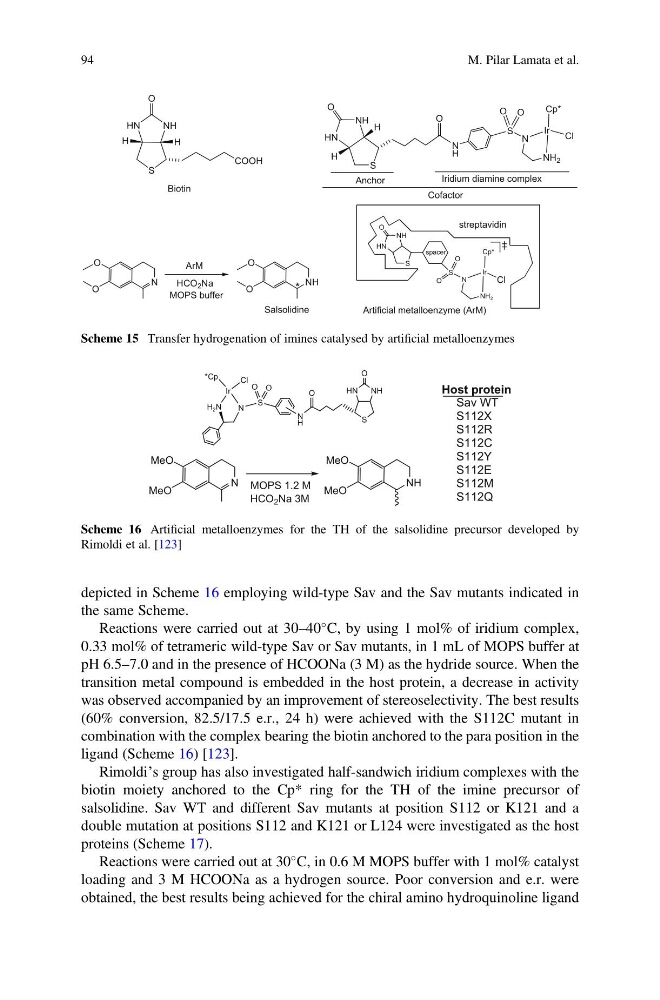
depicted in Scheme 16 employing wild-type Sav and the Sav mutants indicated in
the same Scheme.
Reactions were carried out at 30–40
C, by using 1 mol% of iridium complex,
0.33 mol% of tetrameric wild-type Sav or Sav mutants, in 1 mL of MOPS buffer at
pH 6.5–7.0 and in the presence of HCOONa (3 M) as the hydride source. When the
transition metal compound is embedded in the host protein, a decrease in activity
was observed accompanied by an improvement of stereoselectivity. The best results
(60% conversion, 82.5/17.5 e.r., 24 h) were achieved with the S112C mutant in
combination with the complex bearing the biotin anchored to the para position in the
ligand (Scheme 16) [123].
Rimoldi’s group has also investigated half-sandwich iridium complexes with the
biotin moiety anchored to the Cp* ring for the TH of the imine precursor of
salsolidine. Sav WT and different Sav mutants at position S112 or K121 and a
double mutation at positions S112 and K121 or L124 were investigated as the host
proteins (Scheme 17).
Reactions were carried out at 30
C, in 0.6 M MOPS buffer with 1 mol% catalyst
loading and 3 M HCOONa as a hydrogen source. Poor conversion and e.r. were
obtained, the best results being achieved for the chiral amino hydroquinoline ligand
Cl
Ir
Cp*
N
NH 2
HN
NH
S
O
H
H
COOH
HN
NH
S
O
H
H
S
O O
N
H
O
N
O
O
NH
O
O
*
HCO 2 Na
MOPS buffer
ArM
HN
NH
S
O
Ir
Cp*
N
NH 2
S
O
O
Cl
spacer
Artificial metalloenzyme (ArM)
Anchor
Iridium diamine complex
Cofactor
streptavidin
Salsolidine
Biotin
Scheme 15 Transfer hydrogenation of imines catalysed by artificial metalloenzymes
Cl
Ir
*Cp
H 2 N
N
N
MeO
MeO
NH
MeO
MeO
HCO 2 Na 3M
MOPS 1.2 M
S
O O
N
H
HN
NH
S
O
O
Sav WT
S112X
S112R
S112C
S112Y
S112E
S112M
S112Q
Host protein
Scheme 16 Artificial metalloenzymes for the TH of the salsolidine precursor developed by
Rimoldi et al. [123]
94
M. Pilar Lamata et al.
the same Scheme.
Reactions were carried out at 30–40
C, by using 1 mol% of iridium complex,
0.33 mol% of tetrameric wild-type Sav or Sav mutants, in 1 mL of MOPS buffer at
pH 6.5–7.0 and in the presence of HCOONa (3 M) as the hydride source. When the
transition metal compound is embedded in the host protein, a decrease in activity
was observed accompanied by an improvement of stereoselectivity. The best results
(60% conversion, 82.5/17.5 e.r., 24 h) were achieved with the S112C mutant in
combination with the complex bearing the biotin anchored to the para position in the
ligand (Scheme 16) [123].
Rimoldi’s group has also investigated half-sandwich iridium complexes with the
biotin moiety anchored to the Cp* ring for the TH of the imine precursor of
salsolidine. Sav WT and different Sav mutants at position S112 or K121 and a
double mutation at positions S112 and K121 or L124 were investigated as the host
proteins (Scheme 17).
Reactions were carried out at 30
C, in 0.6 M MOPS buffer with 1 mol% catalyst
loading and 3 M HCOONa as a hydrogen source. Poor conversion and e.r. were
obtained, the best results being achieved for the chiral amino hydroquinoline ligand
Cl
Ir
Cp*
N
NH 2
HN
NH
S
O
H
H
COOH
HN
NH
S
O
H
H
S
O O
N
H
O
N
O
O
NH
O
O
*
HCO 2 Na
MOPS buffer
ArM
HN
NH
S
O
Ir
Cp*
N
NH 2
S
O
O
Cl
spacer
Artificial metalloenzyme (ArM)
Anchor
Iridium diamine complex
Cofactor
streptavidin
Salsolidine
Biotin
Scheme 15 Transfer hydrogenation of imines catalysed by artificial metalloenzymes
Cl
Ir
*Cp
H 2 N
N
N
MeO
MeO
NH
MeO
MeO
HCO 2 Na 3M
MOPS 1.2 M
S
O O
N
H
HN
NH
S
O
O
Sav WT
S112X
S112R
S112C
S112Y
S112E
S112M
S112Q
Host protein
Scheme 16 Artificial metalloenzymes for the TH of the salsolidine precursor developed by
Rimoldi et al. [123]
94
M. Pilar Lamata et al.