

[(η
5 -Cp*)Ir(picolylamine)Cl]
and
[(η
5 -Cp
propyl )Ir(picolylamine)Cl]
(Cp
propyl
¼ penta-n-propylcyclopentadienyl) depicted in Scheme 22 were prepared.
Application of the computational design software Rosetta [132] to the combination
[(η
5 -Cp*)Ir(pico)Cl]/hCA II WT afforded four hCA II variants that significantly
increased affinity for the catalysts. The combination of designed hCA II mutations
with the η
5 -Cp
propyl complex renders productive (TON up to 100) and highly
selective (up to 98/2 e.r.) ArMs for the reduction of cyclic imines, under the
conditions indicated in Scheme 22 [133].
A half-sandwich iridium complex was assembled to a periplasmic-binding protein such as CeuE, an iron siderophore of Campylobacter jejuni, by using an
azotochelin siderophore as binding anchor. The remaining two coordination sites
around the iron centre were occupied by solvent molecules in the free cofactor.
Nonetheless, it was hypothesised that those sites are used to bind Y288 and H227 of
ene
reductase
Cl Ir
Cp*
N
NH 2
HN
NH
S
O
S
O O
H
N
O
Ir catalyst
N
R
1
R
2
N
R
1
R
2
H H
HCOOH
CO 2
Iridium-cofactor
=
Sav mutant + Ir-cofactor
N
O
NH 2
N
O
NH 2
N
O
N
O
OH
N
CN
NAD
+ mimics
,-unsaturated substrates
O
N
O
O
O
O
O
O
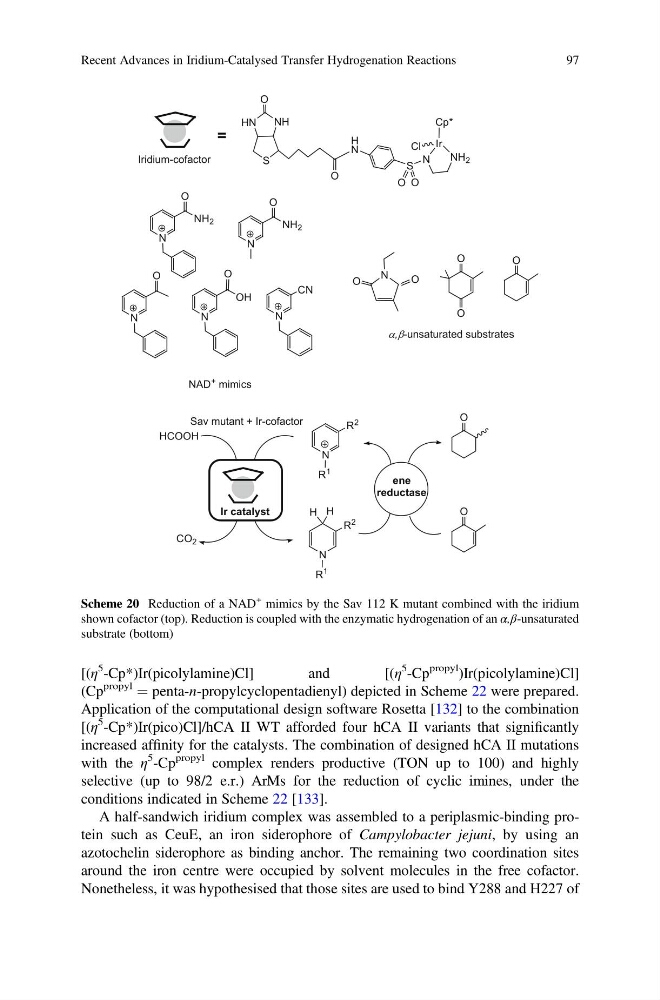
Scheme 20 Reduction of a NAD
+ mimics by the Sav 112 K mutant combined with the iridium
shown cofactor (top). Reduction is coupled with the enzymatic hydrogenation of an α,β-unsaturated
substrate (bottom)
Recent Advances in Iridium-Catalysed Transfer Hydrogenation Reactions
97
5 -Cp*)Ir(picolylamine)Cl]
and
[(η
5 -Cp
propyl )Ir(picolylamine)Cl]
(Cp
propyl
¼ penta-n-propylcyclopentadienyl) depicted in Scheme 22 were prepared.
Application of the computational design software Rosetta [132] to the combination
[(η
5 -Cp*)Ir(pico)Cl]/hCA II WT afforded four hCA II variants that significantly
increased affinity for the catalysts. The combination of designed hCA II mutations
with the η
5 -Cp
propyl complex renders productive (TON up to 100) and highly
selective (up to 98/2 e.r.) ArMs for the reduction of cyclic imines, under the
conditions indicated in Scheme 22 [133].
A half-sandwich iridium complex was assembled to a periplasmic-binding protein such as CeuE, an iron siderophore of Campylobacter jejuni, by using an
azotochelin siderophore as binding anchor. The remaining two coordination sites
around the iron centre were occupied by solvent molecules in the free cofactor.
Nonetheless, it was hypothesised that those sites are used to bind Y288 and H227 of
ene
reductase
Cl Ir
Cp*
N
NH 2
HN
NH
S
O
S
O O
H
N
O
Ir catalyst
N
R
1
R
2
N
R
1
R
2
H H
HCOOH
CO 2
Iridium-cofactor
=
Sav mutant + Ir-cofactor
N
O
NH 2
N
O
NH 2
N
O
N
O
OH
N
CN
NAD
+ mimics
,-unsaturated substrates
O
N
O
O
O
O
O
O
Scheme 20 Reduction of a NAD
+ mimics by the Sav 112 K mutant combined with the iridium
shown cofactor (top). Reduction is coupled with the enzymatic hydrogenation of an α,β-unsaturated
substrate (bottom)
Recent Advances in Iridium-Catalysed Transfer Hydrogenation Reactions
97