

phenolic compound known as gossypol which provides resistance/protection to
cotton plant from pests (Soto-Blanco 2008; Rogers et al. 2002; EFSA 2009). The
gossypol content of cottonseeds varies from 0.02% to 6.64% among the various
cotton varieties (Price et al. 1993). Presence of this compound in cottonseed and
CSM hinders their application for human use and limits its applications in animal
feed only. Gossypol, a crystalline yellow pigment with molecular weight of
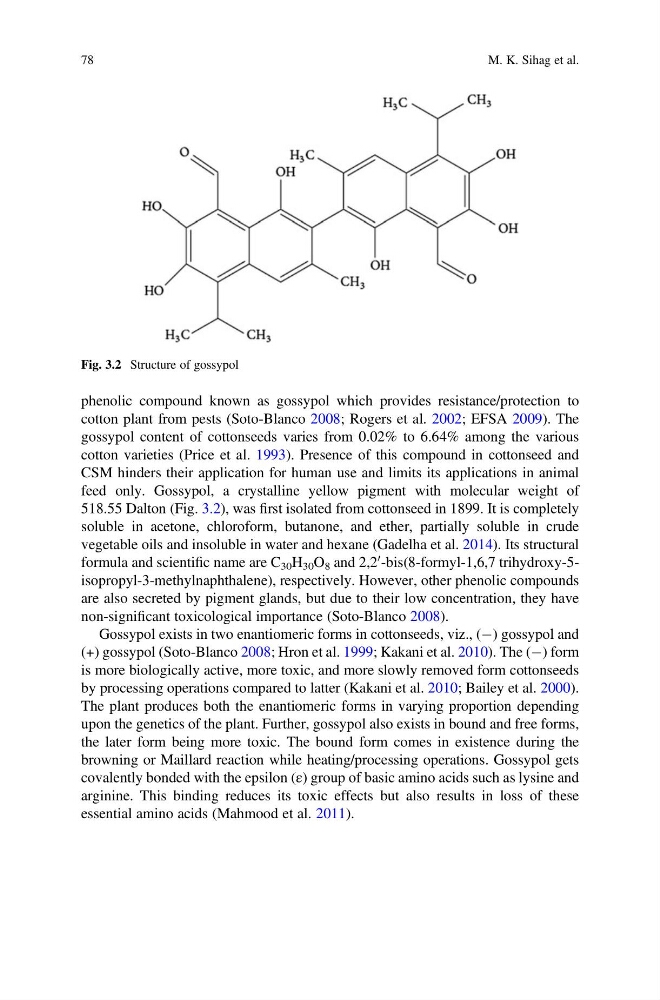
518.55 Dalton (Fig. 3.2), was first isolated from cottonseed in 1899. It is completely
soluble in acetone, chloroform, butanone, and ether, partially soluble in crude
vegetable oils and insoluble in water and hexane (Gadelha et al. 2014). Its structural
formula and scientific name are C 30 H 30 O 8 and 2,2
0 -bis(8-formyl-1,6,7 trihydroxy-5isopropyl-3-methylnaphthalene), respectively. However, other phenolic compounds
are also secreted by pigment glands, but due to their low concentration, they have
non-significant toxicological importance (Soto-Blanco 2008).
Gossypol exists in two enantiomeric forms in cottonseeds, viz., (À) gossypol and
(+) gossypol (Soto-Blanco 2008; Hron et al. 1999; Kakani et al. 2010). The (À) form
is more biologically active, more toxic, and more slowly removed form cottonseeds
by processing operations compared to latter (Kakani et al. 2010; Bailey et al. 2000).
The plant produces both the enantiomeric forms in varying proportion depending
upon the genetics of the plant. Further, gossypol also exists in bound and free forms,
the later form being more toxic. The bound form comes in existence during the
browning or Maillard reaction while heating/processing operations. Gossypol gets
covalently bonded with the epsilon (ε) group of basic amino acids such as lysine and
arginine. This binding reduces its toxic effects but also results in loss of these
essential amino acids (Mahmood et al. 2011).
Fig. 3.2 Structure of gossypol
78
M. K. Sihag et al.
cotton plant from pests (Soto-Blanco 2008; Rogers et al. 2002; EFSA 2009). The
gossypol content of cottonseeds varies from 0.02% to 6.64% among the various
cotton varieties (Price et al. 1993). Presence of this compound in cottonseed and
CSM hinders their application for human use and limits its applications in animal
feed only. Gossypol, a crystalline yellow pigment with molecular weight of
518.55 Dalton (Fig. 3.2), was first isolated from cottonseed in 1899. It is completely
soluble in acetone, chloroform, butanone, and ether, partially soluble in crude
vegetable oils and insoluble in water and hexane (Gadelha et al. 2014). Its structural
formula and scientific name are C 30 H 30 O 8 and 2,2
0 -bis(8-formyl-1,6,7 trihydroxy-5isopropyl-3-methylnaphthalene), respectively. However, other phenolic compounds
are also secreted by pigment glands, but due to their low concentration, they have
non-significant toxicological importance (Soto-Blanco 2008).
Gossypol exists in two enantiomeric forms in cottonseeds, viz., (À) gossypol and
(+) gossypol (Soto-Blanco 2008; Hron et al. 1999; Kakani et al. 2010). The (À) form
is more biologically active, more toxic, and more slowly removed form cottonseeds
by processing operations compared to latter (Kakani et al. 2010; Bailey et al. 2000).
The plant produces both the enantiomeric forms in varying proportion depending
upon the genetics of the plant. Further, gossypol also exists in bound and free forms,
the later form being more toxic. The bound form comes in existence during the
browning or Maillard reaction while heating/processing operations. Gossypol gets
covalently bonded with the epsilon (ε) group of basic amino acids such as lysine and
arginine. This binding reduces its toxic effects but also results in loss of these
essential amino acids (Mahmood et al. 2011).
Fig. 3.2 Structure of gossypol
78
M. K. Sihag et al.