

reduce plasma non-HDL-C levels and raise HDL-C (Wilson et al. 2007). Chen and
Cheng (2006) stated that consumption of RBO promotes the decomposition of
cholesterol by increasing the expression of liver LDL receptors, which in turn is
favorable for diminishing LDL-C levels by increasing cholesterol 7-alpha-hydroxylase (CYP7a1) expression. Sierra et al. (2005) studied the effect of diets
supplemented with RBO and γ-oryzanol on the immune response of mice and
observed that RBO modulates the immune system by boosting B-lymphocyte
proliferation.
Studies conducted by various researchers concluded that RBO oryzanol can also
prevent the oxidation of linoleic acid and cholesterol even better than vitamin
E. Cycloartenyl ferulate and 24-methylenecycloartanyl ferulate present in oryzanol
can act as antioxidants in methyl linoleate bulk and multiphase lipid systems and
inhibit the oxidation of low-density proteins (Xu et al. 2001; Andreasen et al. 2001;
Kikuzaki et al. 2002; Siddiqui et al. 2010). Rice bran oil, like palm oil, also contains
substantial amounts (approx. 500 ppm) of tocotrienols. The chemical structure of
tocotrienols is similar to the tocopherols and is found in at least four forms. They
belong to the vitamin E family and are known to be powerful natural antioxidants,
and their ability to prevent chronic disease is comparable to that of γ-oryzanol (Ryan
2011).
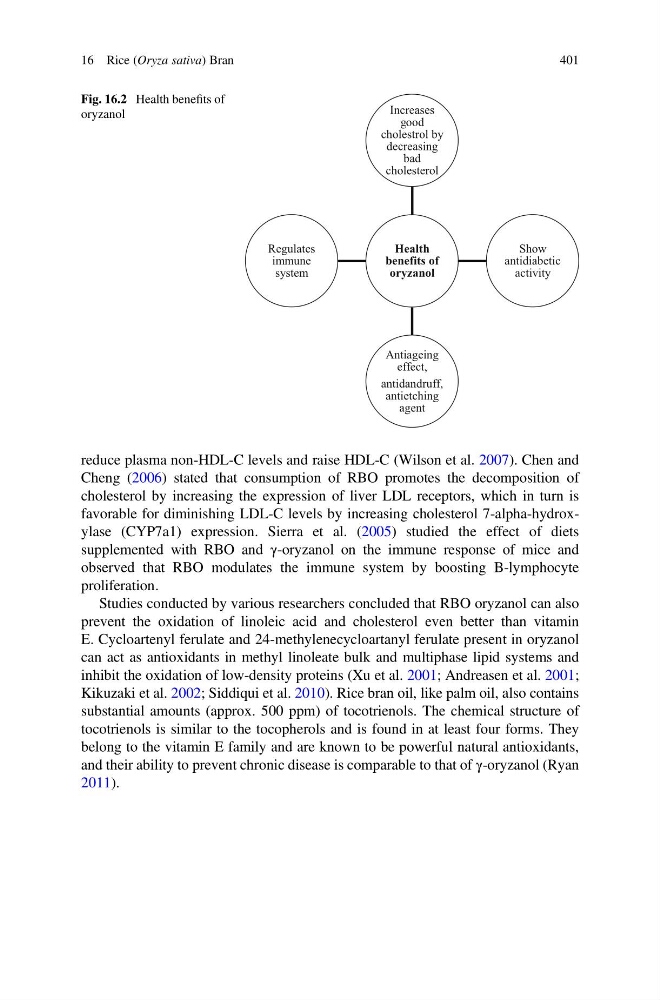
Health
benefits of
oryzanol
Increases
good
cholestrol by
decreasing
bad
cholesterol
Show
antidiabetic
activity
Antiageing
effect,
antidandruff,
antietching
agent
Regulates
immune
system
Fig. 16.2 Health benefits of
oryzanol
16 Rice (Oryza sativa) Bran
401
Cheng (2006) stated that consumption of RBO promotes the decomposition of
cholesterol by increasing the expression of liver LDL receptors, which in turn is
favorable for diminishing LDL-C levels by increasing cholesterol 7-alpha-hydroxylase (CYP7a1) expression. Sierra et al. (2005) studied the effect of diets
supplemented with RBO and γ-oryzanol on the immune response of mice and
observed that RBO modulates the immune system by boosting B-lymphocyte
proliferation.
Studies conducted by various researchers concluded that RBO oryzanol can also
prevent the oxidation of linoleic acid and cholesterol even better than vitamin
E. Cycloartenyl ferulate and 24-methylenecycloartanyl ferulate present in oryzanol
can act as antioxidants in methyl linoleate bulk and multiphase lipid systems and
inhibit the oxidation of low-density proteins (Xu et al. 2001; Andreasen et al. 2001;
Kikuzaki et al. 2002; Siddiqui et al. 2010). Rice bran oil, like palm oil, also contains
substantial amounts (approx. 500 ppm) of tocotrienols. The chemical structure of
tocotrienols is similar to the tocopherols and is found in at least four forms. They
belong to the vitamin E family and are known to be powerful natural antioxidants,
and their ability to prevent chronic disease is comparable to that of γ-oryzanol (Ryan
2011).
Health
benefits of
oryzanol
Increases
good
cholestrol by
decreasing
bad
cholesterol
Show
antidiabetic
activity
Antiageing
effect,
antidandruff,
antietching
agent
Regulates
immune
system
Fig. 16.2 Health benefits of
oryzanol
16 Rice (Oryza sativa) Bran
401