

16.4 Bioactive Components
Apart from an ample amount of wax (1.5–4%) and phosphatides (0.5–1.5%), RBO
also contains bioactive compounds such as phytosterols, γ-oryzanol, tocopherols,
and tocotrienols. The free fatty acid content (59.19%) of RBO is higher than other
plant oils such as groundnut oil, in which about 70% is oleic and linoleic acid, while
22% is palmitic acid (Kaneto et al. 2010; Afinisha and Arumughan 2012; Gopala
et al. 2006). A major bioactive component, γ-Oryzanol consists of a group of
compounds containing 4-hydroxy-3-methoxycinnamic acid (ferulate) esters of
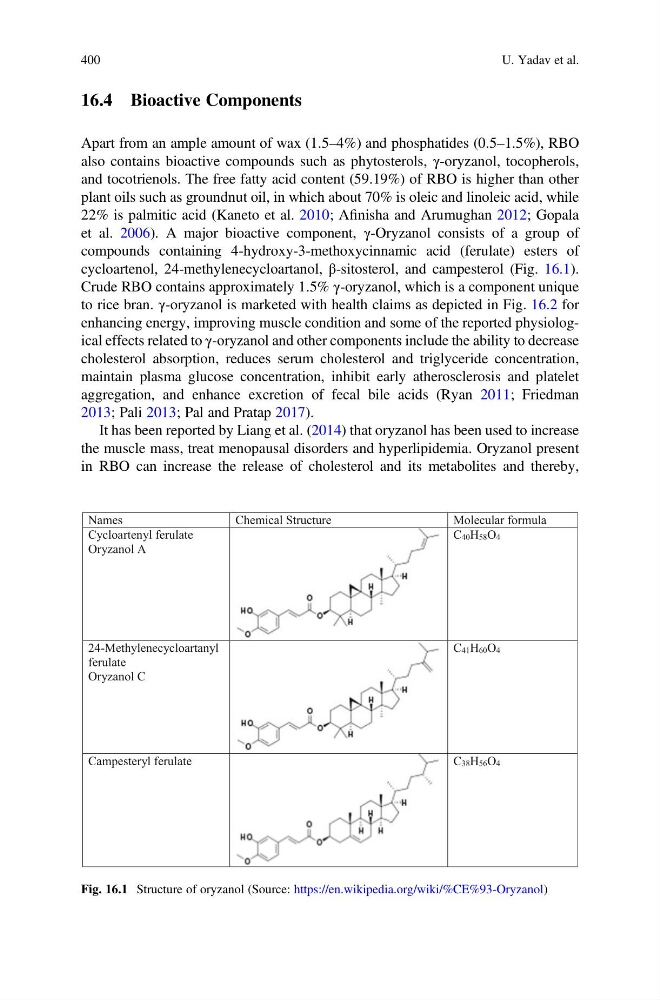
cycloartenol, 24-methylenecycloartanol, β-sitosterol, and campesterol (Fig. 16.1).
Crude RBO contains approximately 1.5% γ-oryzanol, which is a component unique
to rice bran. γ-oryzanol is marketed with health claims as depicted in Fig. 16.2 for
enhancing energy, improving muscle condition and some of the reported physiological effects related to γ-oryzanol and other components include the ability to decrease
cholesterol absorption, reduces serum cholesterol and triglyceride concentration,
maintain plasma glucose concentration, inhibit early atherosclerosis and platelet
aggregation, and enhance excretion of fecal bile acids (Ryan 2011; Friedman
2013; Pali 2013; Pal and Pratap 2017).
It has been reported by Liang et al. (2014) that oryzanol has been used to increase
the muscle mass, treat menopausal disorders and hyperlipidemia. Oryzanol present
in RBO can increase the release of cholesterol and its metabolites and thereby,
Names
Chemical Structure
Molecular formula
Cycloartenyl ferulate
Oryzanol A
C40H58O4
24-Methylenecycloartanyl
ferulate
Oryzanol C
C41H60O4
Campesteryl ferulate
C38H56O4
Fig. 16.1 Structure of oryzanol (Source: https://en.wikipedia.org/wiki/%CE%93-Oryzanol)
400
U. Yadav et al.
Apart from an ample amount of wax (1.5–4%) and phosphatides (0.5–1.5%), RBO
also contains bioactive compounds such as phytosterols, γ-oryzanol, tocopherols,
and tocotrienols. The free fatty acid content (59.19%) of RBO is higher than other
plant oils such as groundnut oil, in which about 70% is oleic and linoleic acid, while
22% is palmitic acid (Kaneto et al. 2010; Afinisha and Arumughan 2012; Gopala
et al. 2006). A major bioactive component, γ-Oryzanol consists of a group of
compounds containing 4-hydroxy-3-methoxycinnamic acid (ferulate) esters of
cycloartenol, 24-methylenecycloartanol, β-sitosterol, and campesterol (Fig. 16.1).
Crude RBO contains approximately 1.5% γ-oryzanol, which is a component unique
to rice bran. γ-oryzanol is marketed with health claims as depicted in Fig. 16.2 for
enhancing energy, improving muscle condition and some of the reported physiological effects related to γ-oryzanol and other components include the ability to decrease
cholesterol absorption, reduces serum cholesterol and triglyceride concentration,
maintain plasma glucose concentration, inhibit early atherosclerosis and platelet
aggregation, and enhance excretion of fecal bile acids (Ryan 2011; Friedman
2013; Pali 2013; Pal and Pratap 2017).
It has been reported by Liang et al. (2014) that oryzanol has been used to increase
the muscle mass, treat menopausal disorders and hyperlipidemia. Oryzanol present
in RBO can increase the release of cholesterol and its metabolites and thereby,
Names
Chemical Structure
Molecular formula
Cycloartenyl ferulate
Oryzanol A
C40H58O4
24-Methylenecycloartanyl
ferulate
Oryzanol C
C41H60O4
Campesteryl ferulate
C38H56O4
Fig. 16.1 Structure of oryzanol (Source: https://en.wikipedia.org/wiki/%CE%93-Oryzanol)
400
U. Yadav et al.