

15.3.1 Carbohydrates
Whole hempseeds consist of about 20–30% carbohydrates (Deferne and Pate 1996).
Finola variety of hempseed was found to have an average carbohydrate content of
27.6% (Leizer et al. 2000) with glucose and fructose being the predominant ones at
amounts of 0.30 g/100 g and 0.45 g/100 g, respectively. However, other carbohydrates such as lactose and maltose were also reported to be present but in small
quantities (<0.1 g/100 g) (Leyva et al. 2011).
15.3.2 Proteins
Hempseed, also known as the seed of nondrug cultivars of industrial hemp, is often
considered as an underexploited nonlegume protein-rich seed (Aiello et al. 2016).
Hempseed is an excellent source of digestible protein with protein content varying
from 20 to 25%. It is an abundant source of all the amino acids which are essential
for the human body (Deferne and Pate 1996; Erasmus 1999). The amino acid
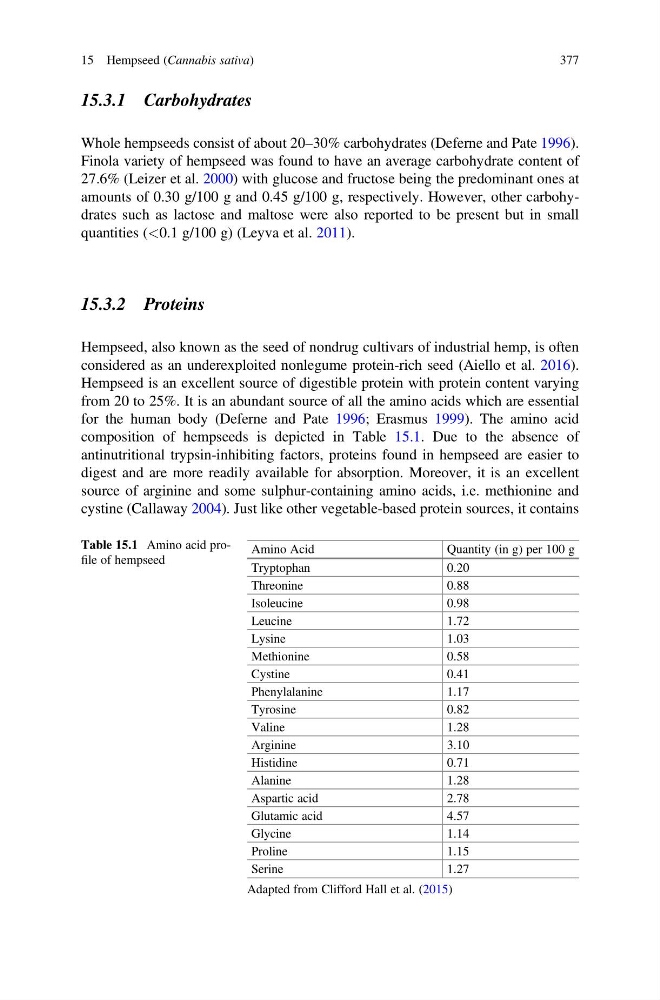
composition of hempseeds is depicted in Table 15.1. Due to the absence of
antinutritional trypsin-inhibiting factors, proteins found in hempseed are easier to
digest and are more readily available for absorption. Moreover, it is an excellent
source of arginine and some sulphur-containing amino acids, i.e. methionine and
cystine (Callaway 2004). Just like other vegetable-based protein sources, it contains
Table 15.1 Amino acid profile of hempseed
Amino Acid
Quantity (in g) per 100 g
Tryptophan
0.20
Threonine
0.88
Isoleucine
0.98
Leucine
1.72
Lysine
1.03
Methionine
0.58
Cystine
0.41
Phenylalanine
1.17
Tyrosine
0.82
Valine
1.28
Arginine
3.10
Histidine
0.71
Alanine
1.28
Aspartic acid
2.78
Glutamic acid
4.57
Glycine
1.14
Proline
1.15
Serine
1.27
Adapted from Clifford Hall et al. (2015)
15 Hempseed (Cannabis sativa)
377
Whole hempseeds consist of about 20–30% carbohydrates (Deferne and Pate 1996).
Finola variety of hempseed was found to have an average carbohydrate content of
27.6% (Leizer et al. 2000) with glucose and fructose being the predominant ones at
amounts of 0.30 g/100 g and 0.45 g/100 g, respectively. However, other carbohydrates such as lactose and maltose were also reported to be present but in small
quantities (<0.1 g/100 g) (Leyva et al. 2011).
15.3.2 Proteins
Hempseed, also known as the seed of nondrug cultivars of industrial hemp, is often
considered as an underexploited nonlegume protein-rich seed (Aiello et al. 2016).
Hempseed is an excellent source of digestible protein with protein content varying
from 20 to 25%. It is an abundant source of all the amino acids which are essential
for the human body (Deferne and Pate 1996; Erasmus 1999). The amino acid
composition of hempseeds is depicted in Table 15.1. Due to the absence of
antinutritional trypsin-inhibiting factors, proteins found in hempseed are easier to
digest and are more readily available for absorption. Moreover, it is an excellent
source of arginine and some sulphur-containing amino acids, i.e. methionine and
cystine (Callaway 2004). Just like other vegetable-based protein sources, it contains
Table 15.1 Amino acid profile of hempseed
Amino Acid
Quantity (in g) per 100 g
Tryptophan
0.20
Threonine
0.88
Isoleucine
0.98
Leucine
1.72
Lysine
1.03
Methionine
0.58
Cystine
0.41
Phenylalanine
1.17
Tyrosine
0.82
Valine
1.28
Arginine
3.10
Histidine
0.71
Alanine
1.28
Aspartic acid
2.78
Glutamic acid
4.57
Glycine
1.14
Proline
1.15
Serine
1.27
Adapted from Clifford Hall et al. (2015)
15 Hempseed (Cannabis sativa)
377