

a relatively lower proportion of lysine. However, it cannot be considered as the only
source of dietary protein for children (less than 10 years) as per WHO essential
amino acid requirements (Nishida and Uauy 2009).
The major drawback with hempseed is that a significant fraction of total proteins
is accounted by edestin (60–80%), while albumin balances the rest proportion.
Edestin is a hexamer which is made up of six identical AB protein subunits and
can serve as a potential biopolymer for the formation of cast films for its use as
biodegradable and even edible food packaging (Odani and Odani 1998). In the
recent past, hempseed protein finds its potential application in the development of
nutraceuticals and functional foods (Aiello et al. 2016). Adequate treatment of
hempseed proteins with suitable enzymes is known to produce hydrolyzed proteins
that benefit the health as hypotensive agents and antioxidants (Aiello et al. 2016).
15.3.3 Fats
Hempseed oil is an exceptionally high source of unsaturated fatty acids with linoleic
acid and α-linolenic acid being the predominant fatty acids (Leizer et al. 2000). The
concentration of linoleic acid and α-linolenic acid in total fatty acid was observed to
range in between 52–62% and 12–23%, respectively. This variation in fatty acid
profile is generally observed due to the natural difference in samples, different
processing conditions and storage methods adopted (Leizer et al. 2000). In addition,
it is considered as a brilliant source of omega-3 polyunsaturated fatty acids (PUFA)
and known to possess the corresponding omega-6 to omega-3 PUFA ratio of 3:1
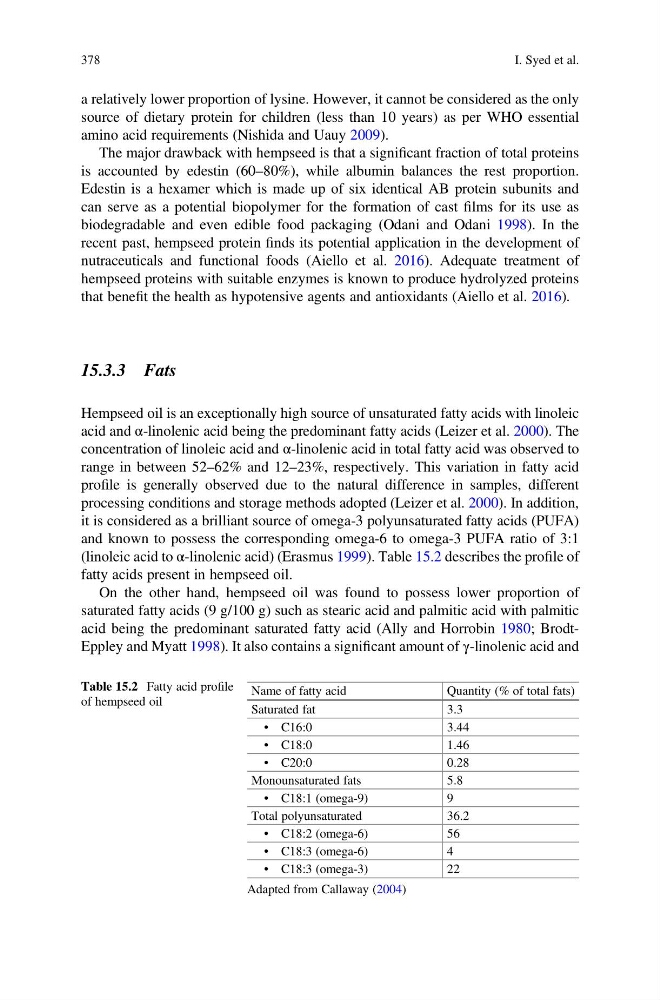
(linoleic acid to α-linolenic acid) (Erasmus 1999). Table 15.2 describes the profile of
fatty acids present in hempseed oil.
On the other hand, hempseed oil was found to possess lower proportion of
saturated fatty acids (9 g/100 g) such as stearic acid and palmitic acid with palmitic
acid being the predominant saturated fatty acid (Ally and Horrobin 1980; BrodtEppley and Myatt 1998). It also contains a significant amount of γ-linolenic acid and
Table 15.2 Fatty acid profile
of hempseed oil
Name of fatty acid
Quantity (% of total fats)
Saturated fat
3.3
• C16:0
3.44
• C18:0
1.46
• C20:0
0.28
Monounsaturated fats
5.8
• C18:1 (omega-9)
9
Total polyunsaturated
36.2
• C18:2 (omega-6)
56
• C18:3 (omega-6)
4
• C18:3 (omega-3)
22
Adapted from Callaway (2004)
378
I. Syed et al.
source of dietary protein for children (less than 10 years) as per WHO essential
amino acid requirements (Nishida and Uauy 2009).
The major drawback with hempseed is that a significant fraction of total proteins
is accounted by edestin (60–80%), while albumin balances the rest proportion.
Edestin is a hexamer which is made up of six identical AB protein subunits and
can serve as a potential biopolymer for the formation of cast films for its use as
biodegradable and even edible food packaging (Odani and Odani 1998). In the
recent past, hempseed protein finds its potential application in the development of
nutraceuticals and functional foods (Aiello et al. 2016). Adequate treatment of
hempseed proteins with suitable enzymes is known to produce hydrolyzed proteins
that benefit the health as hypotensive agents and antioxidants (Aiello et al. 2016).
15.3.3 Fats
Hempseed oil is an exceptionally high source of unsaturated fatty acids with linoleic
acid and α-linolenic acid being the predominant fatty acids (Leizer et al. 2000). The
concentration of linoleic acid and α-linolenic acid in total fatty acid was observed to
range in between 52–62% and 12–23%, respectively. This variation in fatty acid
profile is generally observed due to the natural difference in samples, different
processing conditions and storage methods adopted (Leizer et al. 2000). In addition,
it is considered as a brilliant source of omega-3 polyunsaturated fatty acids (PUFA)
and known to possess the corresponding omega-6 to omega-3 PUFA ratio of 3:1
(linoleic acid to α-linolenic acid) (Erasmus 1999). Table 15.2 describes the profile of
fatty acids present in hempseed oil.
On the other hand, hempseed oil was found to possess lower proportion of
saturated fatty acids (9 g/100 g) such as stearic acid and palmitic acid with palmitic
acid being the predominant saturated fatty acid (Ally and Horrobin 1980; BrodtEppley and Myatt 1998). It also contains a significant amount of γ-linolenic acid and
Table 15.2 Fatty acid profile
of hempseed oil
Name of fatty acid
Quantity (% of total fats)
Saturated fat
3.3
• C16:0
3.44
• C18:0
1.46
• C20:0
0.28
Monounsaturated fats
5.8
• C18:1 (omega-9)
9
Total polyunsaturated
36.2
• C18:2 (omega-6)
56
• C18:3 (omega-6)
4
• C18:3 (omega-3)
22
Adapted from Callaway (2004)
378
I. Syed et al.