

6.3 Production
In terms of land use, the oil palm tree is the most efficient oil crop, and the fruits are
harvested monthly, when the oil palm trees are 3–4 years old. It has the highest yield
per hectare of land with lower amount of fertilizers as compared to other oil crops.
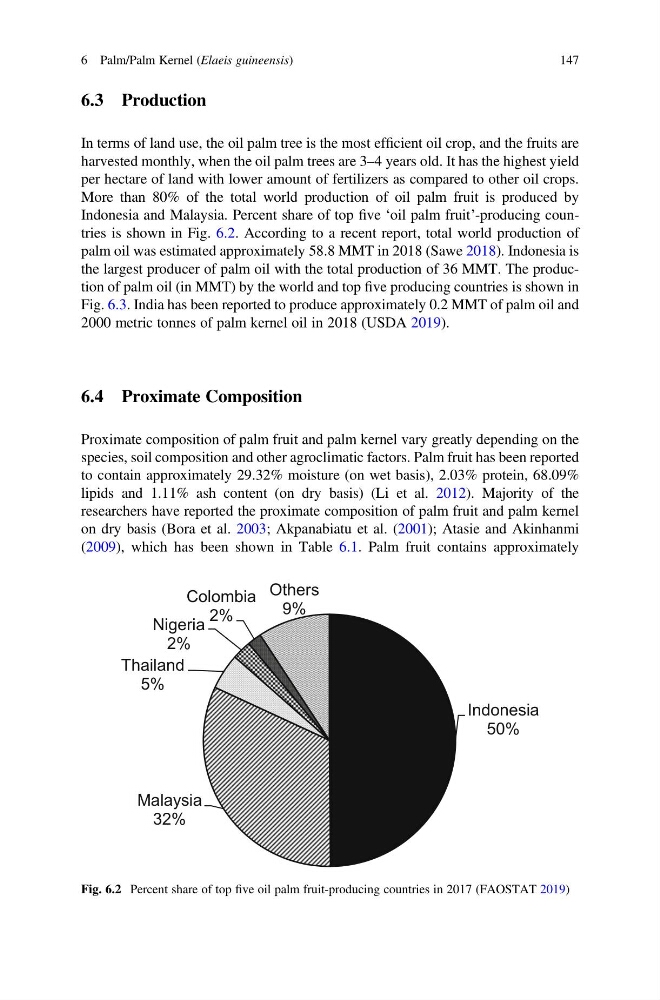
More than 80% of the total world production of oil palm fruit is produced by
Indonesia and Malaysia. Percent share of top five ‘oil palm fruit’-producing countries is shown in Fig. 6.2. According to a recent report, total world production of
palm oil was estimated approximately 58.8 MMT in 2018 (Sawe 2018). Indonesia is
the largest producer of palm oil with the total production of 36 MMT. The production of palm oil (in MMT) by the world and top five producing countries is shown in
Fig. 6.3. India has been reported to produce approximately 0.2 MMT of palm oil and
2000 metric tonnes of palm kernel oil in 2018 (USDA 2019).
6.4 Proximate Composition
Proximate composition of palm fruit and palm kernel vary greatly depending on the
species, soil composition and other agroclimatic factors. Palm fruit has been reported
to contain approximately 29.32% moisture (on wet basis), 2.03% protein, 68.09%
lipids and 1.11% ash content (on dry basis) (Li et al. 2012). Majority of the
researchers have reported the proximate composition of palm fruit and palm kernel
on dry basis (Bora et al. 2003; Akpanabiatu et al. (2001); Atasie and Akinhanmi
(2009), which has been shown in Table 6.1. Palm fruit contains approximately
Indonesia
50%
Malaysia
32%
Thailand
5%
Nigeria
2%
Colombia
2%
Others
9%
Fig. 6.2 Percent share of top five oil palm fruit-producing countries in 2017 (FAOSTAT 2019)
6 Palm/Palm Kernel (Elaeis guineensis)
147
In terms of land use, the oil palm tree is the most efficient oil crop, and the fruits are
harvested monthly, when the oil palm trees are 3–4 years old. It has the highest yield
per hectare of land with lower amount of fertilizers as compared to other oil crops.
More than 80% of the total world production of oil palm fruit is produced by
Indonesia and Malaysia. Percent share of top five ‘oil palm fruit’-producing countries is shown in Fig. 6.2. According to a recent report, total world production of
palm oil was estimated approximately 58.8 MMT in 2018 (Sawe 2018). Indonesia is
the largest producer of palm oil with the total production of 36 MMT. The production of palm oil (in MMT) by the world and top five producing countries is shown in
Fig. 6.3. India has been reported to produce approximately 0.2 MMT of palm oil and
2000 metric tonnes of palm kernel oil in 2018 (USDA 2019).
6.4 Proximate Composition
Proximate composition of palm fruit and palm kernel vary greatly depending on the
species, soil composition and other agroclimatic factors. Palm fruit has been reported
to contain approximately 29.32% moisture (on wet basis), 2.03% protein, 68.09%
lipids and 1.11% ash content (on dry basis) (Li et al. 2012). Majority of the
researchers have reported the proximate composition of palm fruit and palm kernel
on dry basis (Bora et al. 2003; Akpanabiatu et al. (2001); Atasie and Akinhanmi
(2009), which has been shown in Table 6.1. Palm fruit contains approximately
Indonesia
50%
Malaysia
32%
Thailand
5%
Nigeria
2%
Colombia
2%
Others
9%
Fig. 6.2 Percent share of top five oil palm fruit-producing countries in 2017 (FAOSTAT 2019)
6 Palm/Palm Kernel (Elaeis guineensis)
147