

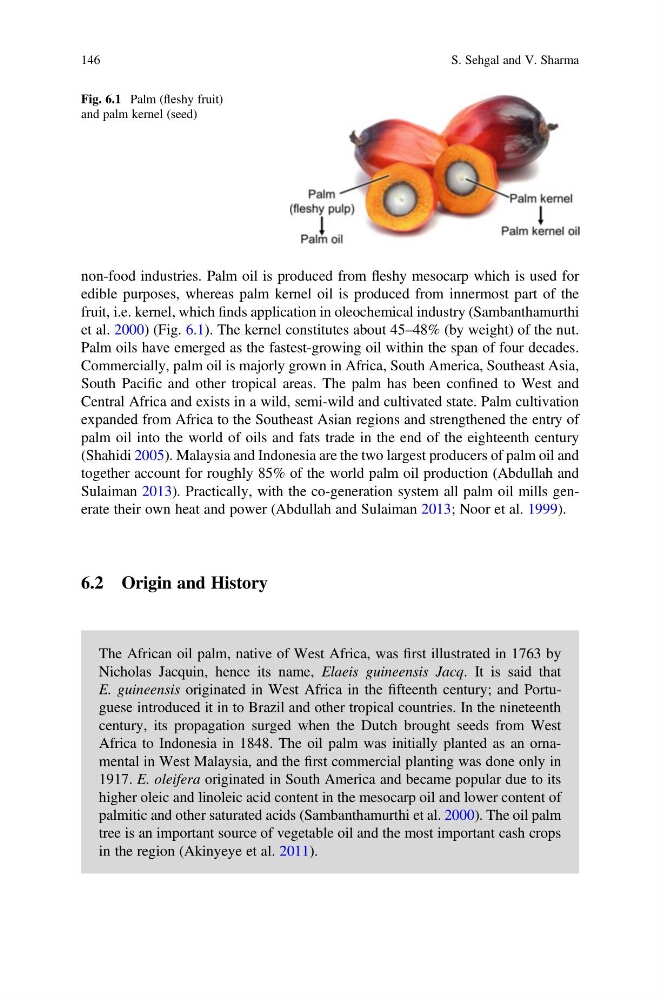
non-food industries. Palm oil is produced from fleshy mesocarp which is used for
edible purposes, whereas palm kernel oil is produced from innermost part of the
fruit, i.e. kernel, which finds application in oleochemical industry (Sambanthamurthi
et al. 2000) (Fig. 6.1). The kernel constitutes about 45–48% (by weight) of the nut.
Palm oils have emerged as the fastest-growing oil within the span of four decades.
Commercially, palm oil is majorly grown in Africa, South America, Southeast Asia,
South Pacific and other tropical areas. The palm has been confined to West and
Central Africa and exists in a wild, semi-wild and cultivated state. Palm cultivation
expanded from Africa to the Southeast Asian regions and strengthened the entry of
palm oil into the world of oils and fats trade in the end of the eighteenth century
(Shahidi 2005). Malaysia and Indonesia are the two largest producers of palm oil and
together account for roughly 85% of the world palm oil production (Abdullah and
Sulaiman 2013). Practically, with the co-generation system all palm oil mills generate their own heat and power (Abdullah and Sulaiman 2013; Noor et al. 1999).
6.2 Origin and History
The African oil palm, native of West Africa, was first illustrated in 1763 by
Nicholas Jacquin, hence its name, Elaeis guineensis Jacq. It is said that
E. guineensis originated in West Africa in the fifteenth century; and Portuguese introduced it in to Brazil and other tropical countries. In the nineteenth
century, its propagation surged when the Dutch brought seeds from West
Africa to Indonesia in 1848. The oil palm was initially planted as an ornamental in West Malaysia, and the first commercial planting was done only in
1917. E. oleifera originated in South America and became popular due to its
higher oleic and linoleic acid content in the mesocarp oil and lower content of
palmitic and other saturated acids (Sambanthamurthi et al. 2000). The oil palm
tree is an important source of vegetable oil and the most important cash crops
in the region (Akinyeye et al. 2011).
Fig. 6.1 Palm (fleshy fruit)
and palm kernel (seed)
146
S. Sehgal and V. Sharma
edible purposes, whereas palm kernel oil is produced from innermost part of the
fruit, i.e. kernel, which finds application in oleochemical industry (Sambanthamurthi
et al. 2000) (Fig. 6.1). The kernel constitutes about 45–48% (by weight) of the nut.
Palm oils have emerged as the fastest-growing oil within the span of four decades.
Commercially, palm oil is majorly grown in Africa, South America, Southeast Asia,
South Pacific and other tropical areas. The palm has been confined to West and
Central Africa and exists in a wild, semi-wild and cultivated state. Palm cultivation
expanded from Africa to the Southeast Asian regions and strengthened the entry of
palm oil into the world of oils and fats trade in the end of the eighteenth century
(Shahidi 2005). Malaysia and Indonesia are the two largest producers of palm oil and
together account for roughly 85% of the world palm oil production (Abdullah and
Sulaiman 2013). Practically, with the co-generation system all palm oil mills generate their own heat and power (Abdullah and Sulaiman 2013; Noor et al. 1999).
6.2 Origin and History
The African oil palm, native of West Africa, was first illustrated in 1763 by
Nicholas Jacquin, hence its name, Elaeis guineensis Jacq. It is said that
E. guineensis originated in West Africa in the fifteenth century; and Portuguese introduced it in to Brazil and other tropical countries. In the nineteenth
century, its propagation surged when the Dutch brought seeds from West
Africa to Indonesia in 1848. The oil palm was initially planted as an ornamental in West Malaysia, and the first commercial planting was done only in
1917. E. oleifera originated in South America and became popular due to its
higher oleic and linoleic acid content in the mesocarp oil and lower content of
palmitic and other saturated acids (Sambanthamurthi et al. 2000). The oil palm
tree is an important source of vegetable oil and the most important cash crops
in the region (Akinyeye et al. 2011).
Fig. 6.1 Palm (fleshy fruit)
and palm kernel (seed)
146
S. Sehgal and V. Sharma