

(ALA, omega-3). The presence of very long-chain saturated fatty acids such as
arachidic acid (C20:0) and behenic acid (C22:0) is also signature fatty acids of
sunflower oil. However, Dorni et al. (2018) did not detect the presence of behenic
acid in sunflower oil. With time, different varieties of sunflower seeds were developed through mutagenesis and/or breeding techniques. These new varieties were
different to each other in just one or two fatty acids, which were developed to meet
the different functional and/or nutritional properties for different food applications.
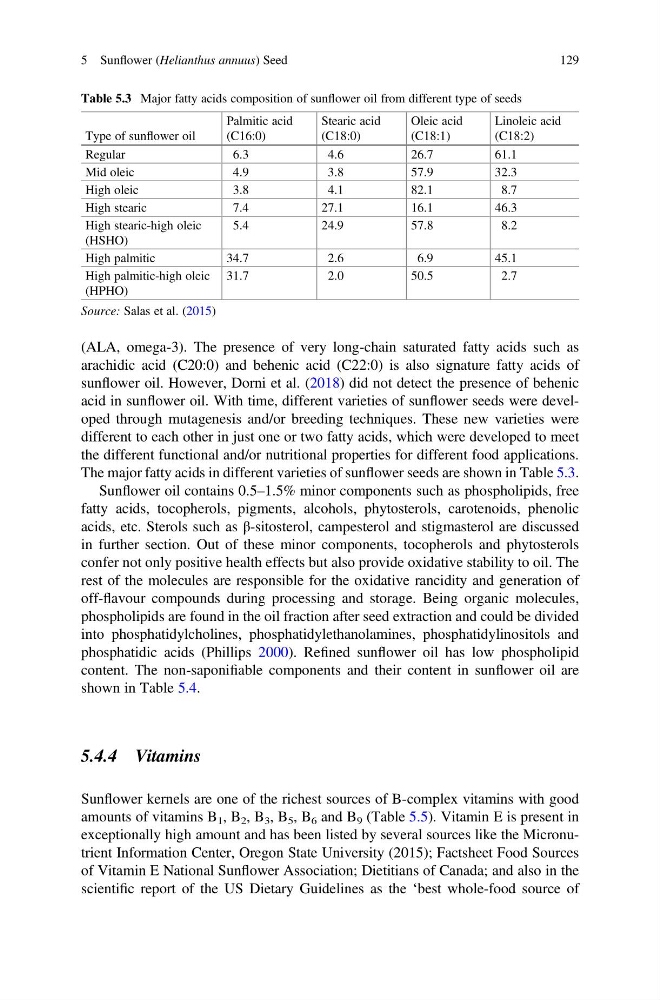
The major fatty acids in different varieties of sunflower seeds are shown in Table 5.3.
Sunflower oil contains 0.5–1.5% minor components such as phospholipids, free
fatty acids, tocopherols, pigments, alcohols, phytosterols, carotenoids, phenolic
acids, etc. Sterols such as β-sitosterol, campesterol and stigmasterol are discussed
in further section. Out of these minor components, tocopherols and phytosterols
confer not only positive health effects but also provide oxidative stability to oil. The
rest of the molecules are responsible for the oxidative rancidity and generation of
off-flavour compounds during processing and storage. Being organic molecules,
phospholipids are found in the oil fraction after seed extraction and could be divided
into phosphatidylcholines, phosphatidylethanolamines, phosphatidylinositols and
phosphatidic acids (Phillips 2000). Refined sunflower oil has low phospholipid
content. The non-saponifiable components and their content in sunflower oil are
shown in Table 5.4.
5.4.4 Vitamins
Sunflower kernels are one of the richest sources of B-complex vitamins with good
amounts of vitamins B 1 , B 2 , B 3 , B 5 , B 6 and B 9 (Table 5.5). Vitamin E is present in
exceptionally high amount and has been listed by several sources like the Micronutrient Information Center, Oregon State University (2015); Factsheet Food Sources
of Vitamin E National Sunflower Association; Dietitians of Canada; and also in the
scientific report of the US Dietary Guidelines as the ‘best whole-food source of
Table 5.3 Major fatty acids composition of sunflower oil from different type of seeds
Type of sunflower oil
Palmitic acid
(C16:0)
Stearic acid
(C18:0)
Oleic acid
(C18:1)
Linoleic acid
(C18:2)
Regular
6.3
4.6
26.7
61.1
Mid oleic
4.9
3.8
57.9
32.3
High oleic
3.8
4.1
82.1
8.7
High stearic
7.4
27.1
16.1
46.3
High stearic-high oleic
(HSHO)
5.4
24.9
57.8
8.2
High palmitic
34.7
2.6
6.9
45.1
High palmitic-high oleic
(HPHO)
31.7
2.0
50.5
2.7
Source: Salas et al. (2015)
5 Sunflower (Helianthus annuus) Seed
129
arachidic acid (C20:0) and behenic acid (C22:0) is also signature fatty acids of
sunflower oil. However, Dorni et al. (2018) did not detect the presence of behenic
acid in sunflower oil. With time, different varieties of sunflower seeds were developed through mutagenesis and/or breeding techniques. These new varieties were
different to each other in just one or two fatty acids, which were developed to meet
the different functional and/or nutritional properties for different food applications.
The major fatty acids in different varieties of sunflower seeds are shown in Table 5.3.
Sunflower oil contains 0.5–1.5% minor components such as phospholipids, free
fatty acids, tocopherols, pigments, alcohols, phytosterols, carotenoids, phenolic
acids, etc. Sterols such as β-sitosterol, campesterol and stigmasterol are discussed
in further section. Out of these minor components, tocopherols and phytosterols
confer not only positive health effects but also provide oxidative stability to oil. The
rest of the molecules are responsible for the oxidative rancidity and generation of
off-flavour compounds during processing and storage. Being organic molecules,
phospholipids are found in the oil fraction after seed extraction and could be divided
into phosphatidylcholines, phosphatidylethanolamines, phosphatidylinositols and
phosphatidic acids (Phillips 2000). Refined sunflower oil has low phospholipid
content. The non-saponifiable components and their content in sunflower oil are
shown in Table 5.4.
5.4.4 Vitamins
Sunflower kernels are one of the richest sources of B-complex vitamins with good
amounts of vitamins B 1 , B 2 , B 3 , B 5 , B 6 and B 9 (Table 5.5). Vitamin E is present in
exceptionally high amount and has been listed by several sources like the Micronutrient Information Center, Oregon State University (2015); Factsheet Food Sources
of Vitamin E National Sunflower Association; Dietitians of Canada; and also in the
scientific report of the US Dietary Guidelines as the ‘best whole-food source of
Table 5.3 Major fatty acids composition of sunflower oil from different type of seeds
Type of sunflower oil
Palmitic acid
(C16:0)
Stearic acid
(C18:0)
Oleic acid
(C18:1)
Linoleic acid
(C18:2)
Regular
6.3
4.6
26.7
61.1
Mid oleic
4.9
3.8
57.9
32.3
High oleic
3.8
4.1
82.1
8.7
High stearic
7.4
27.1
16.1
46.3
High stearic-high oleic
(HSHO)
5.4
24.9
57.8
8.2
High palmitic
34.7
2.6
6.9
45.1
High palmitic-high oleic
(HPHO)
31.7
2.0
50.5
2.7
Source: Salas et al. (2015)
5 Sunflower (Helianthus annuus) Seed
129