

in the evaluation of protein quality is the amino acid composition which is also
helpful in feed formulation. Relative to soybean, sunflower proteins contain high
quantities of sulphur containing amino acids (2.1% vs. 1.3% in soybean) (Piva
1992). However, the lack of lysine as in cereals can be made up by supplementation
with pulses. The sunflower’s proteins are not preferred as a protein supplement for
human consumption probably due to two reasons. Firstly, the sunflower seed proteins get denatured during oil extraction process, and thus, the functionality of the
altered (denatured) protein reduces. Secondly, the phenolic components, particularly
chlorogenic acid (CGA), of seed bind with seed proteins and cause the discoloration
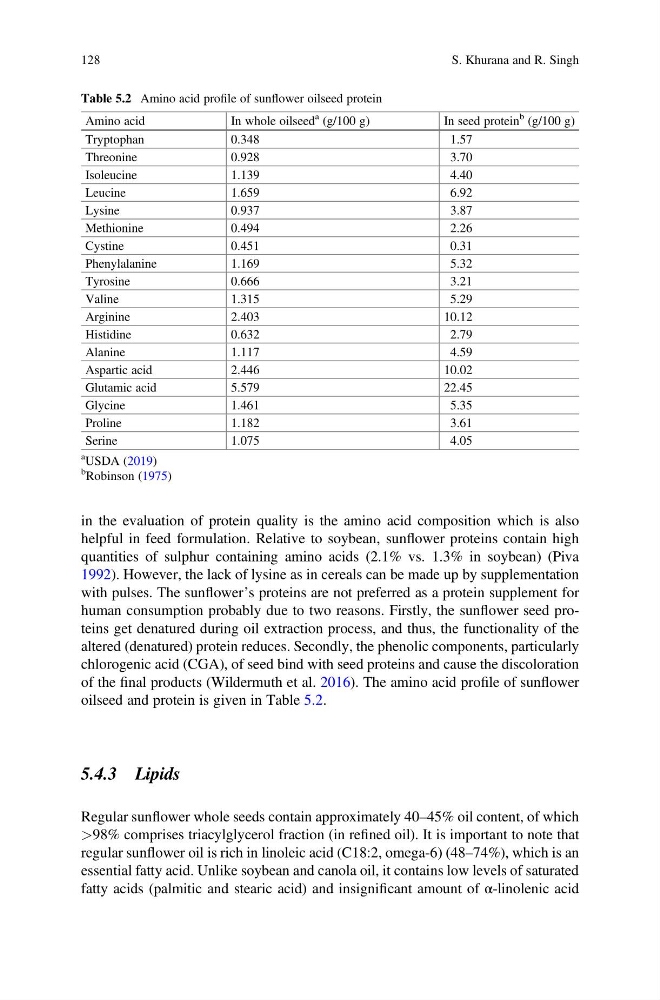
of the final products (Wildermuth et al. 2016). The amino acid profile of sunflower
oilseed and protein is given in Table 5.2.
5.4.3 Lipids
Regular sunflower whole seeds contain approximately 40–45% oil content, of which
>98% comprises triacylglycerol fraction (in refined oil). It is important to note that
regular sunflower oil is rich in linoleic acid (C18:2, omega-6) (48–74%), which is an
essential fatty acid. Unlike soybean and canola oil, it contains low levels of saturated
fatty acids (palmitic and stearic acid) and insignificant amount of α-linolenic acid
Table 5.2 Amino acid profile of sunflower oilseed protein
Amino acid
In whole oilseed
a (g/100 g)
In seed protein
b (g/100 g)
Tryptophan
0.348
1.57
Threonine
0.928
3.70
Isoleucine
1.139
4.40
Leucine
1.659
6.92
Lysine
0.937
3.87
Methionine
0.494
2.26
Cystine
0.451
0.31
Phenylalanine
1.169
5.32
Tyrosine
0.666
3.21
Valine
1.315
5.29
Arginine
2.403
10.12
Histidine
0.632
2.79
Alanine
1.117
4.59
Aspartic acid
2.446
10.02
Glutamic acid
5.579
22.45
Glycine
1.461
5.35
Proline
1.182
3.61
Serine
1.075
4.05
a USDA (2019)
b
Robinson (1975)
128
S. Khurana and R. Singh
helpful in feed formulation. Relative to soybean, sunflower proteins contain high
quantities of sulphur containing amino acids (2.1% vs. 1.3% in soybean) (Piva
1992). However, the lack of lysine as in cereals can be made up by supplementation
with pulses. The sunflower’s proteins are not preferred as a protein supplement for
human consumption probably due to two reasons. Firstly, the sunflower seed proteins get denatured during oil extraction process, and thus, the functionality of the
altered (denatured) protein reduces. Secondly, the phenolic components, particularly
chlorogenic acid (CGA), of seed bind with seed proteins and cause the discoloration
of the final products (Wildermuth et al. 2016). The amino acid profile of sunflower
oilseed and protein is given in Table 5.2.
5.4.3 Lipids
Regular sunflower whole seeds contain approximately 40–45% oil content, of which
>98% comprises triacylglycerol fraction (in refined oil). It is important to note that
regular sunflower oil is rich in linoleic acid (C18:2, omega-6) (48–74%), which is an
essential fatty acid. Unlike soybean and canola oil, it contains low levels of saturated
fatty acids (palmitic and stearic acid) and insignificant amount of α-linolenic acid
Table 5.2 Amino acid profile of sunflower oilseed protein
Amino acid
In whole oilseed
a (g/100 g)
In seed protein
b (g/100 g)
Tryptophan
0.348
1.57
Threonine
0.928
3.70
Isoleucine
1.139
4.40
Leucine
1.659
6.92
Lysine
0.937
3.87
Methionine
0.494
2.26
Cystine
0.451
0.31
Phenylalanine
1.169
5.32
Tyrosine
0.666
3.21
Valine
1.315
5.29
Arginine
2.403
10.12
Histidine
0.632
2.79
Alanine
1.117
4.59
Aspartic acid
2.446
10.02
Glutamic acid
5.579
22.45
Glycine
1.461
5.35
Proline
1.182
3.61
Serine
1.075
4.05
a USDA (2019)
b
Robinson (1975)
128
S. Khurana and R. Singh