

5.4 Chemical Composition
Sunflower seeds are rich source of nutrients providing significant amounts of
vitamins and minerals, phytonutrients and essential fatty acids. The seed meal is a
good source of protein, fibre, zinc, selenium, copper, iron, vitamin B 6 and folate.
Sunflower seed is characterized by a high oil content (40–45%), moderate amount of
proteins (14–18%) and good amount of hulls (25–30%) that predominantly consist
of non-digestible crude fibre. The proximate composition of whole sunflower seed
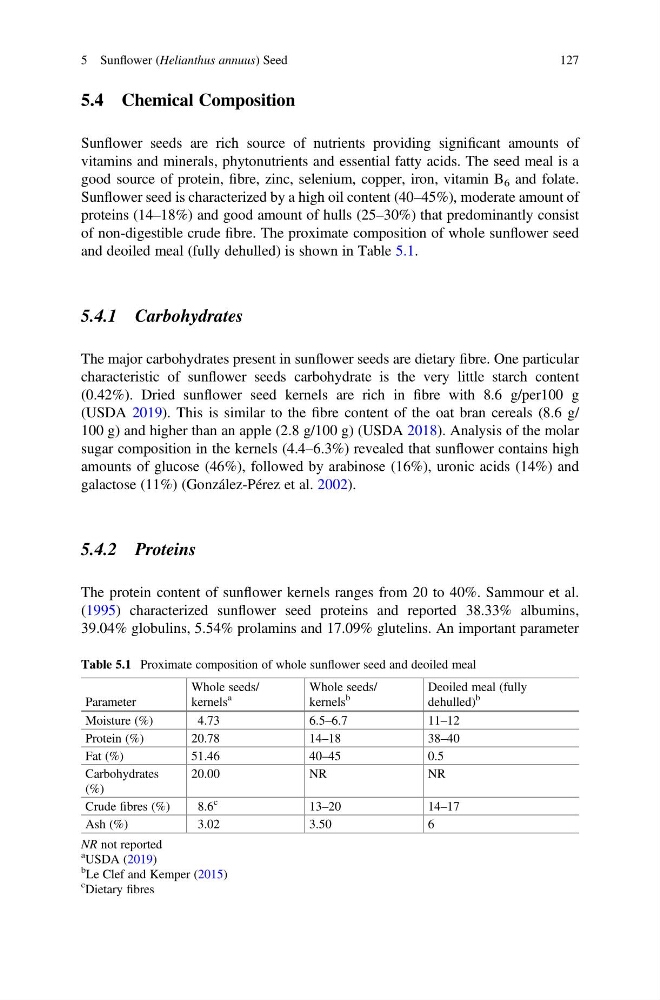
and deoiled meal (fully dehulled) is shown in Table 5.1.
5.4.1 Carbohydrates
The major carbohydrates present in sunflower seeds are dietary fibre. One particular
characteristic of sunflower seeds carbohydrate is the very little starch content
(0.42%). Dried sunflower seed kernels are rich in fibre with 8.6 g/per100 g
(USDA 2019). This is similar to the fibre content of the oat bran cereals (8.6 g/
100 g) and higher than an apple (2.8 g/100 g) (USDA 2018). Analysis of the molar
sugar composition in the kernels (4.4–6.3%) revealed that sunflower contains high
amounts of glucose (46%), followed by arabinose (16%), uronic acids (14%) and
galactose (11%) (González-Pérez et al. 2002).
5.4.2 Proteins
The protein content of sunflower kernels ranges from 20 to 40%. Sammour et al.
(1995) characterized sunflower seed proteins and reported 38.33% albumins,
39.04% globulins, 5.54% prolamins and 17.09% glutelins. An important parameter
Table 5.1 Proximate composition of whole sunflower seed and deoiled meal
Parameter
Whole seeds/
kernels
a
Whole seeds/
kernels
b
Deoiled meal (fully
dehulled)
b
Moisture (%)
4.73
6.5–6.7
11–12
Protein (%)
20.78
14–18
38–40
Fat (%)
51.46
40–45
0.5
Carbohydrates
(%)
20.00
NR
NR
Crude fibres (%)
8.6
c
13–20
14–17
Ash (%)
3.02
3.50
6
NR not reported
a USDA (2019)
b
Le Clef and Kemper (2015)
c Dietary fibres
5 Sunflower (Helianthus annuus) Seed
127
Sunflower seeds are rich source of nutrients providing significant amounts of
vitamins and minerals, phytonutrients and essential fatty acids. The seed meal is a
good source of protein, fibre, zinc, selenium, copper, iron, vitamin B 6 and folate.
Sunflower seed is characterized by a high oil content (40–45%), moderate amount of
proteins (14–18%) and good amount of hulls (25–30%) that predominantly consist
of non-digestible crude fibre. The proximate composition of whole sunflower seed
and deoiled meal (fully dehulled) is shown in Table 5.1.
5.4.1 Carbohydrates
The major carbohydrates present in sunflower seeds are dietary fibre. One particular
characteristic of sunflower seeds carbohydrate is the very little starch content
(0.42%). Dried sunflower seed kernels are rich in fibre with 8.6 g/per100 g
(USDA 2019). This is similar to the fibre content of the oat bran cereals (8.6 g/
100 g) and higher than an apple (2.8 g/100 g) (USDA 2018). Analysis of the molar
sugar composition in the kernels (4.4–6.3%) revealed that sunflower contains high
amounts of glucose (46%), followed by arabinose (16%), uronic acids (14%) and
galactose (11%) (González-Pérez et al. 2002).
5.4.2 Proteins
The protein content of sunflower kernels ranges from 20 to 40%. Sammour et al.
(1995) characterized sunflower seed proteins and reported 38.33% albumins,
39.04% globulins, 5.54% prolamins and 17.09% glutelins. An important parameter
Table 5.1 Proximate composition of whole sunflower seed and deoiled meal
Parameter
Whole seeds/
kernels
a
Whole seeds/
kernels
b
Deoiled meal (fully
dehulled)
b
Moisture (%)
4.73
6.5–6.7
11–12
Protein (%)
20.78
14–18
38–40
Fat (%)
51.46
40–45
0.5
Carbohydrates
(%)
20.00
NR
NR
Crude fibres (%)
8.6
c
13–20
14–17
Ash (%)
3.02
3.50
6
NR not reported
a USDA (2019)
b
Le Clef and Kemper (2015)
c Dietary fibres
5 Sunflower (Helianthus annuus) Seed
127