

5.3 Types of Sunflowers
Primarily, on the basis of oil content, sunflower can be divided into two types:
1. Oilseed sunflower: Which contain minimum 40% oil and are grown primarily for
oil production. Examples: Peredovik, Armavirec, VNIIMK, Smena.
2. Confection sunflower (non-oilseed): These are used as snacks for human and as
feed for birds. Examples: Mingren, Commander, Mennonite, Arrowhead.
On the other hand, the oilseed variety can also be divided into three types based
on the major fatty acids present (Berglund 2007): (1) linoleic, (2) mid-oleic and
(3) high oleic. Generally, seeds of oilseed variety have black coloured seeds and
have adhered thin hull, difficult to remove from the kernels of oilseed. Their seeds
contain approximately 38–50% oil and 20% protein. Some of these oilseeds are
hulled to be used as bird’s feed (Berglund 2007; OECD 2007). Non-oilseed sunflower or the confection sunflower generally has white stripes and larger seed size
than the oilseed variety. It has a rather thick hull, which is loosely attached to the
kernel, allowing complete separation of the hull. It is classified on the basis of seed
size as follows (Schild et al. 1991):
(a) Largest seeds: Consumed as snack after roasting and salting within the shell.
(b) Mid-size seeds: Dehulled seeds (kernels) may be used as a snack and in bakery
products or other foods for their crispness and/or for improving the nutrient
levels.
(c) Small seeds: Particularly used as bird feed.
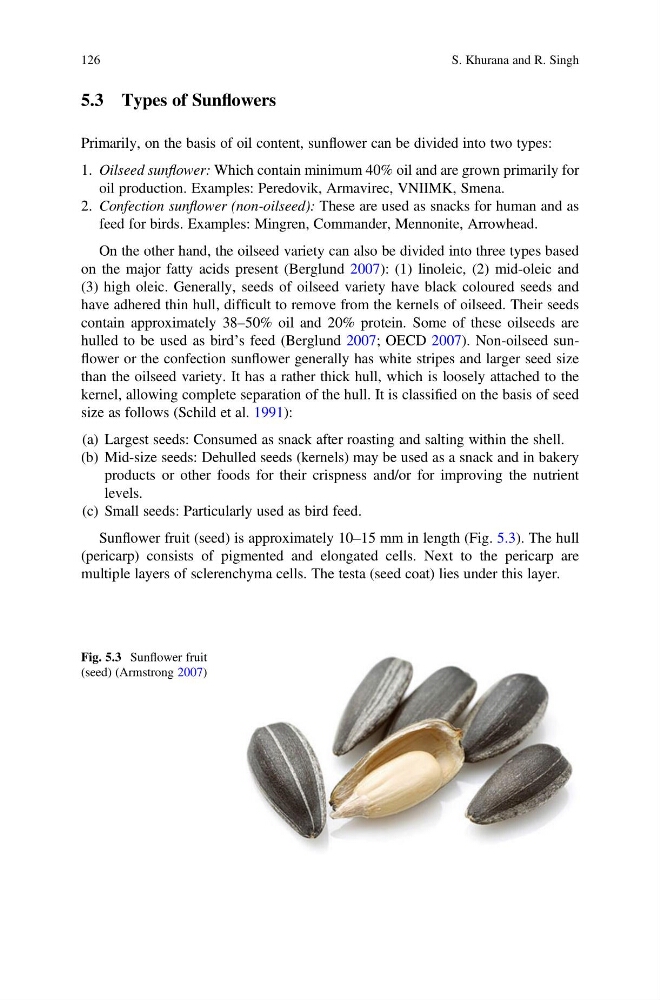
Sunflower fruit (seed) is approximately 10–15 mm in length (Fig. 5.3). The hull
(pericarp) consists of pigmented and elongated cells. Next to the pericarp are
multiple layers of sclerenchyma cells. The testa (seed coat) lies under this layer.
Fig. 5.3 Sunflower fruit
(seed) (Armstrong 2007)
126
S. Khurana and R. Singh
Primarily, on the basis of oil content, sunflower can be divided into two types:
1. Oilseed sunflower: Which contain minimum 40% oil and are grown primarily for
oil production. Examples: Peredovik, Armavirec, VNIIMK, Smena.
2. Confection sunflower (non-oilseed): These are used as snacks for human and as
feed for birds. Examples: Mingren, Commander, Mennonite, Arrowhead.
On the other hand, the oilseed variety can also be divided into three types based
on the major fatty acids present (Berglund 2007): (1) linoleic, (2) mid-oleic and
(3) high oleic. Generally, seeds of oilseed variety have black coloured seeds and
have adhered thin hull, difficult to remove from the kernels of oilseed. Their seeds
contain approximately 38–50% oil and 20% protein. Some of these oilseeds are
hulled to be used as bird’s feed (Berglund 2007; OECD 2007). Non-oilseed sunflower or the confection sunflower generally has white stripes and larger seed size
than the oilseed variety. It has a rather thick hull, which is loosely attached to the
kernel, allowing complete separation of the hull. It is classified on the basis of seed
size as follows (Schild et al. 1991):
(a) Largest seeds: Consumed as snack after roasting and salting within the shell.
(b) Mid-size seeds: Dehulled seeds (kernels) may be used as a snack and in bakery
products or other foods for their crispness and/or for improving the nutrient
levels.
(c) Small seeds: Particularly used as bird feed.
Sunflower fruit (seed) is approximately 10–15 mm in length (Fig. 5.3). The hull
(pericarp) consists of pigmented and elongated cells. Next to the pericarp are
multiple layers of sclerenchyma cells. The testa (seed coat) lies under this layer.
Fig. 5.3 Sunflower fruit
(seed) (Armstrong 2007)
126
S. Khurana and R. Singh