

90
3 The Challenges of Energy Supply
even in electrified villages. They offer a value proposition in meeting peak electricity
requirement in electrified villages.
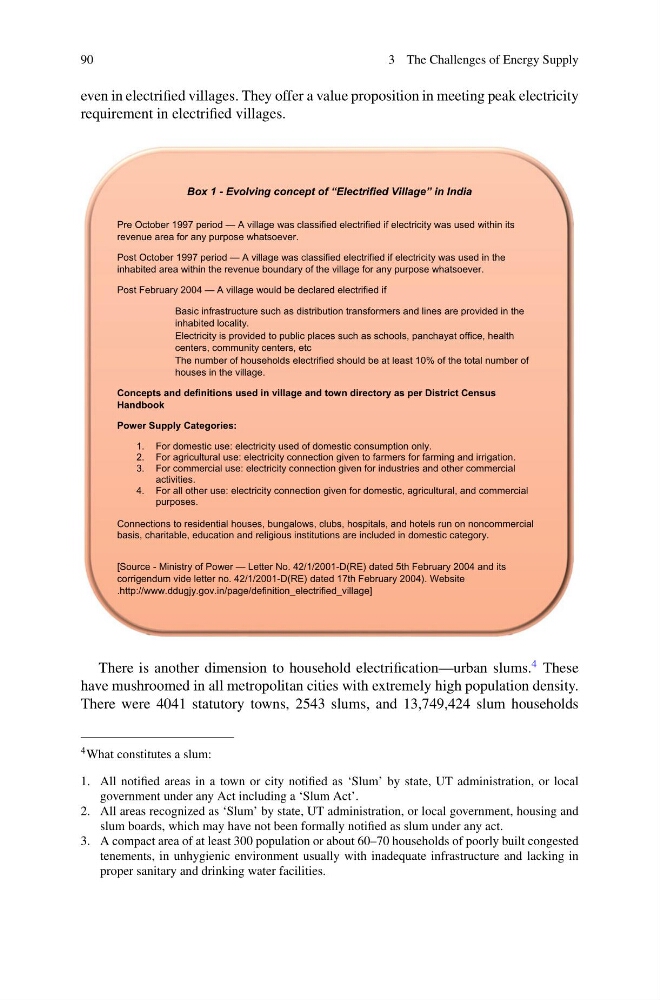
Box 1 - Evolving concept of “Electrified Village” in India
Pre October 1997 period – A village was classified electrified if electricity was used within its
revenue area for any purpose whatsoever.
Post October 1997 period – A village was classified electrified if electricity was used in the
inhabited area within the revenue boundary of the village for any purpose whatsoever.
Post February 2004 – A village would be declared electrified if
Basic infrastructure such as distribution transformers and lines are provided in the
inhabited locality.
Electricity is provided to public places such as schools, panchayat office, health
centers, community centers, etc
The number of households electrified should be at least 10% of the total number of
houses in the village.
Concepts and definitions used in village and town directory as per District Census
Handbook
Power Supply Categories:
1. For domestic use: electricity used of domestic consumption only.
2. For agricultural use: electricity connection given to farmers for farming and irrigation.
3. For commercial use: electricity connection given for industries and other commercial
activities.
4. For all other use: electricity connection given for domestic, agricultural, and commercial
purposes.
Connections to residential houses, bungalows, clubs, hospitals, and hotels run on noncommercial
basis, charitable, education and religious institutions are included in domestic category.
[Source - Ministry of Power – Letter No. 42/1/2001-D(RE) dated 5th February 2004 and its
corrigendum vide letter no. 42/1/2001-D(RE) dated 17th February 2004). Website
.http://www.ddugjy.gov.in/page/definition_electrified_village]
There is another dimension to household electrification—urban slums.
4 These
have mushroomed in all metropolitan cities with extremely high population density.
There were 4041 statutory towns, 2543 slums, and 13,749,424 slum households
4 What constitutes a slum:
1. All notified areas in a town or city notified as ‘Slum’ by state, UT administration, or local
government under any Act including a ‘Slum Act’.
2. All areas recognized as ‘Slum’ by state, UT administration, or local government, housing and
slum boards, which may have not been formally notified as slum under any act.
3. A compact area of at least 300 population or about 60–70 households of poorly built congested
tenements, in unhygienic environment usually with inadequate infrastructure and lacking in
proper sanitary and drinking water facilities.
3 The Challenges of Energy Supply
even in electrified villages. They offer a value proposition in meeting peak electricity
requirement in electrified villages.
Box 1 - Evolving concept of “Electrified Village” in India
Pre October 1997 period – A village was classified electrified if electricity was used within its
revenue area for any purpose whatsoever.
Post October 1997 period – A village was classified electrified if electricity was used in the
inhabited area within the revenue boundary of the village for any purpose whatsoever.
Post February 2004 – A village would be declared electrified if
Basic infrastructure such as distribution transformers and lines are provided in the
inhabited locality.
Electricity is provided to public places such as schools, panchayat office, health
centers, community centers, etc
The number of households electrified should be at least 10% of the total number of
houses in the village.
Concepts and definitions used in village and town directory as per District Census
Handbook
Power Supply Categories:
1. For domestic use: electricity used of domestic consumption only.
2. For agricultural use: electricity connection given to farmers for farming and irrigation.
3. For commercial use: electricity connection given for industries and other commercial
activities.
4. For all other use: electricity connection given for domestic, agricultural, and commercial
purposes.
Connections to residential houses, bungalows, clubs, hospitals, and hotels run on noncommercial
basis, charitable, education and religious institutions are included in domestic category.
[Source - Ministry of Power – Letter No. 42/1/2001-D(RE) dated 5th February 2004 and its
corrigendum vide letter no. 42/1/2001-D(RE) dated 17th February 2004). Website
.http://www.ddugjy.gov.in/page/definition_electrified_village]
There is another dimension to household electrification—urban slums.
4 These
have mushroomed in all metropolitan cities with extremely high population density.
There were 4041 statutory towns, 2543 slums, and 13,749,424 slum households
4 What constitutes a slum:
1. All notified areas in a town or city notified as ‘Slum’ by state, UT administration, or local
government under any Act including a ‘Slum Act’.
2. All areas recognized as ‘Slum’ by state, UT administration, or local government, housing and
slum boards, which may have not been formally notified as slum under any act.
3. A compact area of at least 300 population or about 60–70 households of poorly built congested
tenements, in unhygienic environment usually with inadequate infrastructure and lacking in
proper sanitary and drinking water facilities.