

2.5 The Complexities of Renewable Energy
65
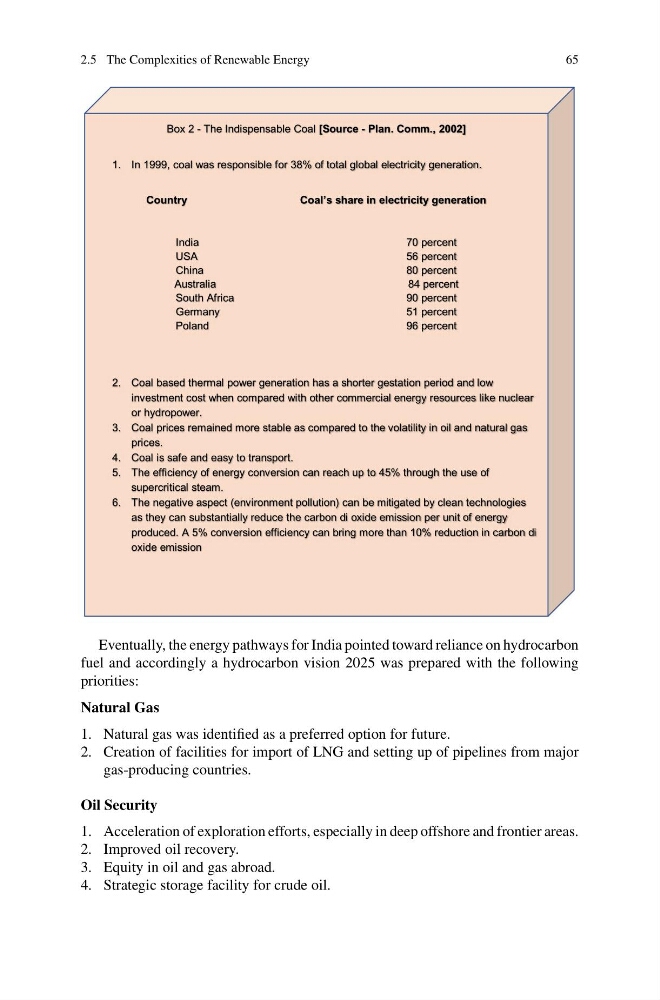
Box 2 - The Indispensable Coal [Source - Plan. Comm., 2002]
1. In 1999, coal was responsible for 38% of total global electricity generation.
Country
Coal’s share in electricity generation
India
70 percent
USA
56 percent
China
80 percent
Australia
84 percent
South Africa
90 percent
Germany
51 percent
Poland
96 percent
2. Coal based thermal power generation has a shorter gestation period and low
investment cost when compared with other commercial energy resources like nuclear
or hydropower.
3. Coal prices remained more stable as compared to the volatility in oil and natural gas
prices.
4. Coal is safe and easy to transport.
5. The efficiency of energy conversion can reach up to 45% through the use of
supercritical steam.
6. The negative aspect (environment pollution) can be mitigated by clean technologies
as they can substantially reduce the carbon di oxide emission per unit of energy
produced. A 5% conversion efficiency can bring more than 10% reduction in carbon di
oxide emission
Eventually, the energy pathways for India pointed toward reliance on hydrocarbon
fuel and accordingly a hydrocarbon vision 2025 was prepared with the following
priorities:
Natural Gas
1. Natural gas was identified as a preferred option for future.
2. Creation of facilities for import of LNG and setting up of pipelines from major
gas-producing countries.
Oil Security
1. Acceleration of exploration efforts, especially in deep offshore and frontier areas.
2. Improved oil recovery.
3. Equity in oil and gas abroad.
4. Strategic storage facility for crude oil.
65
Box 2 - The Indispensable Coal [Source - Plan. Comm., 2002]
1. In 1999, coal was responsible for 38% of total global electricity generation.
Country
Coal’s share in electricity generation
India
70 percent
USA
56 percent
China
80 percent
Australia
84 percent
South Africa
90 percent
Germany
51 percent
Poland
96 percent
2. Coal based thermal power generation has a shorter gestation period and low
investment cost when compared with other commercial energy resources like nuclear
or hydropower.
3. Coal prices remained more stable as compared to the volatility in oil and natural gas
prices.
4. Coal is safe and easy to transport.
5. The efficiency of energy conversion can reach up to 45% through the use of
supercritical steam.
6. The negative aspect (environment pollution) can be mitigated by clean technologies
as they can substantially reduce the carbon di oxide emission per unit of energy
produced. A 5% conversion efficiency can bring more than 10% reduction in carbon di
oxide emission
Eventually, the energy pathways for India pointed toward reliance on hydrocarbon
fuel and accordingly a hydrocarbon vision 2025 was prepared with the following
priorities:
Natural Gas
1. Natural gas was identified as a preferred option for future.
2. Creation of facilities for import of LNG and setting up of pipelines from major
gas-producing countries.
Oil Security
1. Acceleration of exploration efforts, especially in deep offshore and frontier areas.
2. Improved oil recovery.
3. Equity in oil and gas abroad.
4. Strategic storage facility for crude oil.